Get Full Government Meeting Transcripts, Videos, & Alerts Forever!
Get email alerts on the Insurance Regulation topic
No spam. Unsubscribe anytime.
Oregon insurance regulator outlines oversight role for commercial health plans
Summary
Division of Financial Regulation officials told the House Behavioral Health and Health Care Committee how the agency oversees insurers, reviews rates and handles consumer complaints, outlining limits of state authority over Medicare and self‑insured employer plans.
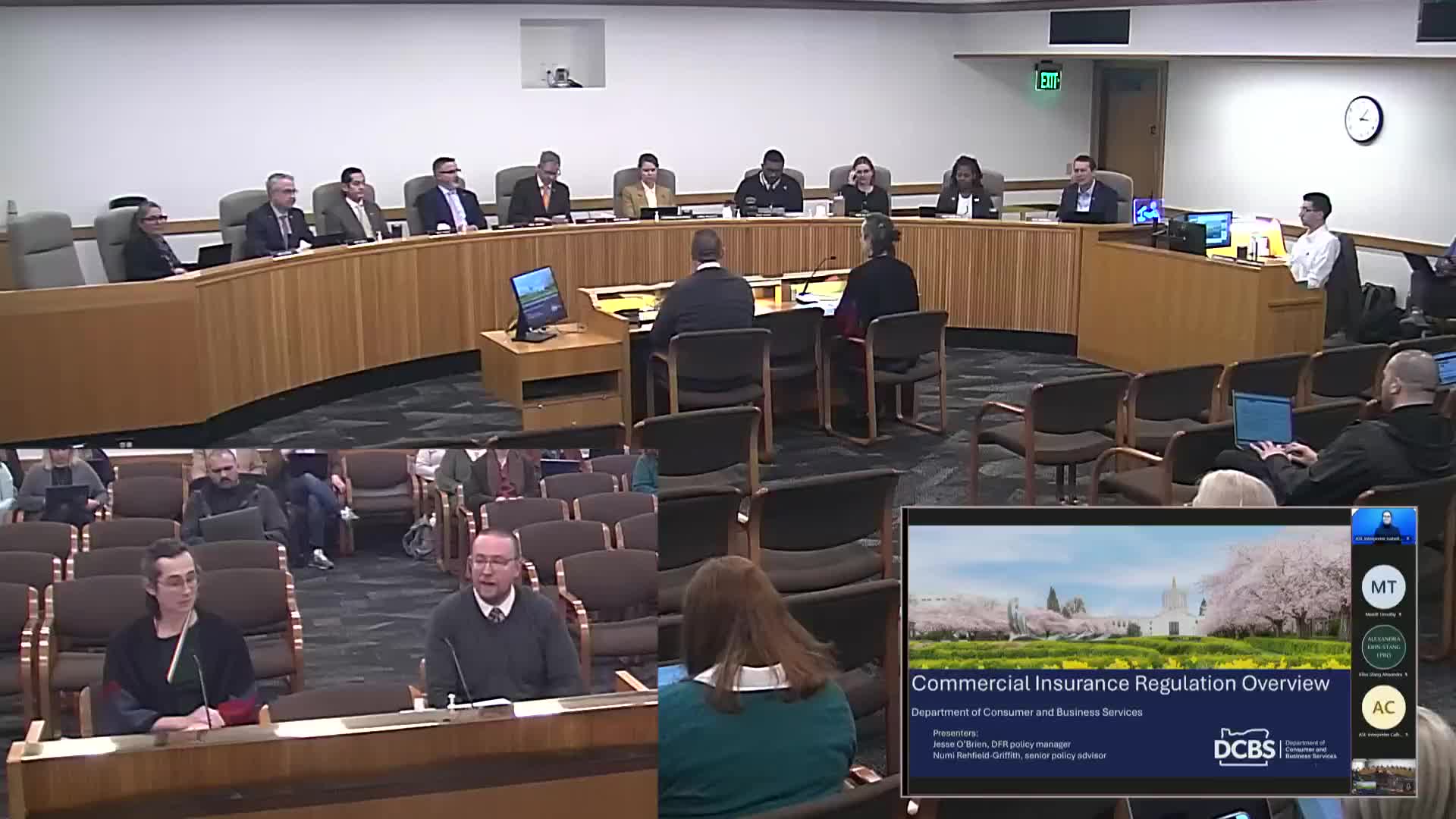
Jesse O'Brien, policy manager for the Division of Financial Regulation at the Oregon Department of Consumer and Business Services, told the House Committee on Behavioral Health and Health Care on Jan. 23 that the division regulates solvency, product filings and consumer assistance for state‑regulated insurance.
DFR’s core mission, O’Brien said, is to make sure licensed institutions have “sufficient funds to pay for the promises they make to consumers and that they do in fact fulfill those promises when they're due.” He described three primary regulatory functions: consumer assistance, product regulation and compliance, and investigations and enforcement. “Our enforcement decisions are highly fact specific and they can include restitution to affected consumers, suspension or revocation of licenses, or civil penalties,” O’Brien said.
Why it matters: the division’s authority covers the commercial health insurance market sold to individuals and to small and large employers that choose fully insured plans. O’Brien emphasized the limits of state authority: Medicare and many self‑insured employer plans are regulated by the federal government, and ERISA preempts state regulation of self‑insured large‑employer plans.
DFR reviews and approves products and premium rates for the small‑group and individual markets and conducts an annual rate review process that includes public input. Noomi Bridal Griffith, senior policy advisor at DFR, described technical rate and benefit concepts—actuarial value, deductibles, maximum out‑of‑pocket limits and the metal tiers used under the Affordable Care Act—and explained how the agency evaluates filings.
DFR also enforces the medical loss ratio (MLR) requirements from the Affordable Care Act, which require carriers to spend 80–85% of premium dollars on care. Bridal Griffith said carriers that collect more premium than necessary “are required by law to rebate the difference back to consumers.”
On consumer complaints, O’Brien said the agency receives many inquiries that are outside its statutory scope because they involve federal programs or provider–insurer contract disputes. He said DFR recovered “over $1,000,000” for consumers on health‑related complaints in 2024, and that 129 complaints were confirmed as actionable under the insurance code.
The agency also participates in National Association of Insurance Commissioners (NAIC) work and must periodically adopt technical statutory updates to maintain accreditation. DFR licenses 12 insurers that sell health plans in Oregon and thousands of insurance producers and third‑party administrators, including pharmacy benefit managers, Bridal Griffith said.
DFR officials urged legislators to frame proposals with the agency’s statutory limits in mind and offered continuing technical assistance and constituent help: “we really encourage people to contact us with any kind of complaint or concern that they have about insurance,” O’Brien said.
Ending: Committee members followed with questions about rate filings, what constitutes a consumer for DFR, and when the division can and cannot intervene in provider–insurer contract disputes. DFR staff said many provider issues require legislative direction or changes to statute to give the agency more specific enforcement tools.