Get Full Government Meeting Transcripts, Videos, & Alerts Forever!
Get email alerts on the City Council Appointment topic
No spam. Unsubscribe anytime.
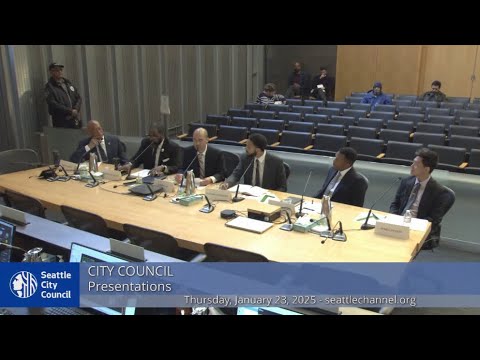
Seattle council holds special hearing as finalists seek District 2 appointment; decision set for Jan. 27
Summary
The Seattle City Council on Jan. 23 heard three-minute statements from District 2 finalists, received public comments and questions from council members on homelessness, public safety, the comprehensive plan and Little Saigon; the council will vote on an appointment at its Jan. 27 meeting.
The Seattle City Council convened a special meeting Jan. 23 to hear public comment and candidate presentations for the vacant District 2 seat, and set a Jan. 27 meeting to vote on an appointment. Council President Sarah Nelson opened the session and, after suspending the usual rules to allow public comment, said "the council rules are suspended" so speakers could address the day's agenda.
The clerk reported that 24 people had signed up to speak: "We have 17 remote and 7 in person," the clerk told the council. Dozens of residents and community leaders used one-minute public-comment slots to support several finalists and raise issues they want the next councilmember to prioritize: public safety, anti-displacement measures tied to the 20-year comprehensive plan, recovery and youth services, tree canopy and sidewalks, and an urgent plan for the Chinatown–International District (CID)/Little Saigon commercial corridor around 12th and Jackson.
Finalists for the appointment each gave three-minute opening statements, followed by a round of council questions. Candidates described their relevant experience and priorities. Adonis Duxworth said he would "address the state of emergency in the CID Little Saigon," and described community engagement and youth services as central priorities. Eddie Lynn said he would focus on constituent services and committee work and warned that "The CID cannot wait any longer." Other finalists — including candidates who described backgrounds in land use, community advocacy and city work — emphasized anti-displacement strategies and the need to move quickly on the comprehensive plan while protecting existing residents.
Council members pressed candidates on several recurring themes: whether an appointee would run in the coming election (some were asked to commit to serving only as a caretaker), approaches to the comp plan and tree and sidewalk policy, and how a short-term appointee would balance immediate neighborhood needs with citywide responsibilities. Questions reflected council members' priorities such as transportation safety, missing sidewalks and the pending adoption of the comprehensive plan.
Public commenters included homeowners, nonprofit leaders and longtime neighborhood activists who repeatedly urged the council to select a candidate with deep District 2 ties and experience working with small businesses and community-based organizations. Several speakers explicitly asked for urgency on Little Saigon conditions and anti-displacement protections as the comp-plan update proceeds. Multiple speakers — including Stephanie Velasco, who said she had worked with one finalist at the Office of Housing — praised finalists' listening skills and community connections: "He has the ability to quickly understand someone's concerns and then turn those concerns into actions and advocacy," Velasco said.
The council did not take a final vote at the Jan. 23 meeting. Nelson reminded members that, under the city charter timetable the council is following, "our deadline is on the 27th." The council president confirmed the appointment vote is scheduled for the Jan. 27 council meeting, giving members several days to review materials, follow up with candidates and hear additional public input.
The session provided a focused public forum on a single-item vacancy: candidates, supporters and council members converged on public safety, neighborhood economic recovery and anti-displacement policies as the measures they want a short-term appointee to advance.