Get email alerts on the Wildland Urban Interface topic
No spam. Unsubscribe anytime.
State Building Code Council members debate timing for Wildland-Urban Interface code as DNR mapping lags; designate representative for hearings
Summary
Dustin, a staff member for the State Building Code Council, said HB 1254 would put the International Wildland-Urban Interface Code into effect once statewide hazard maps are complete, but DNR mapping is delayed and lacks a target completion date.
Dustin, a staff member for the State Building Code Council, told the committee that House Bill 1254 (HB 1254), which would implement the International Wildland-Urban Interface (WUI) Code in Washington, is slated for discussion but that the statewide wildfire-hazard maps from the Department of Natural Resources are delayed and have no firm completion date.
The issue matters, the committee heard, because the WUI code’s technical provisions will take effect “upon the completion of the statewide hazard map,” and members said adopting the code before maps are available could produce mismatches between maps and requirements for many jurisdictions. Dustin said he intends to convene a WUI code technical advisory group (a “tag”) and to work toward a 2024 WUI code that can be reconciled with the mapping once it is available.
Committee members emphasized two competing priorities: get some WUI standards in place now to respond to increasing wildfire risk, or wait for maps to avoid wide unanticipated application. Angela (identified in the transcript as a WAVO representative) told the council she and others prefer moving the WUI code forward in the 2024 cycle and noted concerns with specific statutory language that could allow local jurisdictions to adopt the ICC WUI code “in whole or any portion thereof.” Roger Haringa, BFRW committee chair, said, “the adoption of a WUI code ... should be a priority,” citing recent wildfire events and insurance impacts.
Several members suggested procedural workarounds. One proposal described removing or making optional the WUI sections that overlap with other Washington statutes (notably chapters addressing water supply and road access) so local jurisdictions could adopt a version that fits existing state law. Jay Arnold, MBPE committee chair, asked whether parts of the WUI work could occur in parallel with DNR map development and recommended reviewing the timing to identify which pieces can be advanced now and which require maps.
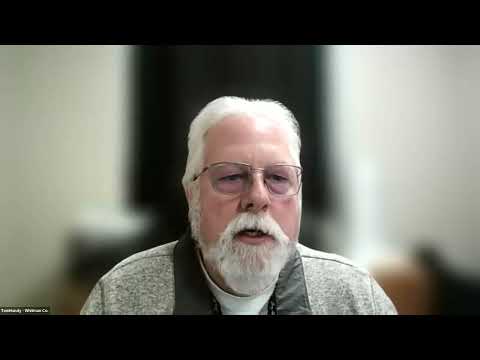
Members reported that DNR’s map effort is behind schedule and underfunded. Tom Handy, committee chair, relayed information that a DNR representative told a local group the mapping “has not even been started yet” and that a completion date is not targeted. Angela said DNR has not received appropriate funding and is only starting an exploratory committee in February.
The committee also reviewed other bills on its tracking spreadsheet. Dustin summarized several bills the council is monitoring: HB 1345 and HB 1353 (ADU-related measures), HB 1458 (an embodied-carbon bill the committee was asked to review), HB 1462 and HB 1497 (greenhouse-gas and waste-management items), and several senate bills including SB 5055, SB 5156, SB 5190, SB 5249 and SB 5438. On HB 1458 (embodied carbon), members were told product-level embodied-carbon information is “readily available” for many listed products and referenced CalGreen and other jurisdictions with similar requirements.
Members also discussed Senate Bill 5429, which would expand the membership of the State Building Code Council. Angela and others noted the bill would add multiple seats (one attendee counted the council growing to 21, an increase of eight seats) and would create more narrowly specified builder and trade representative slots (including plumbing and mechanical representatives). Concerns were raised that a larger council could make quorum and scheduling more difficult and that some new slots might be hard to fill.
As a procedural outcome, the committee moved to name a representative to attend hearings and give the council’s perspective on the WUI bill. Tom Handy and others agreed to ensure SBCC presence at hearings. A motion to “designate Todd as our representative to meet with [Representative] Dewar on the wildland urban interface bill” was moved, seconded and approved by voice vote.
The committee chair asked members to review HB 1458 and SB 5429 and promised Dustin would circulate PDFs of those bills for further comment. No formal position on the WUI bill or the other bills was adopted during this meeting; members agreed to continue deliberations and to bring the matter to the full council as needed.
Ending: The committee adjourned the agenda after completing the legislative update and designating a representative for the WUI hearings. Further review and formal comment on HB 1458 and SB 5429 were scheduled for future meetings.
Quotes used in this article are drawn from the meeting transcript and are attributed to speakers who appear in the transcript: Dustin (staff member); Angela (WAVO representative); Roger Haringa (BFRW committee chair); Jay Arnold (MBPE committee chair); Tom Handy (committee chair); Todd Baberther (council vice chair).
AI generated
The text on this page is AI generated. Summaries, highlights, analysis, and video transcripts are all produced from the original source material.
AI can make mistakes, so if you spot one, and we will fix it for everyone.
Note: the source content is unaltered by us. Any content source we link to, be it a video, an audio recording, or a document, is presented exactly as its publisher released it. That publisher is usually a government body, sometimes an individual official or another organisation.