Get Full Government Meeting Transcripts, Videos, & Alerts Forever!
Get email alerts on the Public Safety Workforce topic
No spam. Unsubscribe anytime.
Scott County approves provisional fire/EMS hires and training class to reduce overtime costs
Summary
Fiscal Court approved a training class and provisional hiring approach for the fire and EMS departments after staff presented cost estimates and operational impacts intended to reduce overtime and staffing strain.
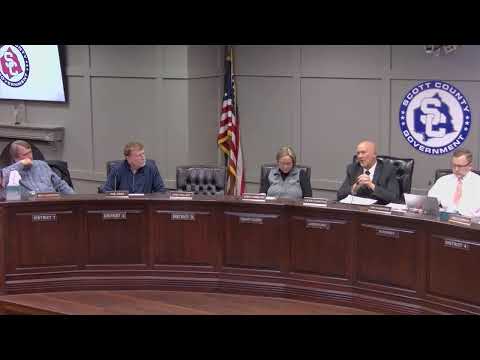
Scott County Fiscal Court approved a training class and provisional hiring plan on Jan. 23, 2025, authorizing the fire and EMS departments to begin a recruitment and provisional-hire process intended to reduce unscheduled overtime and staffing strain.
The court voted on a motion to authorize the department to run a training class and provisionally hire additional firefighters before vacancies occur. Jeff (Fire/EMS staff) presented the financial analysis underpinning the request, saying, “If the process takes 6 months, you're gonna have a $148,000 in wage expense, $65,000 in benefit cost, and a total cost of 200 $3,000.” He said the provisional approach could nevertheless yield net savings compared with prolonged overtime costs and that provisional hires also reduce physical strain on current staff who average 56 hours per week.
Supporters emphasized both financial and staffing benefits. Duane Ellison moved the measure; the motion received a second and passed on a voice vote.
Court discussion covered implementation details: the hires are not new positions but provisional fills of existing slots so that when an employee leaves the provisional hire simply moves into the existing vacancy. Staff and court members discussed class size and timing, with officials saying a class of about seven recruits (to cover three current vacancies and four provisionals) was the target to match recent turnover patterns.
Court members and department leaders also said provisional hires can reduce the department’s unscheduled overtime window and the associated costs that occur while vacancies remain unfilled. Jeff and others noted historical averages of roughly seven separations per year and argued that running classes preemptively would smooth staffing transitions.
The court’s action directs the department to proceed with the recruitment and training class; details including start dates, final class size and exact budget impacts will be determined by staff and brought back in subsequent communications to the court.
Ending: The training-class authorization passed by voice vote Jan. 23; departmental staff will proceed with recruitment and planned training and report back to the Fiscal Court on implementation and any budgetary adjustments.