Get Full Government Meeting Transcripts, Videos, & Alerts Forever!
Get email alerts on the Mass Care Resilience Hubs Authorities topic
No spam. Unsubscribe anytime.
DHS resilience office describes warming/cooling centers, resilience hubs and gaps in authorities for emergency deliveries
Summary
Ed Flick, director of the Office of Resilience and Emergency Management at the Oregon Department of Human Services, told the House committee that his office leads mass care, supports warming and cooling centers and is developing resilience hubs and evacuation planning tools, while seeking statutory clarity for water and other delivery authorities.
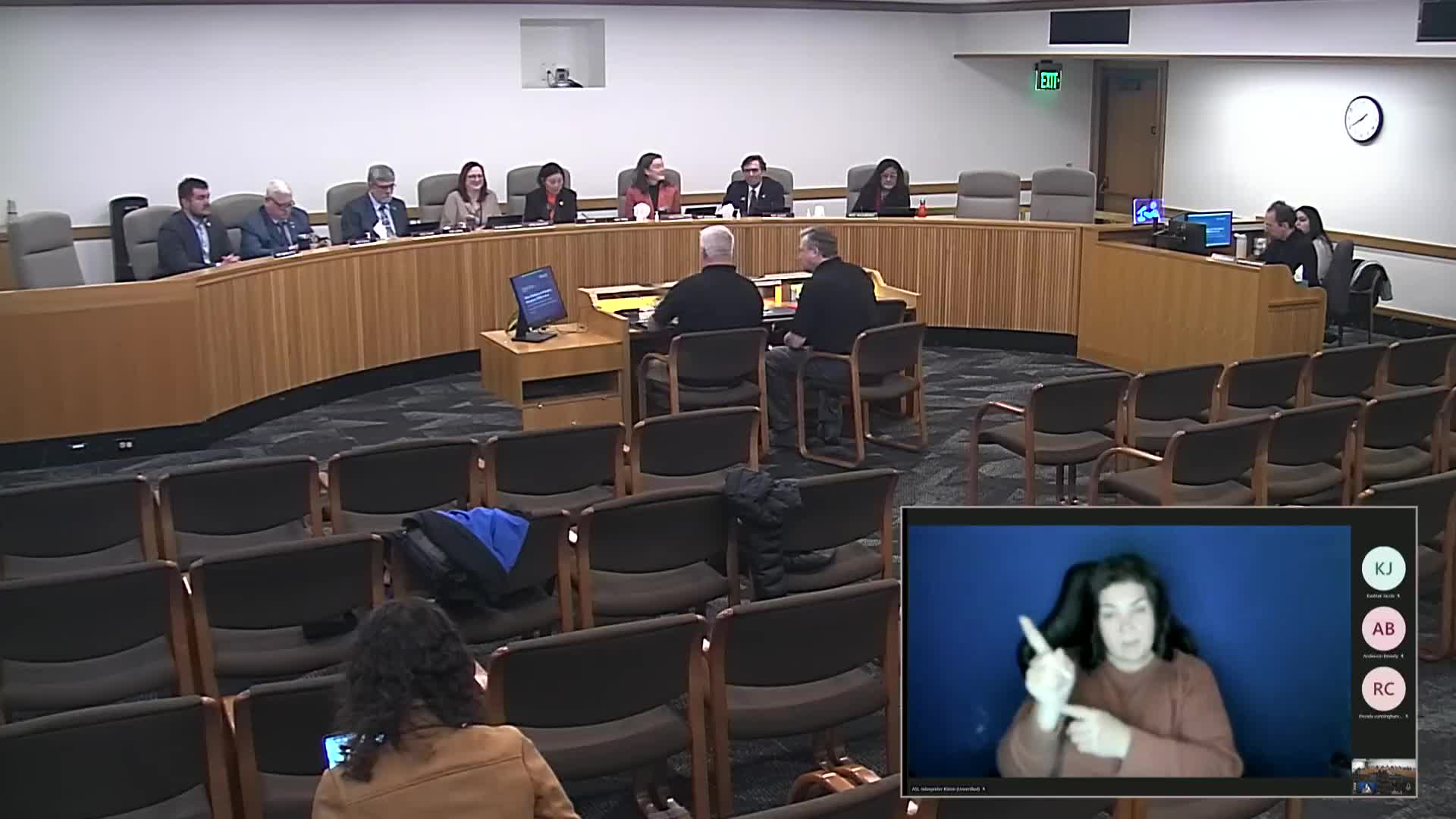
Ed Flick, director of the Office of Resilience and Emergency Management at the Oregon Department of Human Services, told the House Committee on Emergency Management, General Government, and Veterans on Jan. 23 that his office is focused on mass care, evacuation support and building a network of resilience hubs across the state.
Flick said the office carries responsibilities assigned by OEM under the state emergency management plan — specifically mass care (ESF‑6) and state recovery social services — and supports continuity of operations for the Department of Human Services. He described four core work areas: preparedness, response, recovery and continuity.
The nut graf: Flick emphasized that DHS’s role is often to keep vulnerable Oregonians safe in place where possible, through delivery of resources such as air‑filtration units, air conditioners and water, and by supporting local warming and cooling centers and service providers that help residents in disasters.
Flick described preparedness investments including pre‑positioned air filtration devices and high‑capacity tents and equipment on the coast (Tillamook, Newport, Coos Bay) and said the office planned to fund resilience hubs and networks with the first round of grant awards (roughly 100 partners). He said the office relies on public‑private partnerships and contracts with groups such as Rogue Food Unites and 2‑1‑1 info to deliver meals, information and referrals during incidents.
On evacuation planning, Flick said the state procured a planning tool for counties and the nine federally recognized tribes to help pre‑plan evacuation zones and prioritize people with access and functional needs. He described real‑world work last summer supporting evacuation planning in eight counties and said the tool is being rolled out to many counties and tribes after consultation.
Flick said Oregon currently lacks a standing individual assistance program for disaster survivors, though special‑purpose appropriations have been used previously to provide targeted individual aid after major events. He noted a recent Willamette City recovery effort in which the legislature appropriated $2,000,000 to replace storm‑damaged trailers.
Flick raised authority questions that delay action in some cases. He said the office received a $4,000,000 legislative appropriation to deliver drinking water but DOJ has questioned whether OREM has explicit authority to distribute water absent an executive order. He said House Bill 2346 is expected to be introduced to “consolidate and elaborate” the office’s authorities and that the bill includes language recommended by the Department of Justice to reduce those delays.
Flick summarized three measures likely to reach the committee this session: a DHS POP (purpose‑of‑position) for $5,000,000 to move special‑purpose appropriations into the agency’s central service line for quicker distribution; House Bill 3170 for resilient hubs and networks funding; and House Bill 2346 to formally establish and clarify the Office of Resilience and Emergency Management in statute.
A questioner observed that the authority bill is not a “power grab” but an effort to remove legal uncertainty that inhibits rapid delivery of resources. Flick said the office is working on consultation with tribes and local jurisdictions as elements are rolled out.
Ending: Flick invited further committee follow‑up and said the office will continue rolling out evacuation planning tools, resilience hub funding, and clarifying authorities to speed response and recovery work.