Get Full Government Meeting Transcripts, Videos, & Alerts Forever!
Get email alerts on the Emergency Operations 9 1 1 Grants Mitigation topic
No spam. Unsubscribe anytime.
Oregon emergency management director outlines 9-1-1 modernization, grant mix and post‑fire mitigation needs
Summary
At a Jan. 23 House committee informational hearing, Oregon Department of Emergency Management Director Erin McMahon described efforts to modernize 9‑1‑1 systems, administer federal preparedness grants and obligate post‑fire mitigation funds, and warned that local cost‑share requirements create funding challenges for recovery projects.
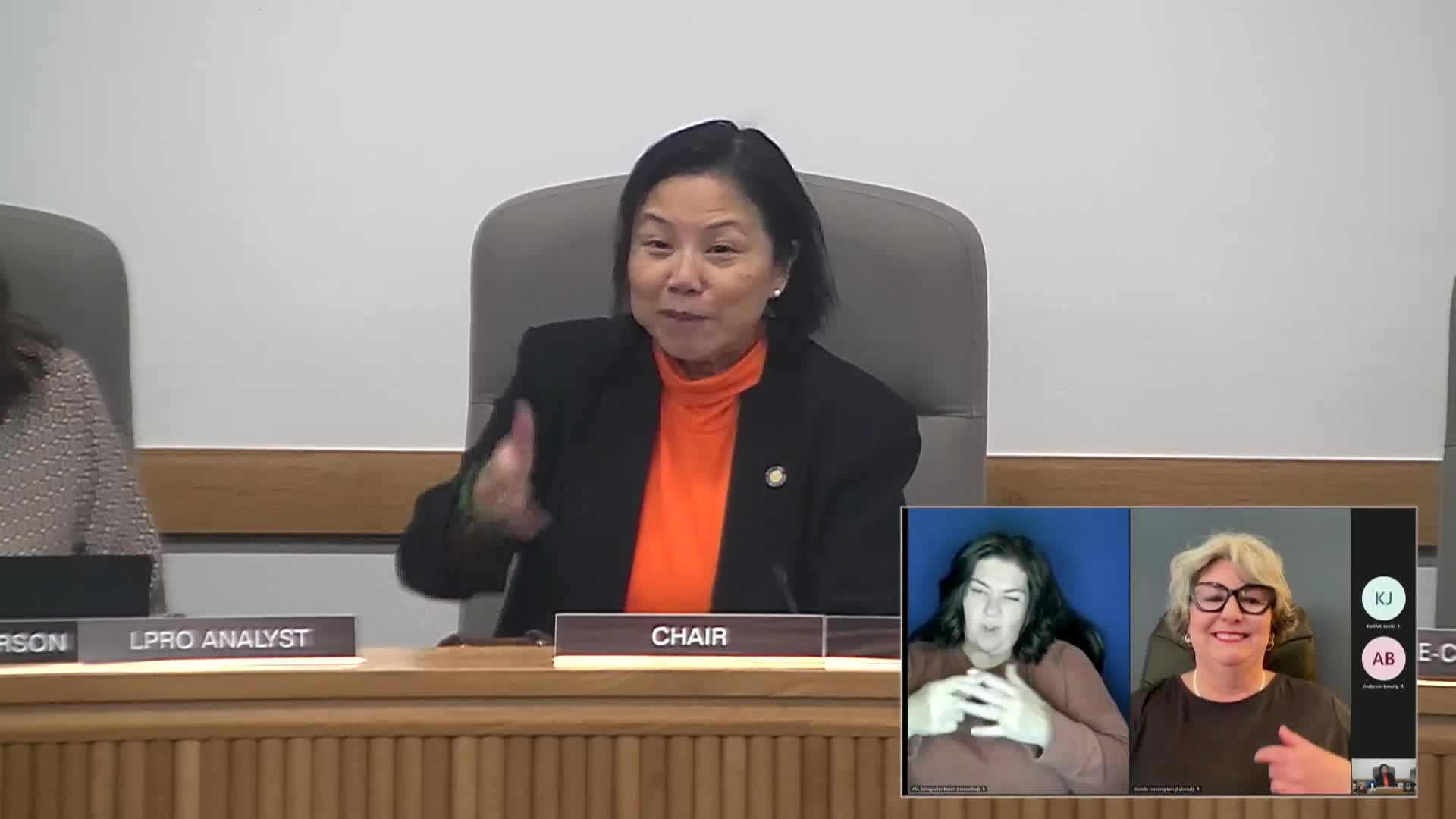
Erin McMahon, director of the Oregon Department of Emergency Management, briefed the House Committee on Emergency Management, General Government, and Veterans on Jan. 23 about plans to transition the state to next‑generation 9‑1‑1, the agency’s grant portfolio and ongoing wildfire recovery work.
McMahon told lawmakers that OEM is largely federally funded — “less than 7% of our operating budget is from the general fund” — and that the state’s 9‑1‑1 program manages about $80,000,000 in annual 9‑1‑1 tax revenue. She said a major technical upgrade, described in the presentation as next‑generation 9‑1‑1, is scheduled to begin core‑service acquisition in 2025 and would allow voice, photo, video and text to flow to public safety answering points (PSAPs).
The nut graf: The director framed modernization and federal grants as central to Oregon’s emergency capacity — “For every $1 that you invest in OEM, $10 of federal funds come into our organization,” McMahon said — while emphasizing that federally funded programs often require local matches that can hinder mitigation and recovery in communities with fewer resources.
McMahon described recent PSAP consolidation work and technology updates. She said the state consolidated Lake County’s PSAP with Klamath County and completed another consolidation in Coos County (Coos Bay), and that OEM is preparing geographic information systems and a statewide IP network to replace call‑handling equipment at the state’s 41 PSAPs in advance of next‑generation 9‑1‑1 acquisition. She said the consolidation decisions are made case‑by‑case and that “there are efficiencies that can be made through that consolidation.”
On preparedness and equipment, McMahon said OEM administers a State Preparedness and Incident Response Equipment grant program (SPIRE) and has completed one round of procurements and is working on rounds two and three. She described roughly $3,000,000 in pre‑positioned equipment across 27 jurisdictions that can be deployed during incidents and noted OEM maintains an equipment map tied to a GIS overlay that shows capacity and availability.
McMahon outlined OEM’s federal grant portfolio: the Emergency Management Performance Grant (EMPG), Homeland Security Grant Program (including SHSP and UASI), cybersecurity grants, Nonprofit Security grants, the National Earthquake Hazards Reduction Program (NEHRP) grant, and emergency operations center grants. She warned that EMPG drawdowns have declined despite population growth and said OEM is working with a multi‑partner working group to reassess cost allocation of EMPG funds.
On mitigation and recovery, McMahon said OEM’s mitigation section obligated $38,000,000 in FEMA Hazard Mitigation Grant Program (HMGP) money for Oregon projects last year and expected almost $12,000,000 in post‑fire mitigation funding for 2024 (allocation details pending). She said Oregon secured “a hundred and 20 plus million dollars” in federal mitigation funding from 2022–2024.
She cautioned that FEMA grant programs typically require a local match — “there is a community investment of 25 percent” — which can be burdensome for jurisdictions with limited tax bases. McMahon said the state has set aside funds in some mitigation programs to provide match support and that the committee may be asked to consider adjustments to cost‑share requests for wildfire recovery.
McMahon also reviewed public assistance and open disaster grants. She said OEM recently asked the committee for authorization to expend additional federal COVID‑19 closeout funds — describing the request as a half‑billion dollar authorization and referring to the total federal monies as “almost a billion dollars” — and that OEM is working to identify and obligate projects across roughly 952 subrecipients and about 3,800 projects tied to 10 open disasters.
Committee members asked several operational questions. Representative David (Rep.) Evans and others pressed McMahon about the scope of PSAP consolidation and whether Lake County received needed funding; McMahon said the consolidation was complete but she would confirm funding details. Committee members expressed concern about long‑term federal funding uncertainty and asked about state options if federal support were to change; McMahon said Oregon needs to be prepared to “take care of Oregonians” if federal funding were reduced and described mitigation investments as a way to reduce future costs.
McMahon closed by reiterating OEM’s three mission buckets — emergency coordination, grant administration and preparedness — and noting the agency’s role as a FEMA state administering agency. She said many of the agency’s activities are built around federal grants and program requirements and that funding and cost share remain central barriers for some local partners.
Ending: McMahon invited further committee engagement on technology demonstrations and said OEM would provide more detail on funding allocations as they become available.