Get Full Government Meeting Transcripts, Videos, & Alerts Forever!
Get email alerts on the State Police Disaster Response topic
No spam. Unsubscribe anytime.
Oregon State Police outlines statewide disaster-response capabilities, dispatch redundancy and new agency operations center
Summary
The Oregon State Police told lawmakers it maintains redundant dispatch centers, an agency operations center with backup communications, specialized response teams and equipment, and can activate state-level command functions rapidly during large incidents, citing a December tsunami warning and extensive wildfire support as recent examples.
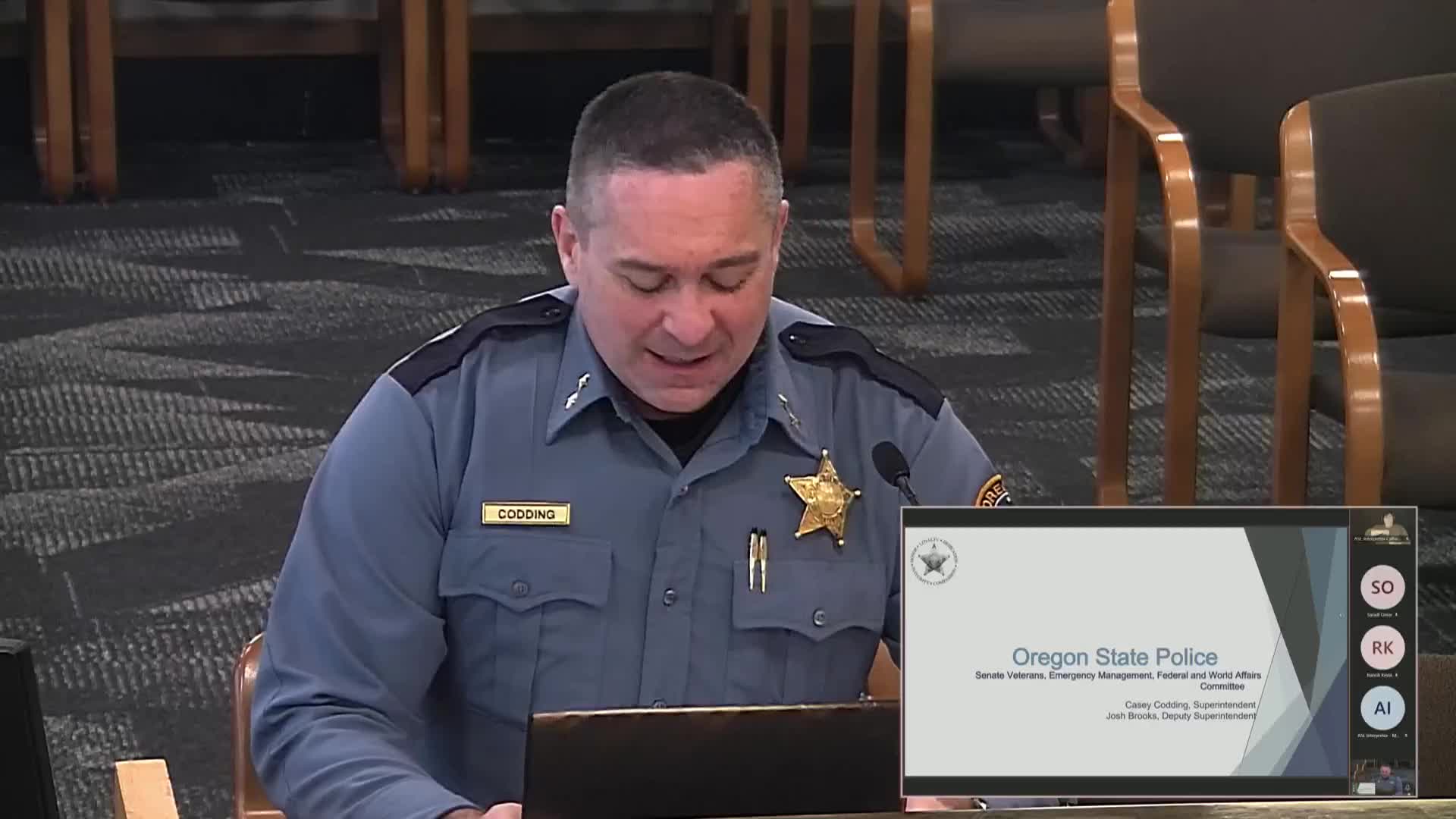
The Oregon State Police briefed the Senate Committee on Veterans, Emergency Management, Federal and World Affairs on its statewide emergency-response capabilities, redundancy in communications, and recent activations for large-scale incidents.
"The mission of the Oregon State Police (OSP) is to serve all people with priority of safeguarding life, property, and natural resources," Superintendent Casey Cotting told the committee. Cotting outlined OSP's role as the law enforcement representative in the state's emergency management framework (Emergency Support Function 13), its participation in interoperability and fusion-center bodies, and its statewide force structure.
OSP said its department comprises 766 sworn positions and 627 professional staff for a total of 1,393 authorized positions. The agency described 35 patrol offices, specialized units (SWAT, canine, collision reconstruction, mobile response, a state overdose response team pilot), and prepositioned equipment including aircraft, watercraft, armored vehicles and off-road vehicles.
Cotting described communications redundancy: two regional dispatch centers (Salem and Central Point) that operate 24/7 and are fully redundant, an Agency Operations Center (AOC) at general headquarters that houses backup dispatch consoles and radio base stations, auxiliary ham-style radio capability, Starlink internet and generator backup, and satellite phones for command staff in remote areas.
The agency said the AOC and regional dispatch centers were activated during a December tsunami-warning event; commanders monitored live ocean feeds and coordinated resources and evacuations as warnings evolved. Cotting said the AOC became fully operational within months of being stood up and allowed agency command to share real-time information and allocate resources statewide.
OSP also noted that it houses the state medical examiner's office and can deploy a mobile morgue and refrigerated trailers in the event of mass-casualty incidents. Cotting described OSP's emergency operations plan — an all-hazards approach of approximately 417 pages as of 2024 — and a continuity-of-operations plan to preserve essential functions during prolonged incidents.
Committee members asked about go-bag expectations for sworn members (Cotting said most troopers garage their issued vehicles at home and are prepared to respond immediately with multi-day equipment) and interoperability updates. Cotting said OSP is a partner in the statewide radio project and that broader interoperability activities are led by state agencies and OEM, noting geographic and terrain challenges in Oregon's frontier areas.
The committee thanked Cotting and Deputy Superintendent Josh Brooks for the briefing and expressed support for OSP's communications and operational improvements.