Get Full Government Meeting Transcripts, Videos, & Alerts Forever!
Get email alerts on the Community Colleges topic
No spam. Unsubscribe anytime.
Community colleges report enrollment rebound, rising career‑technical demand and a $120 million shortfall to maintain services
Summary
Oregon community college leaders told the House higher education committee that headcount and full‑time equivalent enrollment rose in 2023–24, that career and technical education and short certificates are driving growth, and that the system needs about $120 million more to maintain current services.
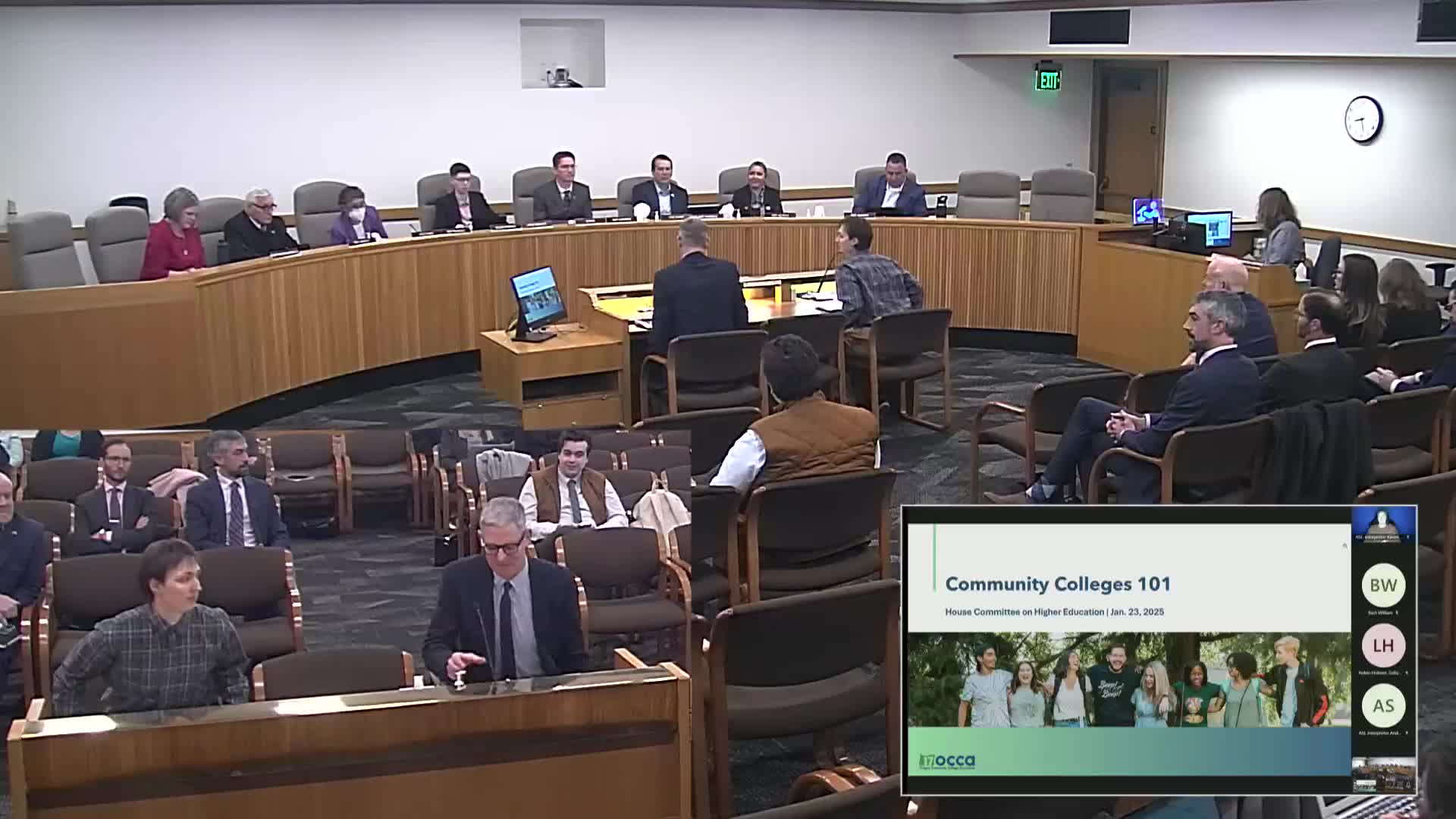
John Wyckoff, deputy director of the Oregon Community College Association, told the House Committee on Higher Education and Workforce Development on Jan. 23 that community colleges are seeing an enrollment rebound and growing demand for career and technical education programs but face funding pressures.
“We're in every county of the state,” Wyckoff said. “Currently, our headcount is about, is almost 200 and, a little over 200,000. It was up, headcount was up 4% in 2023–24. FTE has increased over this last year 7%.”
Wyckoff said community colleges’ enrollment gains since the pandemic are concentrated in short‑term career and technical education (CTE) certificates — programs he described as directly tied to local labor demand and family‑wage jobs. He said CTE enrollment has roughly doubled over the past decade and cited nursing and other CTE programs as among the costliest to operate because of equipment, simulators and clinical requirements.
The community college system, Wyckoff said, serves a predominantly part‑time, older student population. He told the committee that roughly 3% of community college students were full time while 59% were part time, and that only a small share of system students attend full time overall. Wyckoff also emphasized widespread food and housing insecurity among community college students and described Benefits Navigators — positions that help students connect to public benefits — as an important tool whose funding was removed from the governor’s recommended budget. “That was 10,000,000 for that that is that was zeroed out in the budget,” he said.
On state funding, Wyckoff said the Community College Support Fund (the primary state appropriation for the colleges) was $800,000,000 for the current biennium and estimated the system needs about $120,000,000 (roughly a 15% increase) to maintain current services without tuition increases. He warned that absent state investment the system’s options are limited to cutting programs or raising tuition, which he said would disproportionately affect students.
Wyckoff described applied baccalaureate programs as an emerging strategy: the legislature recently authorized community colleges to offer certain bachelor’s degrees in applied fields. He said six colleges had formed a consortium to offer a shared Bachelor of Science in Nursing so students around the state can complete a BSN without relocating.
Student perspective: Ryan Vaughn, a second‑year student at Portland Community College, told the committee that the Oregon Promise grant and PCC itself made college affordable and helped him explore majors and serve in student government. “Portland Community College and the Oregon Promise Grant gave me the foot in the door for higher education,” Vaughn said.
Ending: Wyckoff asked the committee to consider increased investment to sustain services and expand capacity for high‑demand programs; committee members thanked him and the student speaker and moved to the next informational presenters.