Get Full Government Meeting Transcripts, Videos, & Alerts Forever!
Get email alerts on the Puc Regulation topic
No spam. Unsubscribe anytime.
Oregon PUC tells Legislature how it regulates rates, wildfire safety and clean-energy planning
Summary
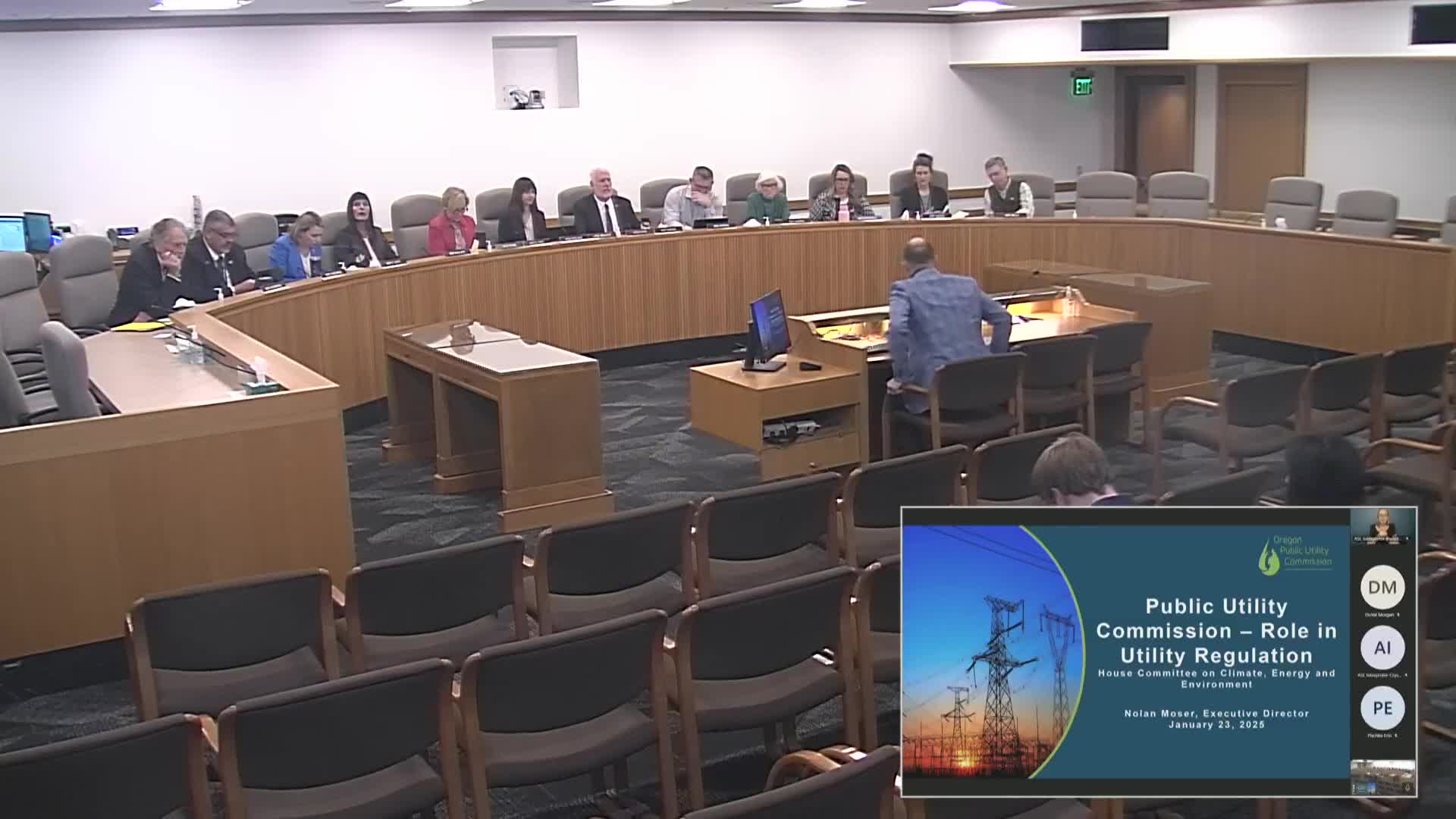
Nolan Moser, executive director of the Oregon Public Utility Commission, briefed the House Climate, Energy and Environment Committee on the PUC’s authority, processes for contested rate cases, public-participation changes and the agency’s role on wildfire and clean-energy obligations under HB 2021.
Nolan Moser, executive director of the Oregon Public Utility Commission, told the House Climate, Energy and Environment Committee that the commission reviews utility rates, enforces safety and advances state energy policy while operating without general fund support.
The PUC’s decisions are made by three full-time commissioners appointed by the governor; no two commissioners may be of the same party. Moser said the commission is funded by assessments on regulated investor-owned utilities and “received no general funds.” He described the agency as an economic regulator for investor‑owned electricity, natural gas, water and certain telecommunications services and said municipal utilities and many cable or cellular services are outside its authority.
Moser outlined the commission’s three main work streams: traditional rate reviews, planning (including integrated resource plans and clean-energy plans created under HB 2021) and program oversight such as community solar and energy-efficiency initiatives. He said contested cases are “quasi judicial” and must be decided on an evidentiary record, rulemakings are staff-led and open to broad stakeholder input, and commissioners also make routine decisions at biweekly public meetings.
On public participation, Moser said the PUC has taken steps to make technical proceedings more accessible: the commission will give roughly six weeks’ notice for rate-case public hearings, about a week’s notice for routine public‑meeting agenda items, and offers both in-person and remote hearings. “When we do a rate case public hearing, at a minimum, we're giving roughly 6 weeks notice,” Moser said. He added that the PUC now provides Spanish translation for every major rate case and has a public comment portal that consolidates comment into the record.
Moser described how general rate cases function: utilities file tariff proposals that may be suspended for up to nine months while the PUC conducts a year‑long, trial‑like review of costs and prudency. He said the commission often approves less than what utilities request, citing recent cases in which utilities received substantially smaller increases than sought.
The commission has increased emphasis on wildfire mitigation and a dedicated safety division that inspects overhead assets and supports emergency response. Moser said wildfire risk has grown and is driving new costs, noting rising insurance and other expenses that can be passed to customers.
On clean-energy implementation, Moser said HB 2021 has changed the PUC’s role and that the commission interprets the statute as allowing it to require utilities that are not making progress to solicit procurement (for example, by issuing an RFP). "We have the commission has determined that we have the authority to order something like that. And even that initial determination that we have that authority has been appealed," he said, referring to an appeal by PacifiCorp.
Moser also described a 2023 legislative program, HB 2475, that created recurring support for community participation: about $500,000 per year is available to help low‑income and environmental‑justice groups hire experts or lawyers to participate in PUC dockets. He said the funding has brought new voices into rate and planning cases.
Committee members asked about notice time and speaker duration, time‑of‑use tools and how the PUC can manage large, new electricity loads. Moser said some time‑of‑use tools exist but are less developed in Oregon than in California, and he called load‑growth and transmission limitations “a moment where our previous assumptions need to be completely reimagined.”
Moser said the commission staff includes about 142 people (including accountants, policy analysts and administrative law judges) and routinely works with the Oregon Department of Justice on legal sufficiency. He also noted the PUC reorganized staff to reduce silos between rates and policy teams to better evaluate how compliance options affect customer rates.
The briefing closed with committee members asking for deeper review ahead of anticipated PUC‑related legislation; Moser said PUC staff and commissioners will be available as a resource.