Get Full Government Meeting Transcripts, Videos, & Alerts Forever!
Get email alerts on the Energy Programs And Budget topic
No spam. Unsubscribe anytime.
Oregon Department of Energy outlines programs, federal awards and budget pressures for 2025–27
Summary
Director Janine Benner and government relations coordinator Christy Split briefed the House Committee on Climate, Energy and Environment on the department’s programs, recent federal grants, and the governor’s recommended 2025–27 budget, including a proposed increase to the Energy Supplier Assessment.
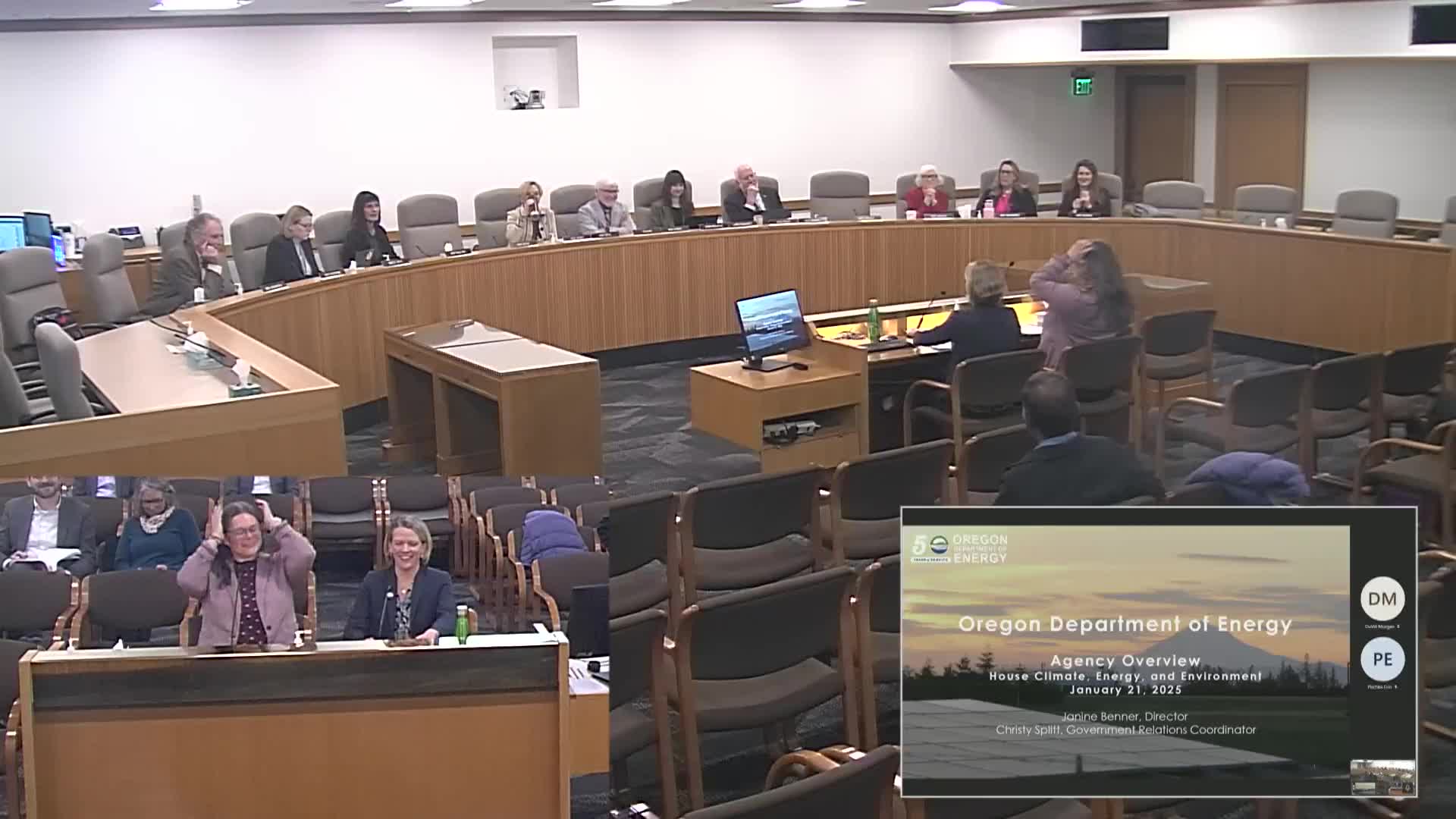
Janine Benner, director of the Oregon Department of Energy, and Christy Split, the agency’s government relations coordinator, briefed the House Committee on Climate, Energy and Environment on Jan. 21, 2025, detailing the department’s programs, recent federal awards and the governor’s recommended budget for the 2025–27 biennium.
Benner said the agency’s mission is to “help Oregonians make informed decisions and maintain a resilient and affordable energy system,” and noted 2025 marks the department’s 50th anniversary since its 1975 creation. The presentation described how the department provides technical analysis, reports and program administration to support a statewide clean energy transition.
Christy Split told the committee that the agency functions as a policy and technical resource for the Legislature, preparing biennial reports and ad hoc studies and tracking energy-related bills. She highlighted recent program activity and incoming federal grants that the department is administering.
Key programs and federal awards - Oregon Solar and Storage Rebate: the department reported issuing $3,500,000 in rebates in 2024. The program supported projects across most counties; a bill making a small change to the program was noted as assigned to this committee. - Energy-efficient Wildfire Program: assisted property owners in wildfire-affected areas in 2024. - Oregon Rental Heat Pump Program: issued rebates supporting approximately 3,000 units, including more than 500 low- and moderate-income households and nearly 700 affordable housing providers. - Community Renewable Energy Grant program: created by House Bill 2021 and initially allocated $50 million with a later $20 million allocation, the program provides planning grants (up to $100,000) and construction grants (up to $1,000,000) for projects outside the City of Portland. The department said it received 195 eligible applications, awarded 94 projects in 28 counties, and that more than 20% of awarded funds have supported projects serving environmental justice communities.
Federal funding summarized by the department - Grid resilience grants: the agency expects to provide $18,900,000 to 13 utilities across 17 counties in the first round of funding. - Home energy rebate programs: the department said it has been awarded $113,000,000 to support single-family and multifamily efficiency upgrades; rebates are expected to be available late in 2025. - Climate Pollution Reduction Grant (EPA): $197,000,000 awarded to Oregon; the department said it will receive part of this funding to expand energy-efficiency incentives. - Solar for All: $86,600,000 awarded in partnership with Energy Trust of Oregon and the Bonneville Environmental Foundation; the department said the federal program targets low-income households and differs from Oregon’s state rebate model.
Planning, standards and facilities Benner described the Planning and Innovation Division’s work on energy efficiency, codes and standards, building performance standards for large commercial buildings, and the Oregon Energy Strategy, which the department will refine in spring–summer 2025 and present policy recommendations in the fall.
On siting and facility oversight, the department described Energy Facility Siting Council (FSEC) activity and compliance work. The department reported 212 megawatts of FSEC-jurisdictional solar and 56 megawatts of battery storage currently in place, about 200 megawatts under construction, and 3,194 megawatts of solar under review by FSEC.
Budget and Energy Supplier Assessment (ESA) Under the governor’s recommended budget for 2025–27, the department said its overall budget would be $174,500,000, including about $60,000,000 for operating costs. The department said the ESA—an assessment on fuel providers and utilities based on gross operating revenues—was $7,910,000 on $8,250,000,000 of reported gross operating revenues in 2024, equal to about $1.87 per Oregonian per year. Under the governor’s recommendation the department estimated the ESA would be about 18% higher than the current biennium; the department estimated most customers’ monthly bills would increase by roughly 4 cents compared with the last biennium. Benner said the ESA increase is driven mainly by personal services costs and state service charge increases rather than new ESA-funded programs.
Committee members asked questions about federal funding stability, siting compliance and program outcomes. Benner said the department is monitoring an executive order affecting federal disbursements and that many federal agreements are already signed. On siting compliance, she said the department currently has two compliance staff and may seek an additional position to review developer documentation, conduct site inspections and serve as a resource for local landowners.
Christy Split and Benner offered to provide committee members with reports, links and thresholds (including details about the Solar for All income definitions) and to return with updates on the energy strategy and other programs as legislation arises.