Get Full Government Meeting Transcripts, Videos, & Alerts Forever!
Get email alerts on the Long Term Care Ombudsman topic
No spam. Unsubscribe anytime.
Long-term care ombudsman urges audit after memory-care resident deaths, warns of blurred DHS roles
Summary
State long-term care ombudsman Fred Steele described a December 2023 incident at a new Sandy memory-care facility in which a resident walked out and later died, urged a full audit of Department of Human Services licensing and regulatory functions, and said his office has investigatory and subpoena authority to pursue system-level concerns.
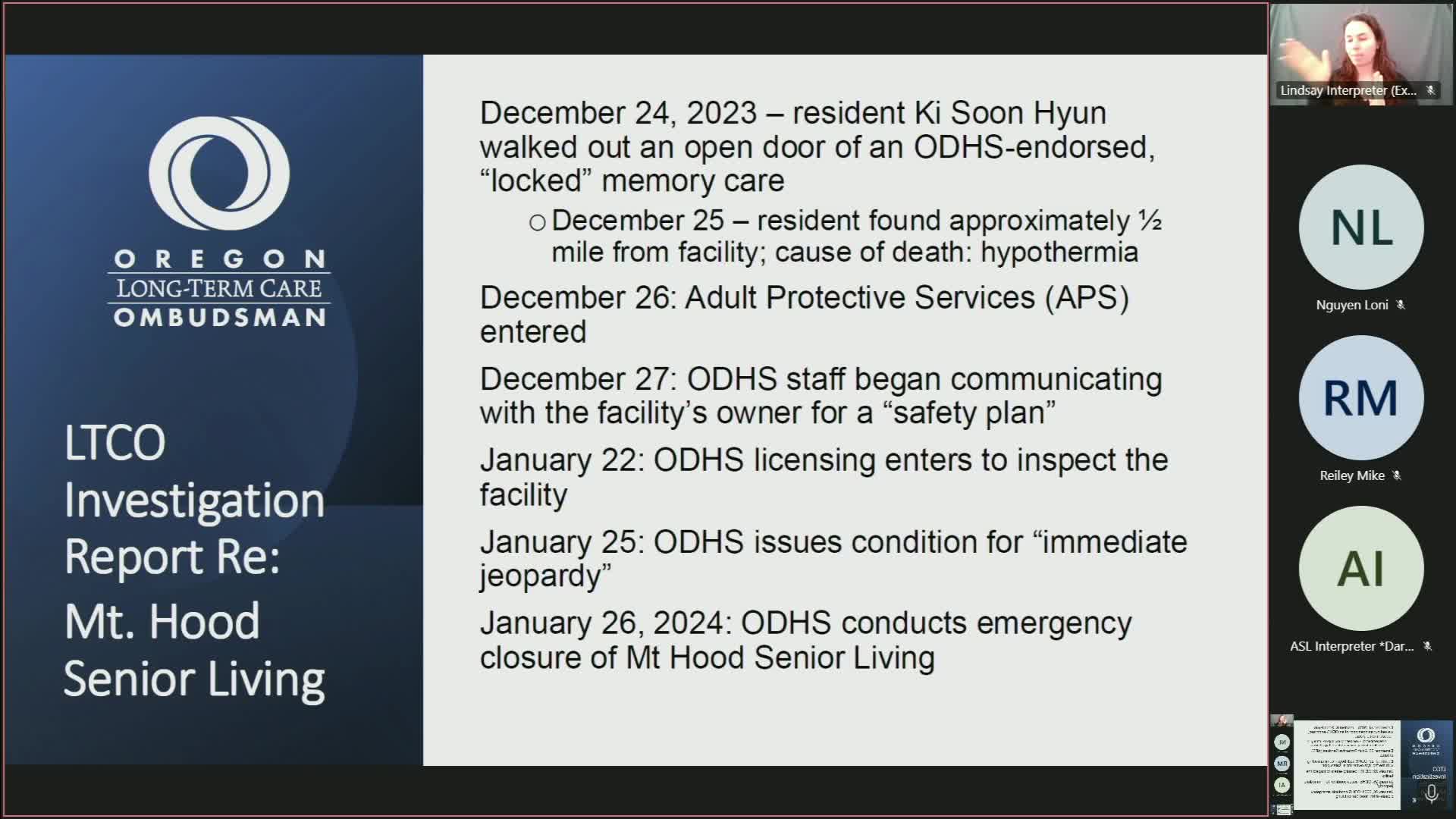
State Long-Term Care Ombudsman Fred Steele told the Senate Committee on Human Services on Jan. 21 that his office’s review of a December 2023 death at a recently opened memory-care facility in Sandy revealed multiple warning signs and missteps by the facility and by the Department of Human Services.
Steele said a resident moved into the facility on Dec. 24, 2023, and “she walked out an open door the very next day.” The resident was found dead outdoors the following day, Steele said. Steele described the facility as new, with staff turnover and inadequate training. He said the person serving as administrator at the time had been a business office manager who told DHS in November that she had no background to run the facility.
Steele said DHS did not deploy its full licensing investigative team until Jan. 22, 2024; when DHS investigators did arrive they identified conditions that prompted the department to move residents out and close the facility. Steele told senators the department’s removal of residents happened rapidly and, in at least one case, an individual later died after being moved because some medical needs were not transferred with the resident.
Steele described three overlapping functions that, in his view, need clearer separation: (1) consumer protection and licensing enforcement; (2) provider support and technical assistance; and (3) systems-level assistance. He said the current mix can result in provider-support staff advising against investigation in some cases. ‘‘You have a provider support staff telling the investigator not to investigate,’’ Steele said, adding, ‘‘They shouldn't have that power.’’
Steele said his office has investigatory authority under state and federal law and subpoena power to obtain records; he said the ombudsman’s office can receive unredacted records and maintain confidentiality. He said his program relies on roughly 120 trained volunteers statewide and about 10 paid long-term care ombudsman staff who support volunteers.
Steele said he called for an audit of DHS’s regulatory work following the Sandy case; the governor directed a program assessment that Steele described as thorough and expected to produce recommendations by May or June. He said the ombudsman’s office issued its own report and that litigation has been filed by the family against the facility owner and DHS; Steele said that litigation was ongoing.
Committee members pressed for details. Sen. Floyd Pruzanski asked whether litigation had been filed; Steele said it had. Sen. Pruzanski and others expressed concern about rapid transfers of residents and gaps in continuity of medical care during emergency moves.
Steele closed by urging investment in caregiver training and workforce supports and recommending statutory clarifications to ensure DHS’s licensing function operates first and foremost as a consumer-protection regulator.
The ombudsman’s presentation framed his office as both an individual-advocacy and systems-advocacy body with authority to take positions and mobilize residents or families when authorized by statute and directed by resident interests.