
Commissioners direct code revisions on tree protection, approve pursuit of urban canopy inventory and monitoring
Get AI-powered insights, summaries, and transcripts
Subscribe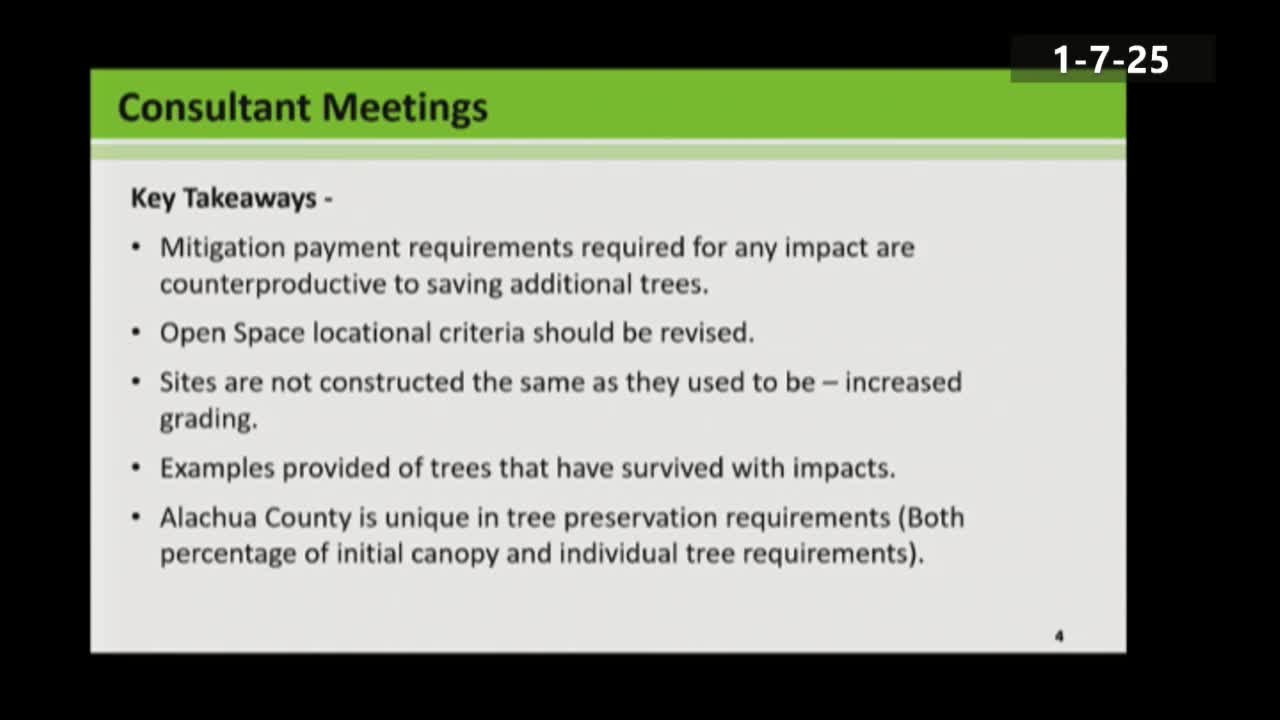
Summary
Board members backed staff recommendations to clarify the tree‑protection hierarchy, adopt a standardized tree‑protection zone and a tiered approach to allowable drip‑line impacts, and to seek grant funding (and add a budget request if needed) to produce a county urban canopy inventory and management plan.
Alachua County commissioners on Jan. 7 directed staff to prepare code changes clarifying the county’s tree‑protection rules, adopt a standardized tree protection zone with tiered allowable impacts and management requirements, and to pursue an urban forest inventory and master plan through available grants or a budget enhancement if grant funding is not secured.
Background and staff recommendations: Jeff Hayes of Growth Management summarized the board’s earlier direction to increase protection of the county’s urban tree canopy and to codify priorities for which trees should be saved. Staff proposed replacing ambiguous language that mixes multiple criteria with a clear hierarchy that prioritizes conservation management areas and high‑quality specimen trees, and codifying an existing rating system for tree quality. Jessica (staff arborist) explained that the county’s current protected area is defined by a variable maximum (historically up to 2 feet of protection per inch of trunk diameter) and that peer communities use simpler, consistent standards. Staff recommended a standardized "tree protection zone" defined as the drip line or one foot radius per inch of trunk diameter (whichever is greater), with tiers of allowable impact and associated management practices rather than blanket mitigation for all disturbances.
Allowed impacts and management tiers: staff proposed permitting limited construction impacts within the protection zone under defined management actions. For example, impacts up to 25% of the calculated tree protection zone would require no mitigation; impacts up to 50% would require management practices (irrigation, mulching, root care) but no monetary mitigation; impacts beyond 50% could trigger a reduced mitigation obligation together with aggressive management. The board discussed the tradeoffs — that allowing managed impacts could make it feasible to save more large trees than forcing developers to remove trees to avoid financial mitigation requirements.
Inventory and monitoring: commissioners also directed staff to pursue an urban canopy inventory and master plan using the i‑Tree and remote sensing tools, estimated in staff research to cost roughly $100,000–$600,000 depending on scope. Staff recommended pursuing state and federal grant opportunities to fund the work and, if grants are not secured by the next budget cycle, to include a budget enhancement request. Staff also reviewed monitoring options used by peer cities — e.g., post‑construction monitoring periods and replacement requirements if a preserved tree fails within three years of certificate of occupancy.
Board discussion and public input: commissioners expressed broad support for stronger protections while urging caution about unintended economic impacts on smaller developers and on the county’s ability to complete public projects. Several consultants and landscape professionals who spoke during public comment supported the proposed changes, said the county’s existing process and staff collaboration work well, and recommended focusing on preserving high‑quality trees and enabling pragmatic management techniques for impacted trees. "The biggest gain I have seen is allowing construction under the drip line with provisions and working with staff," said landscape architect Elizabeth Manley.
Action and next steps: the board approved staff direction to prepare draft ordinance language codifying the tree protection hierarchy, the tree protection zone standard, the tiered impact/management system, and to pursue an urban canopy inventory via grants (with a budget request fallback if necessary). Staff will return with draft code language and a recommended scope and budget for the inventory and monitoring plan.