Get Full Government Meeting Transcripts, Videos, & Alerts Forever!
Get email alerts on the Local Governance topic
No spam. Unsubscribe anytime.
Palatka workshop reviews council–staff roles, sunshine rules and city manager oversight
Summary
An hourlong workshop for the Palatka City Commission on Jan. 23 focused on the legal and practical lines between elected officials and city staff, how Florida’s open‑government rules shape those lines, and recommended practices for evaluating and directing the city manager.
An hourlong workshop for the Palatka City Commission on Jan. 23 focused on the legal and practical lines between elected officials and city staff, how Florida’s open‑government rules shape those lines, and recommended practices for evaluating and directing the city manager.
The presentation, delivered by an associate professor from the University of North Florida who directs the school’s Master of Public Administration program, framed Palatka as a commission–manager city and emphasized that the commission’s primary responsibilities are policy direction, fiscal oversight and hiring (and, if warranted, firing) the city manager. “In yours, you are the boss. You hire and fire the city manager,” the presenter said.
Why it matters: The workshop was explicitly aimed at reducing friction between commissioners and staff, improving public trust and reducing legal exposure under Florida’s open‑meetings and public‑records laws. Commissioners raised several operational questions — including when and how they may contact staff directly, the proper chain for handling staff complaints about the city manager, and how to structure city‑manager evaluations — and the presenter offered specific practices to reduce confusion.
Key points and guidance
- Form of government: The presenter said Palatka operates under a commission‑manager form, meaning the commission sets policy and the city manager implements it. She recommended commissioners defer day‑to‑day staff direction to the city manager and treat the manager as the communication hub for departmental requests.
- Sunshine and public records: The presenter stressed Florida’s public‑access rules, warning commissioners that meetings, emails, social‑media interactions about city business and texts related to official matters can become public records. “Public business needs to be transparent,” she said, and added that officials should always assume communications will be visible to the public.
- Ethics and conflicts of interest: Commissioners heard practical advice on avoiding both actual conflicts and the appearance of impropriety. The presenter urged proactive disclosure and recusal when appropriate, advised declining gifts that could create a perception problem and noted the requirement for annual ethics training.
- Contacting staff and chain of command: Commissioners asked when it is acceptable to contact department directors directly. The presenter recommended limiting direct contact to basic or urgent operational matters, cc’ing the city manager on communications, and never going below the department head without involving the manager, so staff receive a single, consistent direction.
- Handling staff complaints about the city manager: The presenter said commissioners who receive personnel complaints should notify the city manager and ask the manager to investigate and report back. If complaints persist and the manager does not address them, commissioners retain the authority to hold the manager accountable.
- Evaluations and hiring: The presenter recommended annual, documented evaluations of the city manager and suggested using a combination of commission and department‑head feedback (a multi‑source review) rather than a single unilateral review. She also recommended setting evaluation goals in the manager’s contract and scheduling evaluations to avoid being immediately after an election when many commissioners may be new.
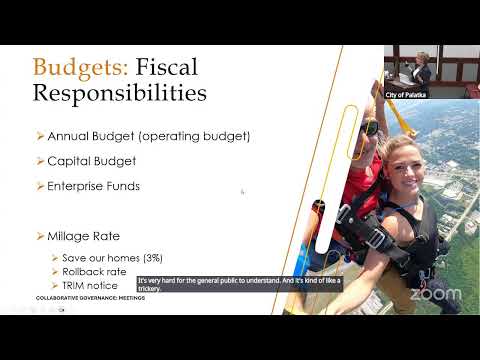
- Budget and fiscal matters: The workshop covered practical budget concepts — enterprise funds, capital planning and the October 1 state budget deadline — and a reminder that Florida limits some taxation growth (the presenter cited the commonly referenced 3% limit on property value increases for certain local calculations) and that the commission must weigh service levels against tax implications.
Commissioner questions and follow‑ups
Commissioners actively questioned how to balance transparency with confidentiality, how to respond when constituents bring complaints directly to a commissioner, and whether the commission should have a direct line to legal counsel separate from the city manager. The presenter recommended routing most operational or personnel matters through the city manager, using the manager to coordinate and document responses, and reserving one‑on‑one discussions with the manager for sensitive supervisory concerns.
No formal actions or votes were taken during the workshop. The session was framed as training and policy guidance rather than an opportunity for the commission to adopt or change ordinances or binding policies.
Ending
Commissioners and staff were given resources and advised to consider regular workshops and clearer internal protocols — including cc’ing the city manager on commissioner‑staff contacts and formalizing city‑manager evaluation procedures — to reduce confusion and strengthen public accountability. The presenter offered to supply follow‑up materials and contact information for commissioners wishing additional guidance.