Get Full Government Meeting Transcripts, Videos, & Alerts Forever!
Get email alerts on the Broadband Bead topic
No spam. Unsubscribe anytime.
CPUC webinar outlines BEAD application technical requirements: 100/20 Mbps minimum, PE certification, GIS mapping
Summary
In a CPUC webinar, staff and a consultant reviewed technical application requirements for California’s BEAD program, including minimum speed and latency standards, required professional-engineer certifications, GIS/network design deliverables, cost templates and a four-year build timeline; templates and office hours were announced.
Jonathan Lachratz, program manager at the California Public Utilities Commission, and Ziggy Rifkenfisch of CTC Technology and Energy presented a technical overview of application requirements for California’s Broadband Equity, Access, and Deployment (BEAD) program during a CPUC webinar.
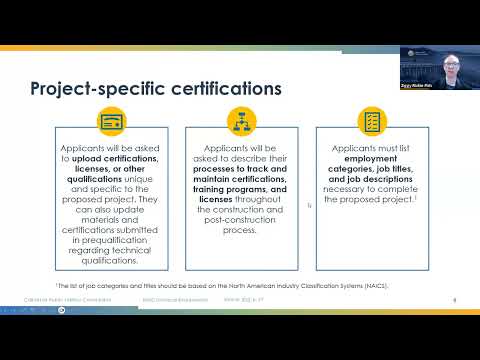
The webinar laid out the technical materials applicants must submit to be considered for BEAD funding, why those items matter, and how the CPUC will evaluate technical capability and design.
The BEAD application will require a detailed project plan and network design, a cost estimate with unitized line items and written justifications, a build-out timeline with milestones submitted in Excel, and GIS shape files showing proposed conduit/fiber routes and project-area polygons. "All these elements were incorporated into the commission's decision," Rifkenfisch said, referencing the National Telecommunications and Information Administration notice of funding opportunity and the CPUC's implementation materials.
Applicants must certify, via a professional engineer, that their proposed network can meet minimum program performance requirements of at least 100 megabits per second download and 20 megabits per second upload, with latency at or below 100 milliseconds for all locations served by the project. At project closeout, any community anchor institutions the applicant committed to must be capable of gigabit symmetric service and usable for business data services, the presenters said.
The CPUC will provide the BSL (broadband serviceable locations) and CAI (community anchor institution) datasets for applicants to incorporate into GIS files; applicants must include the specific routes where they propose conduit or fiber. The webinar also told applicants that conduit runs along roadways should include interspersed conduit access points at short intervals "so they can be available for interconnection by others," Rifkenfisch said.
Project cost submissions must use a template with prepopulated categories. Applicants will enter cost descriptions, category, unit type (feet, hours, etc.), quantity, unit cost (if applicable) and a cost justification when market values are not directly available. Presenters said the templates are intended to reduce uncertainty about eligible expenses and that templates and sample drawings will be made available by CPUC.
The project timeline must demonstrate an ability to complete the work within the program timeline. Presenters said applicants should assume a four-year completion requirement set by NTIA, although NTIA allows the state to request a one-year extension if necessary. Key milestones the CPUC expects include planning/engineering, permitting and make-ready, procurement, construction, subscriber activation and project closeout.
For non-fiber technologies, the webinar described additional template fields. Fixed wireless proposals must include site radio-frequency parameters, sector information, projected signal data per BSL, base-station equipment types and customer-premises equipment details. Satellite proposals must include network performance capabilities, provisioning and customer-premises equipment details.
Professional-engineer certification must attest that the reviewer has examined the proposed network design and that it meets the program requirements and any deployment or speed commitments in the application. The certification template will request the engineer’s name, license number, state of licensure, license status/expiration and a signature.
The CPUC said it will not answer questions during the webinar but will collect questions via the webinar Q&A and will build an FAQ. Staff announced a follow-up webinar on BEAD matching funds scheduled for Tuesday, Jan. 21 at 1 p.m. Pacific and weekly office hours starting that Thursday and continuing through Feb. 27 to help applicants work through templates and application questions.
No formal votes or actions were taken during the webinar; the session was informational and intended to clarify application documents and submission formats. Presenters repeatedly referred attendees to the CPUC’s posted application materials and templates for authoritative submission instructions.