Get Full Government Meeting Transcripts, Videos, & Alerts Forever!
Get email alerts on the Bead Matching Funds topic
No spam. Unsubscribe anytime.
CPUC webinar explains BEAD matching-fund rules, waiver process and evaluation scoring
Summary
California Public Utilities Commission staff and a planning partner outlined matching-fund rules for the federal BEAD program, including a 25% baseline match, allowed in-kind contributions, waiver criteria for high-cost areas, and scoring incentives for higher matches.
Laura Sasaki, a project supervisor at the California Public Utilities Commission, and Ziggy Rifkin Fish of CTC Technology & Energy explained matching-fund requirements for the federal Broadband Equity, Access, and Deployment (BEAD) program during a CPUC webinar.
The webinar detailed where match can come from, how in-kind contributions are valued, the process for requesting a waiver in high-cost census block groups, and how proposals will be scored during the subgrantee selection process.
The matter matters to local applicants and prospective subgrantees because matching funds affect project eligibility, scoring and whether areas with high deployment costs can be included in BEAD-funded projects.
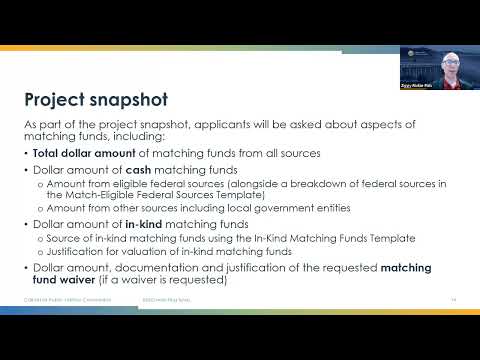
CPUC staff said the BEAD program requires at least a 25% match of total project costs for most project areas. "The b program has a match requirement, and it's, 25% of total project cost," Ziggy Rifkin Fish said. He explained that match can be provided in cash or as in-kind contributions such as dedicated backbone capacity, conduit, pole attachments, easements, labor and equipment used exclusively for the BEAD project.
He said most federal funding sources are not eligible as match unless the NOFO specifically permits them. The National Telecommunications and Information Administration's Notice of Funding Opportunity (NOFO) defines eligible match and lists the high-cost census block groups that are exempt from the match requirement. "For those areas ... the match requirement is waived," Ziggy said, adding that if a proposed project covers multiple block groups the required match will be prorated by which block groups qualify as high cost.
Applicants can request a lower match by seeking a waiver for areas where a business case does not support the 25% requirement, but Ziggy said waiver requests must be justified in the application and will be considered after CPUC evaluates proposals that meet the minimum match. "Proposals that request to have a waiver will be processed later," he said.
The webinar also covered how applicants must certify financial capacity. CPUC will require applicants to certify they have the matching funds they propose to offer and that their commitment covers potential cost increases. "So if you are committing 56%, then that's what you're committing," Ziggy said.
CPUC will require applicants to break matching funds into cash versus in-kind categories in a template included in the application. For in-kind valuation, applicants should provide fair-market documentation or a documented valuation method such as published pricing or existing lease rates for conduit or pole space.
Scoring for the subgrantee selection heavily favors larger matches: CPUC staff said up to 20 points are available for match, with full points awarded at 65% or more and a sliding scale down to zero points at the 25% minimum. "Full 20 points is available. And, you'll get the full 20 points if you offer 65% or more," Ziggy said.
The presenters advised applicants to consult the NTIA NOFO and the CPUC "Initial Proposal Volume 2" document posted on the CPUC BEAD subgrantee page for details, and to join upcoming office hours and webinars for further guidance.
CPUC staff noted other BEAD-related requirements will be discussed in future webinars, including Build America, Buy America compliance, the National Historic Preservation Act review and low-cost service offerings. CPUC also posted a dedicated email for subgrantee selection questions and said recordings and slide decks will be available on the BEAD events page.
The webinar included administrative information about closed captions, chat and Q&A usage and a schedule of office hours (Thursdays, 1 to 2 p.m. Pacific through May 8) for applicants seeking live help.
The session provided clarifications on eligible match, valuation of in-kind contributions, waiver timing and scoring incentives but did not include any formal CPUC decisions or awards; it was an informational webinar about application rules and next steps.