Get Full Government Meeting Transcripts, Videos, & Alerts Forever!
Get email alerts on the Transportation topic
No spam. Unsubscribe anytime.
Planning council advances multimodal vision, hears questions on equity, tech and funding
Summary
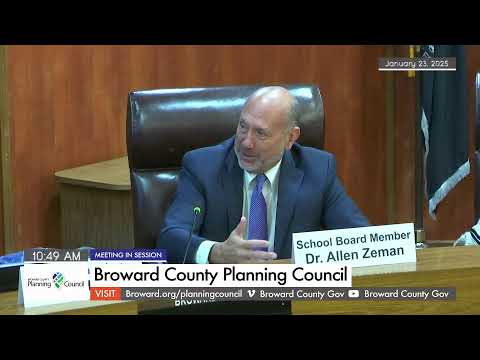
Broward County Planning Council members reviewed proposed updates to the multimodal transportation vision for the Broward Next land-use update, discussing densification along corridors, rapid technology changes and sustainable funding tied to the county's surtax.
Blake Boy, executive director of the Broward County Planning Council, presented planning staff's recommendation to modernize the county's multimodal transportation vision as part of the Broward Next update, highlighting multimodal level-of-service, complete streets, greenways and technology.
The presentation summarized input from subject-matter experts and several agencies who appeared at a Dec. 17 meeting, including Gretchen Cassini of MAP, Corey Cuff Lonergan of Broward County Transportation and MPO staff who discussed long-range plans and digital-twin technologies. "Improving mobility, equitable transit solutions, enhancing economic development and financial stability, and safety and security" were cited as the goals that staff said the updated policies should reflect.
Why it matters: the multimodal vision will guide countywide policy for the next 30 years and inform how local governments plan transportation corridors, transit-oriented development and technology investments. Members flagged equity implications, the pace of technological change and funding priorities.
Discussion highlights
- Equity and densification: Mayor Josh Levy and other members debated a comment submitted by an interested party that redevelopment and densification along transportation corridors could force residents to live only where they can afford. Levy said he "take[s] exception" with the suggestion that such a strategy necessarily creates discriminatory outcomes. School board member Simon Zeman urged caution and urged planners to address historical inequities, saying the county must "be thoughtful" about where investments and amenities are placed.
- Technology and land use: Zeman and other members urged planners to account for rapid technological change, including data centers, artificial intelligence and automated vehicles. Zeman noted that data centers require land and large amounts of energy and warned that autonomous vehicles could change parking needs and land-use patterns. Council members discussed whether sensors and new infrastructure needs should be assumed in the plan.
- Parking and affordable housing: Staff and members discussed parking reductions as a potential tool for affordable housing near corridors, noting resistance from some local governments but recognizing that parking technology and changing vehicle ownership could alter demand.
- Funding and the surtax: Several members urged stronger emphasis on financing and project delivery. One member said the county's pay-as-you-go approach to surtax projects can delay completion and erode public trust. Staff noted Strategy 3 in the existing plan supports a long-term sustainable funding source (the 2018 penny surtax) and said Strategy 3 will be revisited to add "teeth" and promote timely delivery.
Next steps: Planning council staff plan to present draft policy language to the steering committee and a March draft to the full council; staff said a June public hearing is the current goal but cautioned it could slip later in the summer depending on public input and revision timeline.
Ending: Council members generally supported modernizing the multimodal vision while cautioning staff to explicitly address equity, technology infrastructure impacts and mechanisms to accelerate surtax project delivery.