Get Full Government Meeting Transcripts, Videos, & Alerts Forever!
Get email alerts on the Waste Management topic
No spam. Unsubscribe anytime.
Recology reports improved service metrics, lower residential recycling charge to Mercer Island board
Summary
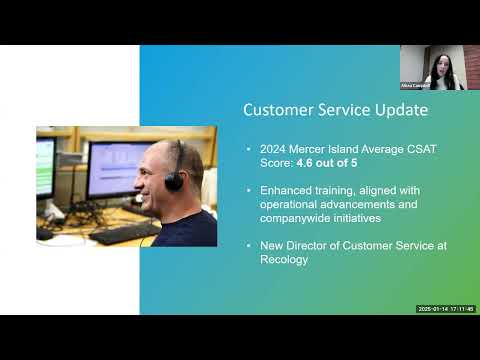
Recology King County told the Mercer Island Utility Board that 2024 customer satisfaction averaged 4.6 out of 5, the island’s diversion rate is about 60% toward a 70% by‑2030 goal, and the county’s fixed annual charge and recycling adjustments produce small rate decreases for 2025.
Recology King County told the Mercer Island Utility Board on Jan. 14 that customer satisfaction improved in 2024 and that the city is closing in on a 70% waste‑diversion target set in the climate action plan.
Alyssa Campbell, government and community relations manager at Recology King County, said, “In 2024, the city of Mercer Island had an average customer satisfaction score of 4.6 out of 5.” Campbell presented the company’s annual report and answered board questions about rates, contamination in the recycling stream and outreach efforts.
The report said a fixed annual charge (FAC) implemented by King County in 2024 continued into 2025 and that Recology opted to show the FAC as a separate line item on customer invoices. Recology reported a $1.34 decrease to residential recycling charges and an $0.85 decrease for multifamily recycling customers for the 2025 cycle. Campbell said the FAC and recycling adjustments are informed by annual waste characterizations and commodity prices.
Campbell outlined other rate elements: the city caps its automatic consumer price index adjustment at 5 percent; the CPI change used for 2025 was 4.18 percent. Recology also reported that the county disposal rate increased and that Recology is using a per‑ton figure of about $165.10 in its calculations for the most recent cycle.
Board members asked for context on diversion targets and current performance. Council liaison Jacobson asked whether the 70 percent target referenced a baseline year and what the current diversion percentage is. Lana (staff member) answered that the 70 percent climate action target is a goal to be reached by 2030 rather than a percent reduction relative to a prior base year, and that Mercer Island “currently sit[s] around like upper 60%” island‑wide; Lana said she would need to pull a report to give an exact year‑end number.
Board member Milton pressed for detail about the roughly 10 percent “residue” in the recycling stream that does not become recycled material. Campbell said the leading contaminant is plastic bags and film and “opaque bagged material” placed in recycling bins; other contaminants include dirty textiles and miscellaneous non‑recyclable items. “Anything that you can use your imagination to think of that would fit into a recycling dumpster, we have probably seen it at the MRF,” Campbell said, referring to Recology’s materials‑recovery facility.
Recology described operational and technology changes made in 2024. Campbell said the company installed two robots at its South Seattle MRF to recover recyclable items from residual lines and plans to add four more robots in 2025. The company also deployed service‑verification cameras on trucks and upgraded information technology systems after a cyber incident the prior winter; Campbell said the fleet and IT improvements “have done really, really well for us.” She also said there was a CrowdStrike incident in the summer and that Recology was “virtually not impacted by that.”
On customer service metrics, Recology reported average answer times of about 15–20 seconds for most of the year, an average handle time of roughly four minutes, and an achieved metric of about 90 percent of calls answered within 20 seconds. The report noted that abandoned calls spiked during January–February when Recology used paper route sheets to work around the earlier cyber incident; abandoned calls dropped to zero in October.
Recology said recruitment for CDL drivers and expanded training—including an in‑house CDL program and an additional safety trainer—helped reduce missed collections. Campbell showed misses per 1,000 customers remained below the 1.0 per 1,000 target and that recent months were approaching the board’s operational target of about 0.1 misses per 1,000.
For outreach, Recology listed its 2024 events on Mercer Island (Leap for Green, Summer Celebration, the farmers market and a holiday makers market) and said it ran recology store workshops on repair and reuse. It reported that 96 percent of multifamily sites on the island have recycling service and that Recology distributed reusable “blue bags” and information to 50 multifamily units during 2024. Recology also reported a 20 percent increase in recycling subscriptions and a 36 percent increase in compost subscriptions between 2023 and 2024.
Recology and city staff discussed pilot and partner programs. Lana said Recology ran two collection events last year with third‑party service Ridwell (plastic film and expanded polystyrene/“styrofoam”) and that staff intend to continue those free community events. Campbell said two new Recology stores opening in fall 2025 in Redmond and Maple Valley will be available to Mercer Island residents for drop‑offs, payments and in‑person customer service.
Campbell concluded by noting a planned north hauling yard with maintenance bays and a paint booth, more MRF enhancements, additional outreach staff, and continued emphasis on food‑waste diversion to meet state organics management requirements for businesses. The presentation required no board action.
The board’s questions and Recology’s responses focused on current diversion rates, contamination in the recycling stream, and the operational and outreach steps Recology is using to reduce misses and increase subscriptions to recycling and compost services.