Get Full Government Meeting Transcripts, Videos, & Alerts Forever!
Get email alerts on the Committee Orientation Land Use Transportation topic
No spam. Unsubscribe anytime.
Baltimore City land use committee adopts monthly docket, hearing rules and emphasizes quasi‑judicial standards
Summary
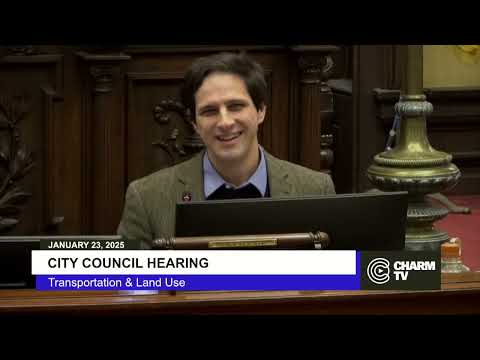
Baltimore City Councilman Ryan Dorsey, chair of the Land Use and Transportation Committee, told members at an orientation meeting that the committee will adopt a regular monthly docket and procedural rules aimed at clearer oversight of transportation, housing, planning and land use bills.
Baltimore City Councilman Ryan Dorsey, chair of the Land Use and Transportation Committee, opened an orientation meeting with a proposed monthly schedule and new procedural rules, saying the committee will “investigate and prod matters related to the Department of Transportation” and conduct regular oversight and coordinated prep meetings with agencies.
The session assembled agency heads, law department staff, planning officials and private land use attorneys to outline how the committee will distinguish between legislative policy work and quasi‑judicial land use cases that require written findings of fact.
Dorsey told members the committee will use a regular monthly cycle: the first week for Department of Transportation operations; the second week for Housing and Planning matters; the third week for policy bills and comprehensive items such as zoning updates; and the fourth week for place‑based, site‑specific land use dockets. He also said the committee will hold pre‑hearing preparation meetings with the mayor’s office, the council president’s office and city agencies “a couple weeks in advance” of oversight hearings to reduce surprises at the public hearing stage.
Adam Levine of the city law department briefed members on the legal standard the committee must follow when acting in a quasi‑judicial capacity. “In the quasi‑judicial context, you can only consider the evidence that’s presented to you at the hearing,” Levine said, and he urged members to identify the specific zoning standards that apply to conditional uses, variances, piecemeal rezoning and planned unit developments and to produce written findings of fact that apply those standards.
Private land use counsel at the meeting urged clearer communication and earlier outreach to council members and communities before bills reach the committee. Caroline Hecker, an attorney with Rosenberg Martin Greenberg, said certainty in the process matters to developers: “We look for certainty and predictability. We want to know what the process is going to be.” Joe Wollman of Silverman Thompson told the committee he advises clients to “reach out to the council person before you reach out to anybody else,” stressing that early engagement with councilmembers helps shape projects and community outreach.
Acting DOT Director Veronica McBeath, introducing herself to the committee, said she was new to the post, describing herself as “one week and 4 days old in this position” and said she looked forward to working with the council on street safety, infrastructure and mobility.
Committee procedural rules presented by Dorsey separate three types of committee business: hearings (public testimony and agency reports), work sessions (internal deliberation and drafting amendments) and voting sessions (formal committee votes). Sponsors of bills will be expected to present at the podium in hearings, agency staff will be asked to report, and committee members—not outside attendees—will ask questions during hearings. The chair said sponsors should generally appear at their hearings and that the committee will be “liberal” with reasonable discretion but require advance sign‑up for virtual testimony to avoid late large surges of online speakers.
Dorsey and others discussed annual, proactive updates to the zoning code — including a comprehensive zoning map update — as an alternative to ad hoc rezoning requests on a case‑by‑case basis. He referenced “Transform Baltimore” as an effort that previously shaped the zoning code and said the committee plans to pursue annual zoning work to identify areas that may need comprehensive rezoning rather than relying solely on the mistake‑or‑change standards used in piecemeal rezoning.
No formal votes were taken during the orientation. The meeting concluded with requests that sponsors and interested parties communicate with committee staff (Dorsey named Sumner Weiss as a principal legislative contact) and with the law and planning departments when complex or ambiguous legal or title issues arise.
The committee’s stated next steps are to begin monthly oversight of DOT operations, develop an annual schedule for zoning code updates, finalize procedural rules for public and virtual testimony, and to continue coordination with the law department on drafting written findings of fact for quasi‑judicial matters.