Get Full Government Meeting Transcripts, Videos, & Alerts Forever!
Get email alerts on the Large Energy Project Funding topic
No spam. Unsubscribe anytime.
Committee Debates Requiring Legislative Approval for Large Energy Project Funding; No Action Taken
Summary
Senate File 83 would require legislative authorization for state funding of large energy projects (defined in the draft as projects over $400,000). The committee heard extensive testimony from the Wyoming Energy Authority and stakeholders about timelines, federal matches and the state's existing review process, then took no action on the bill.
Senate File 83, a bill that would require legislative authorization for large energy-project funding, drew sustained questioning from members of the Senate Minerals, Business & Economic Development Committee but received no action at the hearing.
Sponsor Senator Steinmetz told the committee the bill is intended to insert clearer legislative oversight into energy-project appropriations by defining "large energy projects" (draft threshold: $400,000), requiring reports on recipients and amounts, and requiring legislative authorization by enactment of a bill for expenditures above the threshold. "I believe that the legislature should be more involved in appropriating such a substantial amount of funds in the state and setting energy policy," the sponsor said during his presentation.
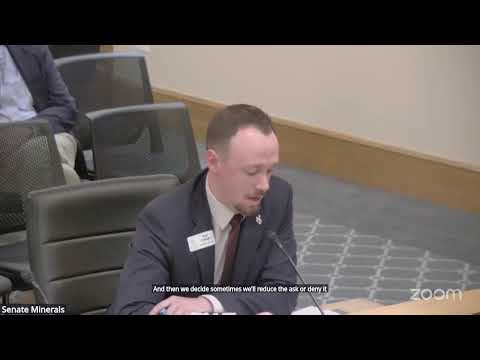
Rob Krieger, executive director of the Wyoming Energy Authority, briefed the committee on how the state's current energy-matching process operates and warned the committee to balance oversight with the need for timeliness on projects that depend on federal awards. He described the current notification process and the scale of prior appropriations: "In the current language ... the governor's office has to notify management counsel and JAC before we expend any funds out of that account," Krieger said. He told senators the Legislature has appropriated $155 million for energy matching funds plus an additional $100 million for a separate large-energy account, for a combined total of approximately $255 million. He said the authority has roughly $46.3 million remaining in the original matching-fund appropriation and that the review committee was considering 10 projects totaling about $47 million.
Krieger described outcomes from earlier investments: of roughly $96 million the state has disbursed through the energy-matching fund program, the authority said those grants leveraged about $260 million in private and federal capital. He also noted the program's projects have included carbon sequestration wells, a microreactor project and coal-to-hydrogen proposals.
Committee members repeatedly raised the timeline issue: several senators said they were concerned that requiring legislative enactment for large projects could add months or more to a project's timeline and possibly imperil federal awards or matching schedules for projects that must move quickly. "If this bill applies to law enforcement as well?" one senator asked at a committee exchange; the sponsor clarified the bill's draft exempts law enforcement and the judicial branch.
Public testimony reflected the same tension. Natalia Macker, president of the Wyoming County Commissioners Association, said the association opposed the bill because county leaders are concerned about potential front-end delays: "Our energy producing counties are concerned about the potential delay on the front end of projects," she told the committee. Rob Krieger and other witnesses asked the committee to consider mechanisms to preserve nimbleness for projects that depend on federal timelines.
After public testimony and discussion, the committee declined to move the bill at this meeting. The sponsor indicated he has a proposed amendment that would exclude impact-assistance funding from the bill's scope and said he would continue working with stakeholders; the committee closed public comment and took no action on the measure at this hearing.