Get Full Government Meeting Transcripts, Videos, & Alerts Forever!
Get email alerts on the Legislative Standing Vs Federal Acts topic
No spam. Unsubscribe anytime.
Senate delays vote on bill giving Legislature authority to sue federal agencies after funding dispute
Summary
Lawmakers debated a bill to expand legislative standing to pursue actions over federal laws and policy; a $75 million appropriation became a flashpoint and the Senate laid the bill back without prejudice after committee chairmen disagreed over an appropriation amendment.
Senate File 41, a bill that would give the Wyoming Legislature standing to bring declaratory-judgment actions over federal laws and actions, was laid back without prejudice after senators disputed an attached appropriation and the proper committee process.
The bill would amend a statute authorizing the Legislature to sue to protect the state's interest in interpretation and administration of federal acts, adding explicit references to statutes and federal laws such as the National Environmental Policy Act, the Federal Land Policy and Management Act, the National Historic Preservation Act, the Endangered Species Act, the Clean Air Act and the Clean Water Act. Sponsor discussion invoked the states interest in federal land management and cited the Legislatures need for a vehicle to challenge federal actions affecting Wyoming federal lands.
Why it matters: sponsors described the bill as a tool to protect Wyomings authority over state land and mineral management, noting roughly 47% of state land and 70% of mineral estate lie under federal control. The measure previously passed both chambers last year by supermajorities before a gubernatorial veto; sponsors said interim committee work revised the measure.
Debate centered on money. The bill originally included a $75,000,000 appropriation. A standing committee amendment reduced that figure in committee materials to $10,000,000; debate on the floor revealed that committee process and appropriations action were out of sync. Senate leadership and committee chairs differed over whether the standing committee amendment or an appropriations committee amendment governed the appropriation language.
Sponsor Senator Ihde, who explained the measure on the floor, described the statutes purpose and the interim changes: "We just need a little more horsepower in the legislature," Ihde said, summarizing the intent to provide the Legislature a way to prosecute federal actions when other plaintiffs may not. Chairman French, speaking for the Agriculture Committee which originally reported the bill, asked the body to vote down the standing committee amendment; several senators urged caution and requested clarity about how the appropriation was handled in Appropriations. Senator Crago, a member of appropriations, said the standing committee amendment created a funding mechanism (an appropriation to the Legislative Service Office) that would allow the Legislature to spend for litigation if necessary.
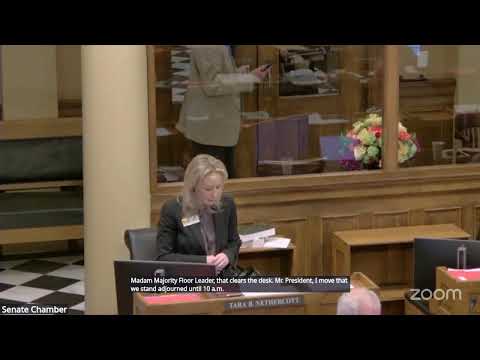
Procedure and outcome: members of the floor noted that the standing committee amendment belonged to the originating committee and that appropriations changes require an appropriations committee amendment. After extended floor colloquy and several requests for time to consult committee members, Majority Leader French moved to lay Senate File 41 back for one day. The motion carried and the clerk announced "Without objection, Senate File 41 has been laid back."
Actions at the meeting: the body considered a standing committee amendment to Senate File 41 (standing committee amendment number 1). The Agriculture Committee chair asked the floor to vote no on the standing committee amendment. No formal final vote on the bill occurred; the bill was laid back without prejudice to allow committees to reconcile the appropriation language and process.
Background and next steps: sponsors said the measure first passed last year with supermajorities in both chambers but was vetoed by the governor. Interim committee work reduced the threshold for the Legislature or the management council to act from two-thirds to a simple majority, and clarified what federal laws the Legislature could challenge. Senators indicated the appropriation language will need reconciling between the originating committee and Appropriations before the bill returns to the floor.
The Senate did not adopt final passage or record a vote on the bill; it was laid back to general file without prejudice.