Get Full Government Meeting Transcripts, Videos, & Alerts Forever!
Get email alerts on the Homelessness topic
No spam. Unsubscribe anytime.
Portland mayor unveils emergency shelter plan, aims for 1,500 surge beds by Dec. 1, 2025
Summary
At a Jan. 22 City Council work session the mayor outlined a crisis-response plan to create emergency nighttime shelters, four district day centers and expanded storage, with a target of 1,500 surge beds and $44 million in biennial costs if fully funded.
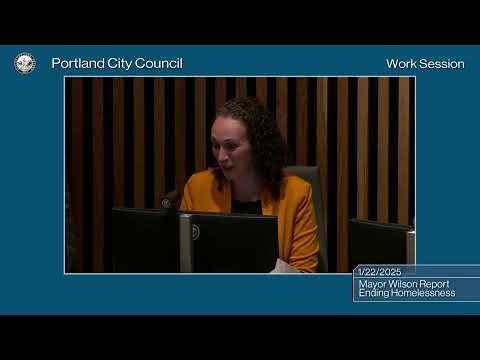
PORTLAND — The mayor on Jan. 22 told the Portland City Council he wants the city to treat unsheltered homelessness as an emergency and to guarantee a bed for anyone in Portland who wants one, presenting a plan that calls for 1,500 surge beds by Dec. 1, 2025 and initial biennial cost estimates of roughly $20 million for fiscal 2025–26 and $24 million for 2026–27.
"We face a crisis that can be overwhelming," the mayor said in opening remarks. "My goal is to make sure everybody in Portland who needs a bed, has a bed to sleep in." The mayor framed the proposal as a rapid, trauma-informed surge effort using existing buildings and a city incident-command structure to accelerate shelter capacity.
The plan centers on three elements: quickly stand up low-barrier nighttime emergency shelters that use existing community facilities, create four day centers (one per council district) modeled in part on Rose Haven, and expand secure day storage for belongings. City staff said 200 emergency shelter beds already have been brought on line; officials described the 1,500-bed target as the full surge capacity the city would flex up to and flex down from as needs change.
Chad Ahmed, director of the Portland Bureau of Emergency Management, said the response will be organized with emergency incident-management principles and daily operational briefings. "We're going to approach this as an emergency mission like we would with any other emergency incident we face," Ahmed said. He told councilors the operation will lean on Emergency Support Functions for mass care and shelter, health and medical, and public safety.
Skyler Brokner Knapp, director of Portland Solutions, told the council the city has stood up an incident command structure and will meet every day to track progress and coordinate city bureaus, county partners and nonprofit providers. "We will be meeting every single day going forward to address this crisis," Brokner Knapp said.
Operational details presented to the council include: - Nighttime emergency shelters (low-barrier, staffed by professionals, volunteers and people with lived experience) that are intended to be quick to open and close, use existing facilities such as community centers and churches, and do not require sobriety though they prohibit weapons and on-site drug use. - Reintroducing stay limits for certain 24-hour shelters (the mayor proposed 90-day limits for applicable sites) and enforcing bed-utilization rules so beds are used nightly, with exceptions for people with documented vulnerabilities. - Four day centers sized to serve about 150 people each (Rose Haven was cited as a cost and service model), and additional secure storage centers; Central City Concern currently provides day storage and was described as a partner that can hold up to about 450 people’s items though the city gave a conservative planning figure of 300.
City staff presented cost comparisons and estimates: some recent 24-hour congregate shelter beds run about $102 per day, some Safe Rest Villages about $190 per day, and the city’s example nighttime shelters average roughly $35–$40 per bed per day in the rapid examples cited. Day centers were costed at about $54–$55 per person per day using Rose Haven as a model. The mayor said the U.S. Department of Housing and Urban Development has provided a $2 million grant to support the work in the current fiscal year.
Officials tied the surge target to existing data: the plan used a by-name list figure of 5,398 people listed as unsheltered in January 2024 and described a goal of adding surge capacity (the mayor’s team said that 200 beds are already online and an additional 1,300 beds would reach the 1,500 surge goal). The city said it and Multnomah County are coordinating budget conversations and that the county will deliver some promised beds under the region’s Homelessness Response Action Plan (HRAP). The city also said it is preparing specific legislative requests for the state and will seek further federal and philanthropic funds.
Councilors questioned enforceability, cost, and the relationship to long-term housing. Several asked what would happen when the emergency beds were reduced ("flexed down") in warmer months and where people would go after proposed 90-day limits. The mayor and staff repeatedly said the shelter surge is intended to create flow into existing programs and permanent housing, while acknowledging the longer-term housing shortage. Brokner Knapp and other staff emphasized that the emergency shelters are not a substitute for permanent housing and that many people on the street will still need housing development and targeted services.
Legal and program constraints were discussed. Staff referenced existing Oregon measures and legal guidance, and councilors raised House Bill 3115 (shelter-availability protections discussed during the meeting) and HB 3124 (notice requirements), and raised the need to consult disability-rights advocates and legal partners before enforcement actions on encampments.
The mayor asked council members to help with local fundraising and partnerships and to join upcoming presentations to the regional Metro Council, the state legislature and the county. He also invited councilors to tour existing emergency sites. Next steps listed by staff included daily incident-command operating briefings, outreach to the homelessness service provider network, a coordinated legislative request to Salem, and continued negotiations with Multnomah County over which entity funds and operates which shelters.
The council did not take any formal votes during the work session; the meeting was a presentation and question-and-answer session. The mayor’s team said more precise financial figures and a funding plan would be provided as budget conversations and legislative requests are finalized.