Get Full Government Meeting Transcripts, Videos, & Alerts Forever!
Get email alerts on the Program Design Outreach topic
No spam. Unsubscribe anytime.
Commission hears lessons from Howard and Montgomery counties on running public election funds
Summary
Representatives from Howard and Montgomery County described outreach, complaint processes and operational lessons for Baltimore County's Fair Election Fund planning commission.
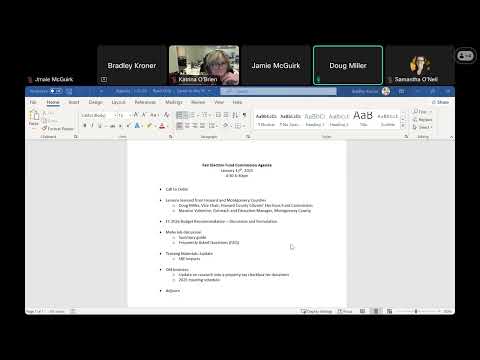
Representatives from Howard and Montgomery counties briefed the Baltimore County Fair Election Planning Commission on Jan. 13 about their experience operating county public election funds, highlighting outreach strategies, administrative burdens and common early problems.
Doug Miller, vice chair of the Howard County Citizens Election Fund Commission, said Howard's program began after voters approved a charter amendment in 2016 and enabling legislation followed. He told Baltimore County commissioners that Howard's first use of the program in 2022 revealed "growing pains," particularly around interpreting timing rules for disbursements when incumbents faced no primary opposition.
Miller said a key problem was that an incumbent certified for public funding sometimes could not receive funds until the general election because county offices interpreted the statute to delay disbursement when no primary opponent was present. "We had a candidate who actually was an incumbent ... who wasn't facing any primary opposition," Miller said, and the commission later amended county legislation to allow funding earlier when appropriate.
John Valentine, the Montgomery County public election fund liaison, said his office provided a public-facing contact point, produced fact sheets and conducted outreach to county party central committees and civic groups. He told the commission Montgomery created a web contact form, speaker-request form and a receipt-format "report card" to help candidates comply with documentation requirements.
Valentine provided operational statistics from Montgomery County's recent cycle: 30 candidates applied for the public fund; 20 were certified; eight won their primary contests and eight won in the general election. He also said his advisory committee was recently dissolved and that program administration is performed by finance staff and the county council.
Both presenters emphasized that public education takes significant staff time. Miller specifically warned that drafting FAQs and a summary guide required more time than expected because of repeated back-and-forth on wording and clarity. Valentine urged Baltimore County to build a one-stop website, maintain updateable FAQs and prepare welcome packets for candidates at the board of elections.
Neither county reported having pursued violations requiring the commission to adjudicate formal complaints in their first cycles. Miller said Howard County had not encountered candidate violations to date but had a formal complaint process in place. Valentine said Montgomery County tracked recurring procedural questions, particularly about receipt format, contributions and reporting timelines, and used those inquiries to develop guidance materials.
The Baltimore County commission heard these accounts ahead of its own outreach and guidance work; staff said they would incorporate the peer counties' materials and suggested procedures into Baltimore County's summary guide and FAQs.