Get Full Government Meeting Transcripts, Videos, & Alerts Forever!
State Water Board advisory group reviews draft criteria to identify inadequate and at-risk wastewater systems
Summary
State Water Resources Control Board project staff and contractors presented draft definitions and quantitative criteria to classify wastewater systems as "inadequate" or "at risk," and advisory members raised concerns about lookback windows, permit overlap, data gaps for WDR systems and how to account for system size and affordability.
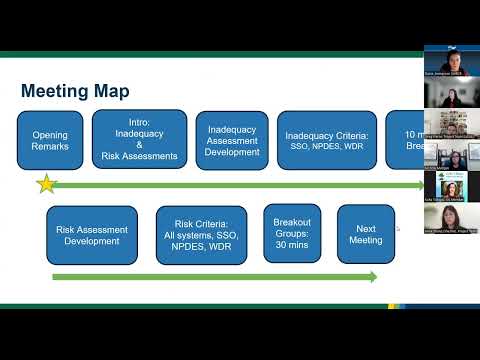
State Water Resources Control Board staff and project contractors presented draft methods for identifying "inadequate" and "at-risk" wastewater systems during a multi-hour Wastewater Needs Assessment advisory group meeting, laying out permit-specific criteria the team plans to apply statewide and asking advisory members for technical feedback.
The project team, led on contract by UCLA and its partners, described a two-part approach: an "inadequacy" assessment that uses recent compliance and enforcement records to flag systems that currently do not treat or dispose of wastewater adequately, and a separate "risk" assessment that uses socioeconomic, operational, environmental and public-health variables to predict systems likely to become inadequate without intervention.
"The needs assessment's long term goal is to identify the number of inadequate and at-risk wastewater systems using a transparent, systematic, and replicable method," State Water Board member Nicole Morgan said during opening remarks, urging broad participation from advisory members. Project staff emphasized this will be a statewide, quantitative effort intended to point to solutions and funding needs, not a regulatory enforcement action.
The team explained it will evaluate three permit categories separately because available data and regulatory triggers differ: sanitary sewer overflow (SSO) permits for collection systems; National Pollutant Discharge Elimination System (NPDES) permits for discharges to surface waters; and Waste Discharge Requirements (WDRs) for discharges to land or non-federally regulated surface waters. Grace Harrison, a UCLA project manager, said the current facilities list contains roughly 1,000 SSO systems, about 260 NPDES systems and about 1,000 WDR systems; Greg Pierce, principal investigator for the contracted work, said the full list will include on the order of 22,100 to 23,100 systems statewide.
Inadequacy criteria proposed for collection systems (SSOs) would use recent, higher-severity overflows and reporting failures…
Already have an account? Log in
Subscribe to keep reading
Unlock the rest of this article — and every article on Citizen Portal.
- Unlimited articles
- AI-powered breakdowns of topics, speakers, decisions, and budgets
- Instant alerts when your location has a new meeting
- Follow topics and more locations
- 1,000 AI Insights / month, plus AI Chat