Get Full Government Meeting Transcripts, Videos, & Alerts Forever!
Get email alerts on the Wastewater Infrastructure topic
No spam. Unsubscribe anytime.
State Water Board advisory group reviews draft criteria to identify inadequate and at-risk wastewater systems
Summary
State Water Resources Control Board project staff and contractors presented draft definitions and quantitative criteria to classify wastewater systems as "inadequate" or "at risk," and advisory members raised concerns about lookback windows, permit overlap, data gaps for WDR systems and how to account for system size and affordability.
State Water Resources Control Board staff and project contractors presented draft methods for identifying "inadequate" and "at-risk" wastewater systems during a multi-hour Wastewater Needs Assessment advisory group meeting, laying out permit-specific criteria the team plans to apply statewide and asking advisory members for technical feedback.
The project team, led on contract by UCLA and its partners, described a two-part approach: an "inadequacy" assessment that uses recent compliance and enforcement records to flag systems that currently do not treat or dispose of wastewater adequately, and a separate "risk" assessment that uses socioeconomic, operational, environmental and public-health variables to predict systems likely to become inadequate without intervention.
"The needs assessment's long term goal is to identify the number of inadequate and at-risk wastewater systems using a transparent, systematic, and replicable method," State Water Board member Nicole Morgan said during opening remarks, urging broad participation from advisory members. Project staff emphasized this will be a statewide, quantitative effort intended to point to solutions and funding needs, not a regulatory enforcement action.
The team explained it will evaluate three permit categories separately because available data and regulatory triggers differ: sanitary sewer overflow (SSO) permits for collection systems; National Pollutant Discharge Elimination System (NPDES) permits for discharges to surface waters; and Waste Discharge Requirements (WDRs) for discharges to land or non-federally regulated surface waters. Grace Harrison, a UCLA project manager, said the current facilities list contains roughly 1,000 SSO systems, about 260 NPDES systems and about 1,000 WDR systems; Greg Pierce, principal investigator for the contracted work, said the full list will include on the order of 22,100 to 23,100 systems statewide.
Inadequacy criteria proposed for collection systems (SSOs) would use recent, higher-severity overflows and reporting failures as indicators. For example, a system that averaged three category 1 or 2 overflows per year across the last five years would be flagged as inadequate under the current draft, the team said. Other proposed SSO criteria include failure to file required annual reports or a sewer system management plan; persistent or active enforcement orders such as administrative civil liability or cleanup-and-abatement orders; and failure to submit required "no-spill" certifications.
For NPDES-permitted systems, the team proposed adopting the federal "significant noncompliance" (SNC) criteria used by EPA: missed discharge monitoring reports beyond 30 days, missed compliance-schedule milestones, repeated effluent-limit exceedances (for example, certain percentage exceedances over multiple months), and chronic violations. The presenters said staff recommended not using notices of violation (NOVs) as a primary trigger for NPDES systems because highly monitored facilities can accumulate NOVs that do not indicate the same severity as SNC designations.
WDR systems present the largest data gap, the presenters said. Unlike NPDES and SSO permittees, many WDR-permitted facilities have less frequent monitoring and reporting. The team proposed a long list of violation types to consider for WDRs—unauthorized discharge, missing monitoring data, exceedances affecting groundwater, exceedance of design capacity or flow, total suspended solids and other effluent parameters—but noted weighting and thresholds remain to be set and that the WDR population will likely produce the most "insufficient data" classifications in the first statewide pass.
Project staff described the data sources they plan to rely on: enforcement and violation records in the Water Boards' databases (referred to in the meeting as CIWQS/CWICs), NPDES discharge monitoring reports, Division of Financial Assistance records and system annual reports. They stressed the project must use data that are available and reproducible for the large universe of systems in order to produce a statewide, repeatable assessment.
Advisory members raised technical and policy questions repeatedly. Several participants — including advisory group member Paul and others — urged the team to shorten the five-year lookback window for some criteria, arguing that long-ago problems that have been corrected should not automatically label a system "inadequate." "If a site had 15 spills five years ago, you're still calling it inadequate," Paul said during the SSO discussion, urging focus on current open enforcement or missing reports. Others recommended scaling spill thresholds to system size or miles of pipe — for example, counting spills per mile or per customer rather than a flat count — because a large regional collection system and a small district system are not directly comparable.
Several commenters pressed the team on permit overlap: facilities sometimes hold multiple permits (collection plus treatment plant permits, or both NPDES and WDRs), and the project must avoid double- or under-counting when different permit components suggest different adequacy outcomes. Office of Water Programs staff and project team members acknowledged this complexity and said they are still developing methods to attribute risk and inadequacy where permits overlap.
Advisory members also suggested additions and clarifications for the risk model. Comments included: incorporate affordability or rate-burden metrics where available; account for operator staffing and governance constraints (board vacancies, bylaws restricting who can serve); consider seasonality and extreme events (storm-related overflows); and include regulatory-change pressure as a risk factor when tightening water-quality standards or biosolids rules could increase compliance costs. Community Water Center and other commenters recommended using established socioeconomic indicators (poverty, housing burden, plumbing access) and looking at per-capita or per-connection capital and operation budgets where possible.
Project staff said their current risk variable set includes a socioeconomic composite used in California's drinking-water needs assessment (household socioeconomic burden), incomplete household plumbing, disadvantaged community status, race and ethnicity indicators, and operational metrics such as population trend, governance type, operator certification level and design flow versus actual flow. Environmental-hazard variables under consideration include drought, flood, sea-level rise, extreme heat and wildfire exposure; public-health risk variables include presence of constituents of emerging concern in wastewater. The presenters said 24 of 39 initially considered variables are recommended for inclusion now because they are available statewide at usable scales.
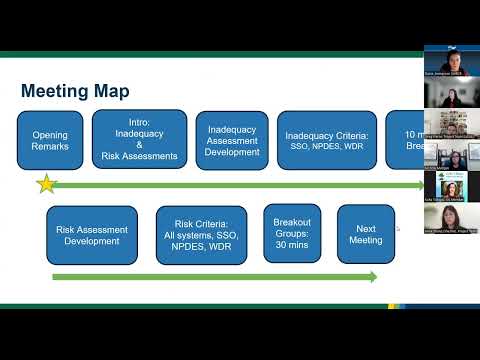
Multiple advisory members asked the team to publish simple explanatory materials (for example, a one-page regulatory primer and links) so nontechnical participants can follow permit nomenclature and data sources. The project team agreed to provide additional materials, keep scheduling office hours (listed in the meeting as Feb. 26 and March 26), and continue iterative refinements: Phase 1d will define inadequacy and risk criteria, followed by Phase 2 public lists and mapping, cost estimates, and a solutions roadmap. The group set the next advisory meeting for April 25 to present the solutions methodology and a groundwater impacts assessment.
Project staff and board members emphasized this is intended to feed funding and technical assistance decisions, not to be a sanctions-only list. "The goal is not to stop at assessing systems as inadequate or at risk," Greg Pierce said. "The goal is to help systems get support, find solutions and understand the cost and funding gap."
The advisory group did not take any formal votes during the meeting; the session was a technical review and public consultation on draft criteria. Project staff said they will refine thresholds, weightings and overlap-handling methods in follow-up work and will publish reports and additional opportunities for comment before any public list is finalized.