Get Full Government Meeting Transcripts, Videos, & Alerts Forever!
Get email alerts on the Regional Health District Treatment Services topic
No spam. Unsubscribe anytime.
Spokane County board to weigh whether regional health district should spin off substance-use treatment
Summary
County staff outlined an ongoing review by the Spokane Regional Health District on whether to separate its treatment services from its prevention and population-health functions and said a regional health district board meeting next week could pause or continue exploratory conversations.
Spokane County officials outlined an information‑gathering process being led by the Spokane Regional Health District (SRHD) on whether the district should transfer its substance‑use treatment services to another provider or keep them inside the regional health district.
The discussion matters because SRHD currently operates one of the county’s main opioid treatment programs (OTPs), including medication for opioid use disorder (MOUD) and jail‑based treatment services. Justin Johnson, speaking for Spokane County, said the district is at an early stage of exploring whether prevention and broad public‑health functions should remain under SRHD while treatment services could be provided by a separate entity.
"The question that has recently come up ... should those two things be separate and spin off treatment services to another provider who could focus entirely on that, and [SRHD] can focus directly on their mandate as the regional health district," Johnson said. He added that the county board, which appoints a majority of the SRHD board members, will receive community feedback and could vote next week on whether to continue exploratory discussions.
Why it matters: SRHD provides walk‑in and managed‑care coverage for MOUD and operates reentry and jail‑treatment programs. Any change could affect how continuity of care is managed, how referrals are routed and which organization holds operational responsibility for treatment programs.
County staff emphasized that the conversations are preliminary. "So I don't see any indication this would ... have any immediate changes based on our conversations," Johnson said, noting that further steps would require a full SRHD board vote and a lengthy planning process if pursued.
Local service providers and advocates at the meeting urged caution. Gail Cogel, acting ombuds for the Office of Behavioral Health Advocacy, described clients who have long tenures with SRHD programs and urged sensitivity to continuity of case management during any transition. A community member identified as Shane described ongoing overdoses and street outreach needs and urged preserving services that reach people on the street.
Next steps: SRHD’s board is scheduled to meet next week; county staff said that meeting could result in a decision to stop exploratory conversations or to request more extensive planning. Johnson said that if the SRHD board opts to explore a separation, any formal change would still require additional votes and an extended implementation process.
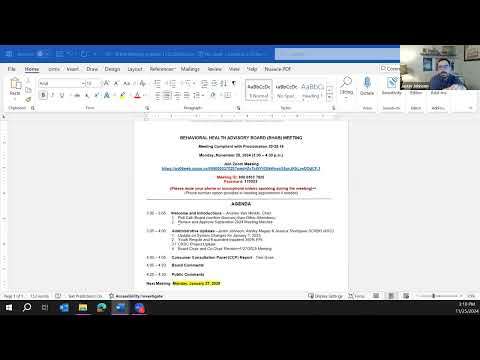
Administrative note: the BHAB approved the meeting minutes at the start of the session by voice vote.