Get Full Government Meeting Transcripts, Videos, & Alerts Forever!
Get email alerts on the State Budget And Legislation topic
No spam. Unsubscribe anytime.
City staff outline state revenue trends, tax-cut proposals and several bills that could affect municipal funding
Summary
At a study session legislative update, presenters reviewed state revenue changes, debated a push to eliminate income tax, and flagged bills on transmission corridors, water planning, municipal elections and marijuana rules; no formal city actions were taken.
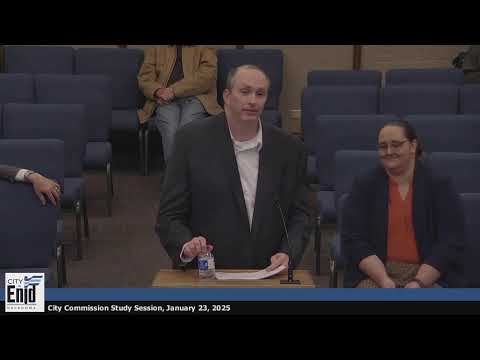
Mr. Rogo, legislative update presenter, briefed the Mayor and Board Commissioners on state revenue trends and a set of bills this legislative session that could affect municipal budgets and local projects.
He told the commission that statewide gross receipts were down about $79,000,000 year-over-year and that components of that change included an increase in individual income tax of $300,000,000, a corporate tax decline of $33,000,000, a sales-tax decline of $181,000,000 and a $286,000,000 drop in gross production (oil and gas) tax. He said motor-vehicle taxes were up $47,000,000 and that the state’s “rainy day” and related stabilization funds together exceed $2,000,000,000.
The figures matter because, he said, “a third of our revenue comes from income tax…another third of our revenue comes from the sales tax,” and proposals to reduce or eliminate the income tax would require choices about replacing that revenue stream.
Why it matters: The commission is weighing local capital needs such as Call Lake and Ames waterline projects that will require outside funding or creative financing. Mr. Rogo emphasized that local officials should help legislators understand the municipal consequences if state tax structures change.
Key details and topics discussed
- Tax-policy debate: Mr. Rogo described active efforts at the state level to pursue tax cuts and, in some proposals, elimination of personal income tax. He warned that removing a major revenue source would shift pressure onto sales taxes and savings balances: “You still have to fund a third of the government, if you eliminate that forever.”
- Economic-development tools: He noted that QualityJobs — a state economic development incentive that captures some income-tax withholding from newly created jobs for gap financing — depends on the existence of an income-tax base.
- Legislation flagged: Mr. Rogo identified several bills of municipal interest, including Senate Bill 241 (creating a Department of Commerce board), Senate Bill 25 (adjusting retro fund population thresholds), Senate Bill 133 (moratorium on groundwater permits in certain circumstances), Senate Bill 914 (regional water districts), House Bill 1095 and House Bill 2819 (firearms on municipal property and employee concealed carry), and Senate Bill 462 (retiring municipal officers and municipal-issue firearms). He also noted many medical-marijuana bills, including measures increasing separation of dispensaries from schools from 1,000 to 3,000 feet.
- Transmission and federal corridor issue: Mr. Rogo described a Department of Energy map that placed the Enid area inside a proposed “Delta Plains” national interest electric transmission corridor. He said state leaders pushed back; the speaker of the house filed a resolution opposing federal control of corridors and Governor Stitt publicly opposed the move. Mr. Rogo contrasted that with privately negotiated projects such as Invenergy’s, which he said are proceeding landowner to landowner.
- Retro fund and thresholds: The “retro fund” is a transportation reserve created to move economic-development-related road projects ahead of the eight-year plan; Mr. Rogo said a proposal to lower the eligible county population threshold from 75,000 to 50,000 would place Garfield County (Enid) among counties affected and deserves scrutiny.
Discussion, directions and next steps
Commissioners asked how the city will explain the funding plan for large local projects to voters; Mr. Rogo said he did not have an exact answer that night but urged staff to coordinate with legislators and OML (Oklahoma Municipal League) to track bills. He also said he will circulate OML’s priority list and his own tagged bills in a Monday newsletter.
No formal vote or city directive on any bill was recorded during this session.
Ending
The commission scheduled follow-up conversations with state legislators in February and asked staff to compile more detailed revenue and project financing information for upcoming meetings.