Get Full Government Meeting Transcripts, Videos, & Alerts Forever!
Get email alerts on the Workplace Discrimination Training topic
No spam. Unsubscribe anytime.
House trainers define DEI, give examples of discrimination and explain where to report misconduct
Summary
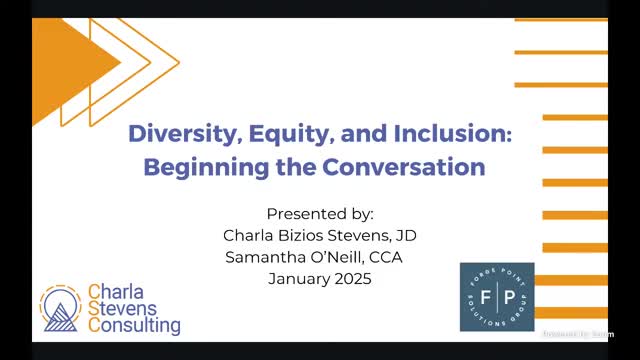
Charlotte Stevens, a labor and employment attorney and consultant, and Sam O'Neil, a human resources executive, led a training for House members and staff on diversity, equity and inclusion and explained where to report alleged misconduct.
Charlotte Stevens, a labor and employment attorney and consultant, and Sam O'Neil, a human resources executive and consultant, led a training for House members and staff on the meaning of diversity, equity and inclusion and on how to address alleged workplace discrimination.
Stevens opened the session by outlining the training and her background, saying, "I spent close to 40 years as a labor and employment attorney," and described the program as a practical, participation-based class that would cover discrimination laws, workplace practices and reporting paths. Sam O'Neil framed the session as a discussion of definitions, examples and strategies for creating a respectful workplace.
The presenters defined terms commonly used in workplace policy. Stevens summarized equity as "the guarantee of fair treatment in terms of access, opportunity, ability to avail oneself of whatever advantages there are," and described inclusion as creating "an environment in which any individual or group will feel welcomed, respected, supported, and valued." O'Neil emphasized that workplace civility affects productivity and morale and cited a Gallup finding that "37% of people across different industries... feel respected," using that figure to underline why workplace respect matters.
The training reviewed conduct that can constitute discrimination in employment and other workplace contexts, including decisions based on membership in protected classes, stereotyping (for example, excluding older workers from technology committees) and adverse treatment based on association with a protected person. Presenters used hypotheticals to illustrate common problems such as interruptions of speakers, name‑mixing, requests that single out women for administrative tasks, and microaggressions (remarks or behaviors that are often unintentional but cumulative). Stevens cited a 2019 Society for Human Resource Management (SHRM) survey finding that about 26% of respondents reported being the target of a microaggression at work and that many more had witnessed them.
Presenters stressed the difference between intent and impact and urged staff and members to give colleagues a chance to correct mistakes. O'Neil recommended allies intervene respectfully in meetings (for example, "Why don't we let Sam finish his thought?") and advised following up privately or escalating to supervisory or HR channels if behavior continues.
On reporting and jurisdiction, Stevens explained that "the House has a policy on the prevention of discrimination" and directed members to the House Discrimination Prevention Panel for allegations concerning members. She said staff conduct should be handled by the Legislative Office of Human Resources. She also noted that the Senate does not have a single standing discrimination‑prevention policy but that discriminatory conduct by a senator can be treated as "conduct unbecoming of a senator" and may be addressed by the Senate ethics panel or the office of the secretary of the Senate.
The training concluded with an emphasis on creating a safe, inclusive environment and practical steps for participants: speak up respectfully when witnessing unacceptable conduct, offer discrete support to colleagues who are targeted, and use established administrative channels when local correction is ineffective.
Questions and a brief discussion followed the formal presentation; presenters remained available afterward to speak with attendees.