
Bernalillo County outlines $79M housing request, seeks $33M for behavioral-health housing
Get AI-powered insights, summaries, and transcripts
Sign Up Free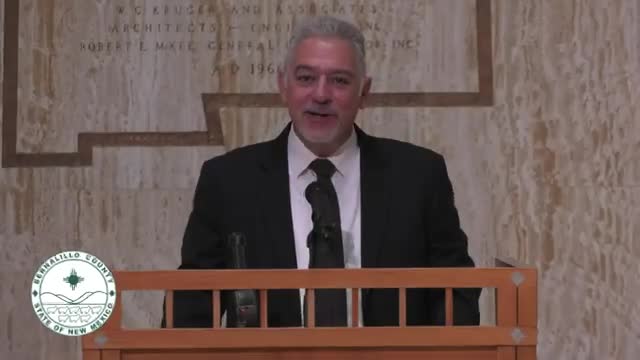
Summary
County leaders told state lawmakers at a rotunda news conference that they are seeking major state funding for affordable housing projects across Albuquerque and separate funds for transitional housing and recovery supports for people with behavioral-health needs.
Bernalillo County officials on the rotunda outlined a package of legislative funding requests focused on affordable housing and behavioral-health–linked housing, and asked the state legislature for support to expand both permanent and transitional housing across Albuquerque.
Vice Chair and District 3 Commissioner Adrianne Barbova said the county is requesting a range of funds, including a $2,000,000 request to build and furnish cottages and renovate a former clinic in the International District for affordable and transitional housing and a larger joint request with the City of Albuquerque for $100,000,000 to build 2,000 new units and rehabilitate more than 800 units.
"We face a significant shortage of affordable housing. It hurts my heart to know that not all our residents enjoy the comfort, the dignity, the security, or especially right now, the warmth of an affordable home," Commissioner Adrianne Barbova said. "But then it soothes my heart to know that we can fight to change that and that it's a real privilege of being a public servant."
The county said it used $3,000,000 in state funds last year to buy four properties for future affordable housing projects, three of which are in the International District. Barbova also cited a county plan for a 60-unit complex at Sixth and Coal for low- and moderate-income seniors and a $500,000 request to upgrade 75 homes in El Centro and Seville Village for low-income seniors or residents with physical challenges.
Representative Janelle Newnordi, representing House District 19, described complementary state-level proposals, including a $2,000,000 community land trust investment created last year and a proposed creditworthiness program to help renters with past evictions or poor credit qualify for housing.
"As we create more housing in infill as opposed to sprawl in the city and in the state, we make sure that we are making new development areas mixed-income areas so that people who have been renting for decades finally see a potential to homeownership," Representative Janelle Newnordi said.
Senator Debbie O'Malley, a former county commissioner who said she founded the Sawmill Community Land Trust, told legislators she supports county-city collaboration and cited interest in multifamily cooperative housing as a model that can provide equity and stability.
Wayne Lindstrom, deputy county manager for behavioral health, asked the legislature to fund projects that provide longer-term transitional housing and recovery supports. Lindstrom said research shows a large share of people experiencing homelessness have severe mental illness or substance-use disorders and that temporary shelter without treatment is insufficient for recovery.
"Until I got a home that offered me the stability and the sense of meaning and belonging and safety, was I ever able to hold down employment," Lindstrom said, recounting an earlier encounter that shaped his view of housing as central to recovery.
Lindstrom described current county programs, including a Tiny Home Village on Zuni offering up to 24 months of transitional housing with care management and wraparound services, a family wellness shelter operating in a hotel, and the Care Campus (historically MATS), which provides transitional recovery housing, including for young mothers.
For future projects linked to behavioral health, Lindstrom said the county and city are asking the legislature to support approximately $79,000,000 in total and that Bernalillo County's portion includes about $33,000,000 for three projects: a $20,000,000 feasibility-backed project for roughly 30 transitional units offering stays up to two years; a $7,000,000 request to convert a hotel to add rooms for families and seniors for stays up to six months; and a roughly $6,000,000 request to expand tiny-home-style villages to serve about 90 individuals in recovery for up to nine months.
Lindstrom characterized those requests as intended to provide stable, recovery-oriented housing while the larger affordable-housing pipeline is built out. He urged continued partnership from the governor, state lawmakers and community providers to support clients navigating transitional housing and recovery supports.
County leadership closed by saying the commission is aligned under County Manager Cindy Chavis and that the county can implement projects if funded.
The news conference did not include formal votes or enacted ordinances; speakers requested state funding and described existing county programs and prior state investments.