Get Full Government Meeting Transcripts, Videos, & Alerts Forever!
Get email alerts on the Zoning Code Rewrite topic
No spam. Unsubscribe anytime.
Woodland Park planners review rewrite of UDC 'Administration' chapter, flag PUD, zoning and procedural clarifications
Summary
At a work session on the city’s Unified Development Code rewrite, staff and a consultant presented a near-final draft of Chapter 6—renamed “Administration”—and asked the Planning Commission to clarify procedures for rezones, planned unit developments, site-plan and subdivision review, variances, appeals and right-of-way vacations.
At a work session on the city’s ongoing Unified Development Code rewrite, staff and a consultant presented an updated Chapter 6—renamed “Administration”—and asked the Planning Commission for targeted edits and direction on procedures governing rezones, planned unit developments (PUDs), site-plan reviews, variances and appeals, and right-of-way vacations.
The draft chapter consolidates process language now scattered across multiple titles and the charter and aims to make review steps, noticing and pre-application thresholds easier for applicants and staff to follow. Consultant Jen said, “Just another work session on our, ongoing, patrol through all of our code and regulations, looking to restructure these into a much more usable format.” Karen, a city staff member, told commissioners the project is near completion but that the PUD section needs a “wholesale rewrite” for clarity.
Why it matters: the Administration chapter governs how the city accepts, reviews and notices development applications. Changes to definitions, review criteria and procedural cross-references affect who must be notified, what level of review (staff vs. public hearing) an application triggers, and how future appeals or charter conflicts are handled.
Most substantive items discussed
- Chapter title and review language: Commissioners and staff agreed to adopt “Administration” as the chapter title and to change many instances of “approval criteria” to the narrower term “review criteria” where staff is reviewing an application and a separate body makes the approval decision. That change is intended to clarify the difference between findings a reviewer must consider and final approval standards.
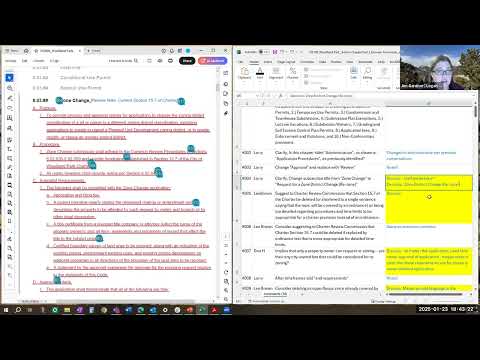
- Zone changes / rezones: The group agreed to use “zone district change (rezone)” with “rezone” parenthetical to reflect common usage. The draft moves much of the current rezone procedure out of the charter and into the code’s administration chapter; staff noted this will be flagged for the Charter Review Committee (Council Member Nakai is serving on that committee) and that timing for any charter amendment could be lengthy.
- Property owner/title certificate language: A comment from a participant asked whether city-initiated rezones of city-owned lots would be permitted; staff said landowner approval still must be documented and the submittal language will be adjusted to clarify how city-initiated requests are handled.
- Pre-application and common review procedures: Commissioners pressed staff to be explicit about which applications require pre-application conferences and which do not. The draft cross-references a Common Review Procedures section (6.02.020–050) that lists pre-application, submittal completeness, scheduling and noticing, and decision/hearing procedures. Commissioners suggested adding a simple checklist or flowchart (kept either in the code or in application materials) so applicants can see which steps apply.
- Comprehensive plan consistency: Commissioners debated how strongly to require consistency with the comprehensive plan. Several members preferred language that compels consistency (a “shall”/approval criterion); others argued for language that requires the reviewing authority to consider the comprehensive plan in its decision. Staff proposed keeping a clear reference to the comp plan and the future land use map and moving toward consistent phrasing across sections.
- PUD (planned unit development): Staff and the consultant said the PUD section in existing regulations is unclear and needs a thorough rewrite. Commissioners asked that the draft clarify the difference between preliminary and final PUD plans, when each is required, and how a PUD rezone interacts with subdivision, site-plan, and other entitlement steps.
- Right-of-way vacations: The group reviewed the draft standard that a vacation shall not create a landlocked parcel and discussed utility easements. Staff noted the city can vacate a right-of-way while reserving easements for subsurface utilities (an example cited was a recent vacation tied to a Les Schwab development on Midland Avenue).
- Site-plan vs. subdivision review: Commissioners asked staff to be explicit that most routine single-family and small residential projects are handled through zoning development permits or administrative site-plan checklists, while major commercial site plans and subdivisions follow separate public-review tracks (minor, major, or exemptions) and technical infrastructure review.
- Variances and building permits: The commission discussed existing language that generally expects a variance before a building permit is issued. Members noted real-world situations (e.g., measurement errors) where an after-the-fact variance is requested; staff said the Board of Adjustment’s decision can be attached to or used to revise an issued permit, and recommended clarifying that a variance typically should be requested before issuance but that the code should allow appropriate administrative follow-up when a variance is granted after issuance.
- Appeals: The draft retains customary language that appeals from the Board of Adjustment go to the district court (as provided by Colorado statutes). Commissioners suggested simplifying and clarifying the appeals text and confirming standing/"aggrieved party" language in consultation with the city attorney.
- Spot zoning and definitions: Commissioners discussed whether to add a local definition of “spot zoning.” Several speakers warned courts ultimately define spot zoning in individual cases; others said a short, plain definition could help staff and the public avoid problematic rezones.
Process and next steps
Staff said the next steps are to incorporate the commission’s edits, resolve cross-references (for example, Titles 16–18 and any remaining items in Title 12), and submit the revised draft for legal review. Commissioners asked to see a consolidated, clean draft (not only strike-and-add markings) before legal review so they can confirm the code text matches commission intent. If the Planning Commission signs off on a near-final draft, staff will bring the document to the City Council, and then to public review and hearing as required.
Ending
Commissioners and staff agreed to continue refining the Administration chapter and related sections (PUD, subdivision and site-plan links, variances, and appeals). Staff will return a cleaned-up draft that incorporates the commission’s wording preferences for review before formal legal review and public hearings.
(Reporting note: the session was a Planning Commission work session; no formal votes or final ordinance adoptions were recorded in the transcript.)