Get Full Government Meeting Transcripts, Videos, & Alerts Forever!
Get email alerts on the Workplace Discrimination Prevention Training topic
No spam. Unsubscribe anytime.
House members and staff receive training on discrimination prevention, microaggressions and workplace civility
Summary
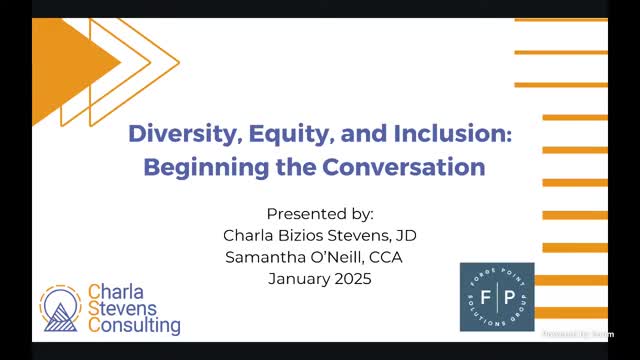
Sharla Stevens, a labor and employment attorney, and Sam O'Neil, a human resources executive, led a training for House members and staff on preventing discrimination and improving workplace civility at the State House.
Sharla Stevens, a labor and employment attorney, and Sam O'Neil, a human resources executive and consultant, led a training for House members and staff on preventing discrimination and fostering workplace civility at the State House.
Stevens and O'Neil outlined definitions of diversity, equity and inclusion, described common forms of workplace discrimination and microaggressions, and explained where complaints should be reported under House policy. Stevens described recent trends in federal enforcement and urged participants to reduce retaliation risk, while O'Neil emphasized building psychological safety and practical steps employees and legislators can take to de-escalate or report problem behavior.
The training began with definitions. Stevens cited a broad definition of diversity that includes "psychological, physical, and social differences" and said equity means "guarantee of fair treatment, access, and opportunity," distinct from equality. O'Neil said inclusion requires creating an environment where "any individual or group will feel welcomed, respected, supported, and their participation" is valued.
Stevens reviewed federal enforcement priorities, noting that the Equal Employment Opportunity Commission oversees federal anti-discrimination statutes and that "the number 1 basis for claims was race discrimination until about 6 or 7 years ago when retaliation became number 1," adding that retaliation frequently accompanies other discrimination claims and can deter people from coming forward.
O'Neil and Stevens gave practical examples of problematic conduct and microaggressions. They cited research results to illustrate prevalence: a Gallup survey reported that only about 37% of workers say they feel respected at work, and a SHRM survey reported roughly 26% of surveyed adults said they had experienced a microaggression at work, 36% had witnessed one, and 22% were unsure. The presenters listed common microaggressions — such as complimenting a person of color for being "articulate," asking "Where are you really from?" and assigning routine tasks based on gender or age — and described how repeated small slights can become "death by a thousand cuts."
O'Neil urged lawmakers to model civility. "So hate has no home here," he said, calling for respectful debate and mindful use of social media. Both trainers recommended that participants approach charged conversations "from a place of curiosity" rather than confrontation, and to escalate unresolved behavior through appropriate channels.
On reporting channels, Stevens said attendees should follow House policy on prevention of discrimination. For conduct by a House member, she said the Panel for Prevention of Discrimination is the appropriate House avenue; for staff complaints, she said the Department of Human Resources handles reports. She also noted that if the Senate needs to address discrimination, the matter can be referred to the Senate Ethics Panel or the Office of the Secretary of the Senate. Participants were told the training slides would be emailed by human resources.
Trainers emphasized several prevention strategies: avoid assumptions about candidates or colleagues, broaden recruitment and outreach rather than exclude groups, create psychological safety so people can raise concerns without fear of retribution, practice allyship by stepping in when someone is interrupted or belittled, and "see something, say something" to prevent escalation. They recommended escalating persistent problems to supervisors, human resources or the Panel for Prevention of Discrimination when informal feedback does not change behavior.
The session closed with references to resources and workplace policies and an offer to answer questions; Stevens and O'Neil said slides and policy references would be distributed to attendees by human resources.