Get Full Government Meeting Transcripts, Videos, & Alerts Forever!
Get email alerts on the Capital Budget topic
No spam. Unsubscribe anytime.
Committee recommends keeping Montgomery County spending-affordability guidelines for FY25–30 CIP
Summary
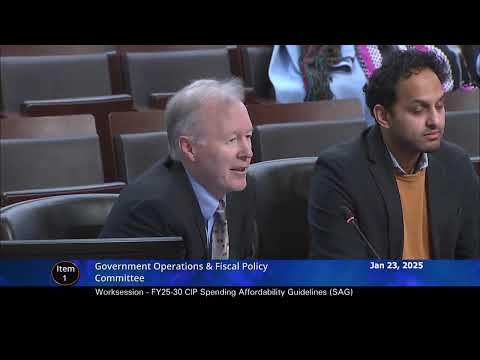
The Government Operations and Fiscal Policy Committee voted unanimously to recommend that the County Council retain the current spending-affordability guideline (SAG) limits for the amended FY25–30 Capital Improvement Program, citing improved debt indicators and updated revenue and cost assumptions.
The Government Operations and Fiscal Policy Committee of Montgomery County recommended unanimously that the County Council keep the current spending-affordability guideline (SAG) limits for the amended FY25–30 Capital Improvement Program (CIP), committee staff said during a Jan. (date not specified) work session.
Committee staff said the current SAG limit — $280,000,000 in general obligation (G.O.) bonds per year across each of the six years of the CIP, for a six‑year total of $1,680,000,000 — should be retained while staff continue to monitor updated economic inputs and debt indicators. "Despite the improvements we're projecting, we do recommend that we stay within the current SAG limit for this upcoming CIP," a Department of Finance presenter told the committee.
The recommendation matters because the Council must approve the CIP and has until the first Tuesday in February to confirm or amend SAGs for the upcoming year. Staff said the committee will send its recommendation to the full Council for consideration; the Council can later exceed years 1 or 2, or the six‑year total, with eight votes during the final May reconciliation of the capital budget.
Staff reviewed six core inputs that drive debt capacity: bond interest rates (assumed at 5%), operating‑budget growth (revised up to 5.8% for FY25), population growth (revised down across the six years), inflation (generally close to last year’s estimates), the assessable property tax base (revised up across all six years), and personal income (revised lower in year 1, slightly higher in later years). Those inputs feed five debt indicators staff use to judge SAGs: total debt as a share of full market value (target ≤1.5%), debt service plus lease payments as a share of general fund revenue (target ≤10%), real debt per capita (guideline ~$1,000, staff referenced a different $2,400 figure in discussion), debt relative to personal income (target ≤3.5%), and a payout ratio (60–75% of debt paid within 10 years).
Staff presented projections showing that several indicators have trended downward and are projected to improve by FY27–FY30. Staff noted the county remained above some guidelines in the early years of the CIP period but expected to fall at or below those guidelines by later years. The presenter said the payout ratio is generally within or near the guideline range across the six years.
Committee members asked for clarification about particular inputs and the CIP set‑aside and PAYGO (pay‑as‑you‑go) policy. Staff noted the executive's recommended CIP keeps PAYGO at or above a 10% target in FY25 and that the executive’s package marginally increases the CIP set‑aside to account for project cost uncertainty and state aid uncertainty affecting the Montgomery County Public Schools (MCPS) program. Staff said the set‑aside typically ramps up in later CIP years because project programming is less certain farther out.
The committee voted to forward a favorable recommendation to the full Council to retain the current SAG limit; committee members stated they will re‑review updated indicators in September 2025 when staff provide new data.
Less critical details: staff noted the last full SAG review had been in October 2023 and that the Council may revise years 3–6 (and the six‑year total) without the 10% per‑year restriction that applies in certain off‑year revisions for years 1–2. The meeting record does not specify the exact date of this committee session.