Get Full Government Meeting Transcripts, Videos, & Alerts Forever!
Get email alerts on the Building Permits And Codes topic
No spam. Unsubscribe anytime.
Regional building official: no new local code adoptions this year; Woodland Park saw $54.6 million in 2024 permits
Summary
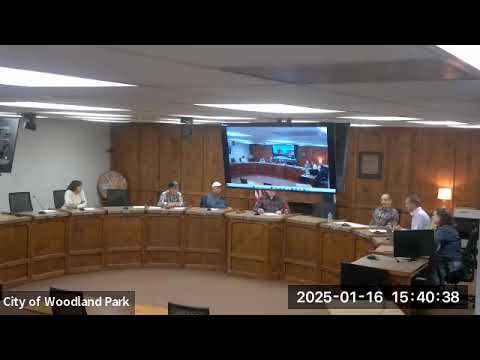
John Walton of the Pikes Peak Regional Building Department told the Board of Review on Jan. 16 that there are no new local code adoptions to implement this year, that the region will monitor state legislation affecting ADUs and energy codes, and that Woodland Park recorded 804 permits in 2024 with $54,601,621 in added construction valuation.
John Walton, deputy building official for the Pikes Peak Regional Building Department, told the Board of Review of Woodland Park on Jan. 16 that the department has no new building-code adoptions to implement locally this year and is monitoring state legislation that could affect local rules on accessory dwelling units and energy codes.
The update matters because changes at the state level could alter which local rules apply to additions and second dwellings and could affect how builders comply with energy-performance requirements. "We actually have no new codes this year that are gonna have to get implemented," Walton said, adding that PPRBD will watch the legislative session for house and senate bills that could affect construction.
Walton provided several workload figures for calendar year 2024. He said PPRBD performed 12,338 total plan reviews across its jurisdiction, 145 of which were for Woodland Park. He reported 804 permits issued within Woodland Park in 2024 and said the total added construction valuation for those permits was $54,601,621. Walton identified the single largest permitted project in Woodland Park as a new crew-support building for Core Electric, a permit he said was pulled in January 2024 and accounted for about $8,000,000 of the year’s valuation. "That single building was a little over $8,000,000 of that $54,000,000 valuation," he said.
Walton also discussed accessory dwelling units, saying state action could limit local zoning authority. "What the state was pushing forward was a statewide bill that would supersede local authority over the zoning element to deny someone the ability to put an ADU, a second dwelling on a residence," he said. He noted Woodland Park already has ADU rules that set size and proximity limits (for example, a detached ADU cannot exceed 40% of the primary dwelling and the city applies neighborhood proximity limits). "We're in the process of trying to restructure our zoning and subdivision regulations, and we are already gone through that section around ADUs prior to that bill passing, but we will be dusting that back off and running it through our city attorney," a city representative said.
On energy codes, Walton described an open public comment period tied to incorporation of the 2024 model energy code into the state code and said the regional department is in a relatively good position after adopting updates last year. He cited examples of technical changes in the 2024 code that his office views as improvements, including expanded allowance for kitchen-exhaust configurations and the return of a simulated-performance compliance path that allows trade-offs. "One big one that instantly comes to mind... is whole-house mechanical ventilation testing...the 2024 has been updated to allow for up to 2 elbows," Walton said, adding that the 2024 code can provide more paths for demonstrating compliance than the 2021 code.
Board members asked for clarifications about how variances and alternative methods would work if the department did not adopt a statewide code immediately; Walton explained the department can approve alternative-material-and-method requests administratively under chapter 1 of the regional building code but that the variance process is tied to the code the jurisdiction has adopted.
The Board and staff also discussed the city’s ongoing CivicGov permit-tracking rollout and a city charter review committee that may examine term limits for volunteer board and commission members. A staff member said the CivicGov implementation is proceeding "slow but steady," with about 300 permits entered for internal testing before a wider rollout.
Walton closed by urging the board to flag any state proposals that raise concerns so the regional department can monitor or respond. "If there's anything you see coming across the state floor, if it concerns you, let it concern us as well," he said.
The Board took no formal action on code adoption, instead receiving Walton’s update and asking staff to follow developments at the state level.