Get Full Government Meeting Transcripts, Videos, & Alerts Forever!
Get email alerts on the Wastewater Route 9 topic
No spam. Unsubscribe anytime.
Southborough leaders explore Route 9 wastewater plant to attract businesses, shore up tax base
Summary
Select Board members and health agents briefed the Board of Health on a preliminary plan for a wastewater treatment system serving the Route 9 corridor, citing shifting tax ratios, development constraints from septic systems, and preliminary cost and siting considerations. No decision was taken; next step is a potential comprehensive plan.
SOUTHBOROUGH, Mass. — Select Board members Al Hamilton and Sam Stivers briefed the Southborough Board of Health on Jan. 22 about a town-led exploration of a wastewater treatment system for the Route 9 commercial corridor, a project they say could unlock new commercial development and reduce pressure on residential taxpayers.
Hamilton told the board the town’s mix of residential to commercial property value — historically about 80/20 — has shifted and that rebuilding commercial valuation to restore that ratio would require roughly $150 million in commercial, industrial and retail (CIP) development. “If we built a wastewater system, it would make the town more attractive to a variety of businesses,” Hamilton said, noting restaurants and certain manufacturing and biotech firms often cannot operate effectively on septic systems.
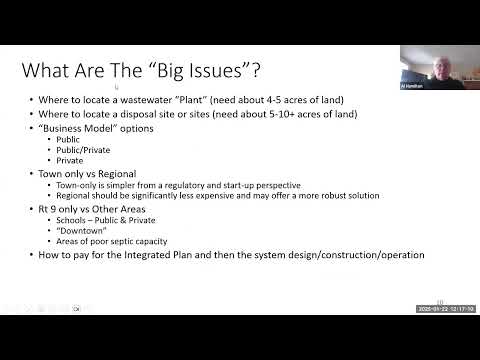
The discussion centered on three near-term technical and policy topics: likely scale and disposal options, potential regional partners and operators, and how to pay for further study and eventual construction. Hamilton said prior studies estimate short- to medium-term flows in the Route 9 area at about 500,000 to 1,000,000 gallons per day and that disposal is most likely to be a ground (subsurface) discharge similar to a leach field. He said the town would need on the order of 4–10 acres for a treatment plant and disposal area, depending on siting and soil conditions.
Town officials reported outreach to nearby communities and agencies. The Framingham Department of Public Works discussed a possible connection; the Massachusetts Water Resources Authority (MWRA) said it is not seeking additional community hookups because of peak-loading and combined-sewer-stormwater challenges. Officials also contacted Westborough, whose regional system includes a surface discharge to the Assabet River — a configuration the presenters said is likely to face federal Clean Water Act limits on adding capacity. The town has spoken with engineering firm Weston & Sampson, which examined disposal and sizing options in recent studies.
Hamilton described private operation as one possible model and said he had discussed options with Veolia, a national water-and-wastewater operator that also operates regulated utility-style systems elsewhere. He cautioned that privately owned utility models are uncommon in New England and would raise governance and rate risks the town would need to manage.
Cost and funding were recurring topics. Weston & Sampson provided a rough ballpark in the “tens of millions” of dollars — Hamilton said the order-of-magnitude estimate is about $30 million — and he said construction economies of scale make a regional plant potentially more cost-effective. Funding approaches discussed include municipal bonding, betterments and user fees. Hamilton said the comprehensive planning step will be a six-figure task the town would likely seek funding for this year and aim to decide by summer 2025 whether to proceed.
Health agents Chris Craig and Dennis Costello participated in the discussion and agreed to help the group narrow potential sites based on soils and other field conditions. Costello said the USDA soils maps are a useful starting point but on-site testing is necessary to confirm suitability: “The soils maps are good, but they're not the end all. You definitely still have to go and do on-site,” he said.
Presenters described one unconventional potential site: a 30–40 acre MassDOT-controlled median area where Interstate 495 splits near the town line. They cautioned negotiating access and performing on-site soils work would be required before treating that location as viable.
Resident Paul Carter, a civil engineer who previously worked for Weston & Sampson and CDM Smith, urged limiting groundwater-discharge permits to A-class sands where possible and flagged groundwater depth as a critical constraint near the reservoir. “You should really limit it to the A soils if you can,” Carter said, adding that depth to groundwater matters for subsurface disposal.
Hamilton said next steps include briefings for the Planning Board and Economic Development Committee, continued stakeholder outreach (including businesses along Route 9 and the schools), and scoping a comprehensive plan with an eye on funding sources and potential regional partners in Westborough and Marlborough. He asked the board of health to provide occasional technical support and soil-map review from Craig and Costello as the team refines candidate sites.
No formal policy decision or binding commitment was made at the meeting. The session ended when a member moved to adjourn at 12:41 p.m.; the motion was approved on an indicated voice vote. The presenters said they will return with a proposed scope and funding plan for the comprehensive study if the town pursues the next step.
(Reporting note: quotes and attributions are drawn verbatim from the Jan. 22, 2025 Board of Health meeting transcript.)