Get Full Government Meeting Transcripts, Videos, & Alerts Forever!
Get email alerts on the Cte Budget topic
No spam. Unsubscribe anytime.
Senate subcommittee reviews CTE budget, flags capital shortfalls and possible transfer of farm management program
Summary
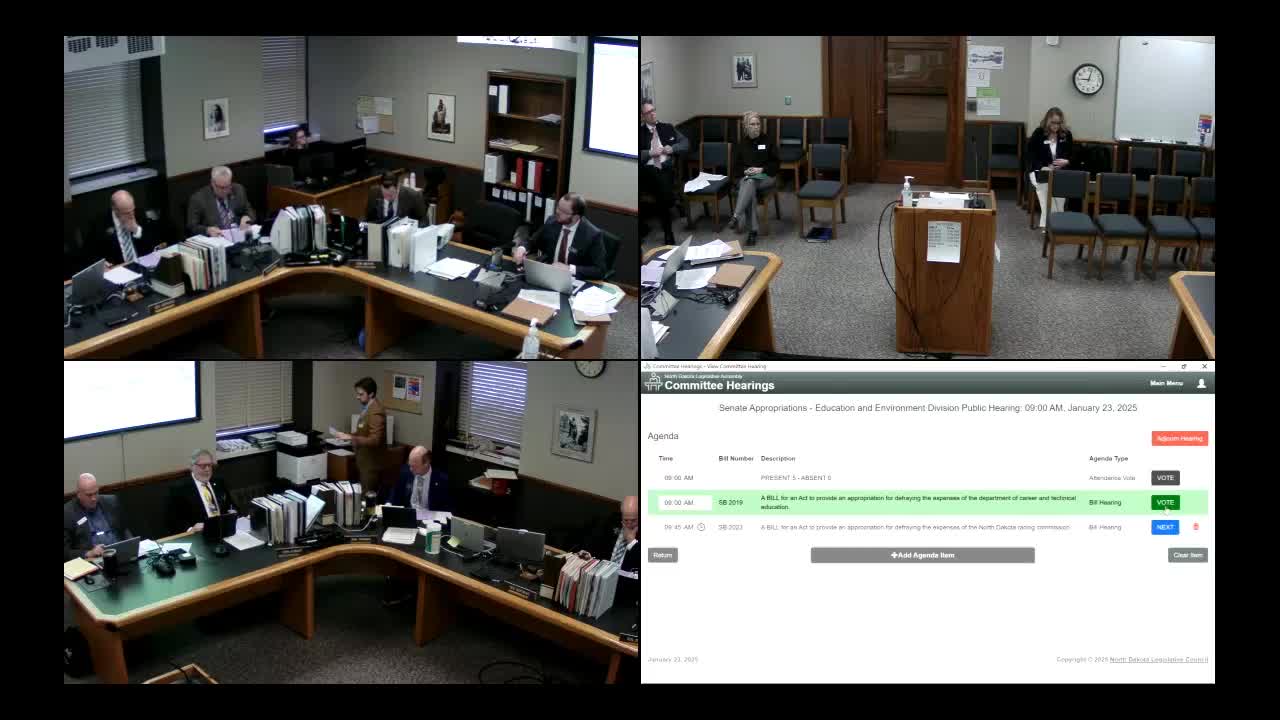
The Appropriations - Education and Environment Division on the floor reviewed the Department of Career and Technical Education budget, focusing on salary and insurance increases, grants and capital shortfalls and a bill (Senate Bill 2274) that would transfer the farm management program to the Department of Agriculture.
The Appropriations - Education and Environment Division on the floor reviewed the Department of Career and Technical Education budget, focusing on salary and insurance increases, grants and capital shortfalls and a bill (Senate Bill 2274) that would transfer the farm management program to the Department of Agriculture.
Budget staff member Alex, delivering the agency’s “purple sheet” summary for the department, said the Armstrong recommendation largely mirrors the governor’s with minor salary adjustments and three main highlights: salary and health insurance cost increases; restoration of a new-and-vacant FTE pool; and new grant and program funding. Alex identified specific additions: $2.5 million in federal funds for CTE grants; $4 million from the general fund to continue CTE reimbursement rates for schools and area career and technical centers; $3 million from the general fund for new and expanding secondary CTE programs; $500,000 added from the general fund for work-based learning coordinator grants, bringing that program to $2 million total; and $100,000 added to the Marketplace for Kids program, for a $400,000 total from the general fund.
Wade, State Director for the Department of Career and Technical Education, told the subcommittee he is tracking Senate Bill 2274, which would move administration of the farm management program from CareerTech to the Agriculture Commissioner and provide $1.9 million, largely for grants. "My understanding is that [the $1.9 million] would remain as 100% grants going out to the programs," Wade said, adding that the department currently budgets about $1.7 million for the program and that the Agriculture Commissioner intends to absorb administrative duties into existing staff.
Committee members pressed for details on how the department selects and funds new CTE programs. Wade described a process in which high schools and area CTE centers apply, provide budgets and alignment with the state’s in-demand job list, and then seek state board approval. He said requests for program starts and expansions are diverse—manufacturing, health care, IT, building trades and others—and that new centers opening in Grand Forks and Fargo (and possible projects in Bismarck/central region) are driving growth.
Members also reviewed capital projects for CTE centers that reported budget shortfalls tied largely to inflation and supply-chain delays since their 2021 applications. Examples provided to the subcommittee included a $5.5 million shortfall to complete interior work at a Grand Forks center, an $11.2 million Cass County request that can be phased (about $4 million to finish the site and shell), and other deficits such as $1.4 million for Bismarck Public Schools’ Silver Ranch interior completion and $3.6 million for Minot (which cut diesel tech and welding enlargements). Several centers cited greenhouse restorations and equipment as the items cut when projects were scaled down.
Committee members and department staff traced the shortfalls to the timeline: applications were drafted in late 2021, approved in early 2022, but federal coronavirus capital dollars did not arrive until June 2023. Rising construction and labor costs between application and execution left many projects underfunded. The subcommittee discussed the pot of federal coronavirus capital/ARPA-derived funds and a separate inflation allocation (about $26.5 million from SIF plus other authorities) used to address cost increases.
The committee did not take final action on the CTE budget. Members requested follow-up information: a detailed list of potential new programs and estimated costs, a list of CTE centers with their associated schools, and a breakdown of the Cass County phased project. The subcommittee scheduled continued committee work on the CTE budget for the following week to allow staff and program directors to provide the requested clarifications.
Context: remarks on budget highlights, the SB 2274 proposal, program-approval process and capital deficits were presented during the CTE budget portion of the Appropriations - Education and Environment Division meeting. No formal vote or appropriation was recorded during this meeting segment.