Get Full Government Meeting Transcripts, Videos, & Alerts Forever!
Get email alerts on the Clean Sustainable Energy Authority topic
No spam. Unsubscribe anytime.
Committee advances bill to add water director to Clean Sustainable Energy Authority advisory panel, funds loan and grant pools
Summary
The Senate Energy and Natural Resources Committee advanced Senate Bill 2188, which would add the Department of Water Resources director to the Clean Sustainable Energy Authority’s nonvoting technical advisory committee and authorize $30 million in grants and $100 million in additional loan capacity for the authority.
Senate Bill 2188, which would add the director of the Department of Water Resources to the Clean Sustainable Energy Authority’s nonvoting technical advisory committee and increase funding for the authority, moved forward from the Senate Energy and Natural Resources Committee on a unanimous committee vote after a clerical amendment.
The bill would add the department’s director as a technical adviser and provide $30 million for grants and $100 million for additional loans for the Clean Sustainable Energy Authority, the program the Legislature created to fund innovative energy projects by grants or loans. The bill passed a committee amendment to correct a numeric typo and then received a due-pass recommendation and referral to the Appropriations Committee.
The authority administers grant and loan awards designed to move research-stage energy ideas to commercialization. Kelvin Hullett, chief business development officer at the Bank of North Dakota, described the authority’s multi-step review: technical review by independent reviewers, financial underwriting by the bank, advisory review that includes state agencies, and final consideration by the authority before the Industrial Commission makes the ultimate funding decision. “It is probably one of the more extensive ones that we have for economic development projects in the state of North Dakota,” Hullett said.
Rhys Haas, director of the Department of Water Resources, testified in support of adding the department to the technical advisory committee. “Water, of course, is a critical resource for all of our industries in North Dakota,” Haas said, adding that water expertise helps evaluate projects where water use, cooling, processing or other operational water needs could determine viability.
Witnesses representing industry and resource interests urged continued funding. Ron Ness, president of the North Dakota Petroleum Council, said the authority helps “finish” large value‑added projects that otherwise stall in late-stage financing, noting projects using North Dakota natural gas and coal can require large, state-level financing commitments to reach final investment decisions. Jonathan Fortner of the Lignite Energy Council and other industry speakers cited Project Tundra and other large projects that have used the authority as examples of where state loan or grant support is leveraged with federal and private financing.
Bank of North Dakota materials shown at the hearing reported roughly $44 million in loans outstanding and a line-of-credit figure the bank described as available for additional commitments; the hearing record shows the committee approved an amendment correcting the bill’s numeric language so the loan increase reads $100,000,000. Committee co-chairs and witnesses emphasized that loan terms are typically low-interest (the statute provides a 2% loan rate) and relatively short (often 5–12 years) so the loan fund can revolve as projects repay.
Committee members repeatedly cited infrastructure concerns that can affect project viability. Committee discussion emphasized that adding the water director to the technical advisory committee is intended to surface infrastructure impacts—water pipelines, natural gas capacity, roads and other needs—early in reviews so those costs and dependencies are known before the authority makes a recommendation. Committee members also noted that some large projects previously committed to the authority, including a $250 million state loan commitment for Project Tundra, are still awaiting final investment decisions and federal policy certainty.
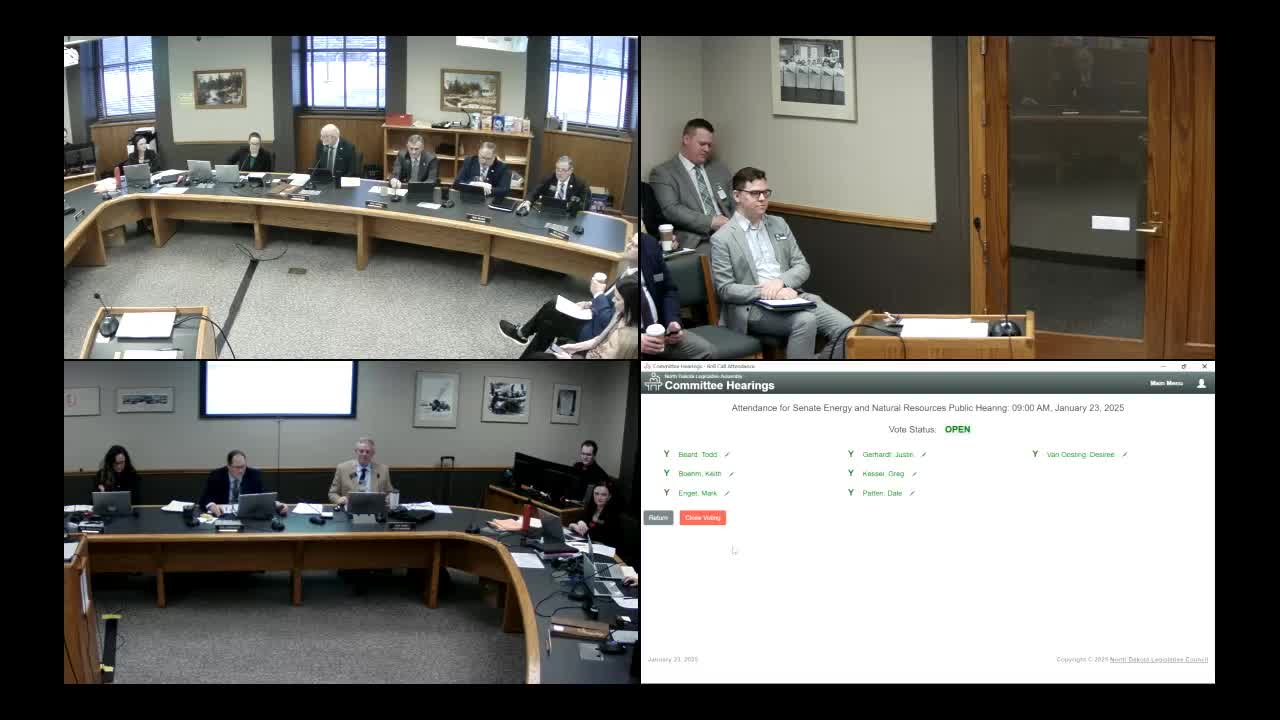
The committee adopted a clerical amendment to correct an extra zero in the bill’s funding line, then voted 7‑0 to recommend the bill for passage and referred it to Appropriations.
The bill’s next steps are consideration in the House Appropriations Committee if it reaches crossover. Supporters said the added water expertise and funding increase would help the authority better evaluate and scale projects that depend on water or other infrastructure; opponents did not appear at the hearing.
Votes at a glance: The committee approved a clerical amendment to correct the funding line (amendment passed 7‑0) and gave the bill a due-pass recommendation, 7‑0, with referral to Appropriations.