Get Full Government Meeting Transcripts, Videos, & Alerts Forever!
Get email alerts on the Accessible Safety Fencing topic
No spam. Unsubscribe anytime.
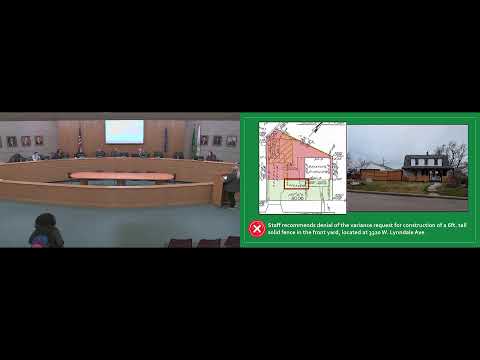
Zoning board denies variance for front-yard fence; tables ADA accommodation for family with elopement risk
Summary
The Zoning Board of Appeals denied a variance for a 4-foot solid front-yard fence at 68100 W. Edgerton Ave., then agreed to consider a reasonable-accommodation request tied to the homeowner's son with autism at next month’s meeting.
The Zoning Board of Appeals on Jan. 23 denied a variance request to install a 4-foot solid fence in the front yard at 68100 West Edgerton Avenue and tabled consideration of a separate reasonable-accommodation request tied to the homeowner’s son with autism until the board’s next meeting.
The board voted 4-0 to deny the variance, adopting staff’s recommendation that the applicant had not shown the “exceptional, extraordinary or unusual” property characteristics required to grant a variance. The board then moved the reasonable-accommodation discussion to the next meeting so the applicant can present an updated site plan and additional materials.
Staff told the board the Greenfield municipal code allows decorative front-yard fencing up to 3 feet tall and requires such fencing to be more than 75 percent open. The applicant’s request sought both an increase in height and a fully closed (solid) fence. Staff recommended denial because the lot did not have unique circumstances that would justify an exception to the code.
At the meeting, the homeowner described the request as a safety measure for her son, who she said turned 6 on the day of the meeting and “is a severe eloper.” The homeowner said therapy and alarms have not prevented repeated elopement; she said she tracked 12 escapes in a four-day period and that a state program and an unnamed contractor would cover the fence cost. The homeowner also said a nearby bar, mall and heavy traffic at the intersection increase the safety risk.
Neighbors offered mixed reactions. Thomas Anik, who said he lives immediately adjacent, told the board he has lived in the neighborhood more than 50 years and opposed additional fences that he said would create “hassles.” Dina Fleming, a resident across Edgerton, said she sympathized with the family but worried a solid fence at the sidewalk would hurt the residential character and could encourage similar requests.
Board members and staff discussed the alternative legal pathway for relief under the Americans with Disabilities Act: a reasonable accommodation that would be tied to the individuals living at the property rather than running with the land. Staff explained the legal difference: a variance runs with the property; an ADA-based reasonable accommodation does not and can be limited to the current residents and a duration the board chooses.
Several board members urged the applicant to work with staff on a revised plan that might preserve neighborhood visibility while providing more safety. Suggested compromises included setting the fence back from the lot line, using an open (picket) design to allow sight lines, adding decorative elements, or exploring a taller fence built to ADA guidance (some board members cited research suggesting 5 feet or more and no handholds for children at flight risk).
The board took two formal actions. First it voted to deny the variance request (4-0). Second, the board voted to table the reasonable-accommodation request to the next meeting and asked the applicant to return with a clearer site plan, any supporting documentation (for example assessments from therapists or local safety programs), and a depiction of proposed gates and driveway access. Board members suggested the applicant work with staff in the interim and to bring any documentation of outreach to city departments (police, DPW, fire) about traffic or safety measures.
The board did not adopt a final design or approve any construction. Staff said it would accept documentation and work with the applicant on options; the board encouraged the applicant to bring back detailed drawings that address sight lines at the driveway, gate operation, setback from the sidewalk, and whether the requested accommodation should be granted only while the child lives at the residence.