Get Full Government Meeting Transcripts, Videos, & Alerts Forever!
Get email alerts on the Drainage Legal Drain 11 topic
No spam. Unsubscribe anytime.
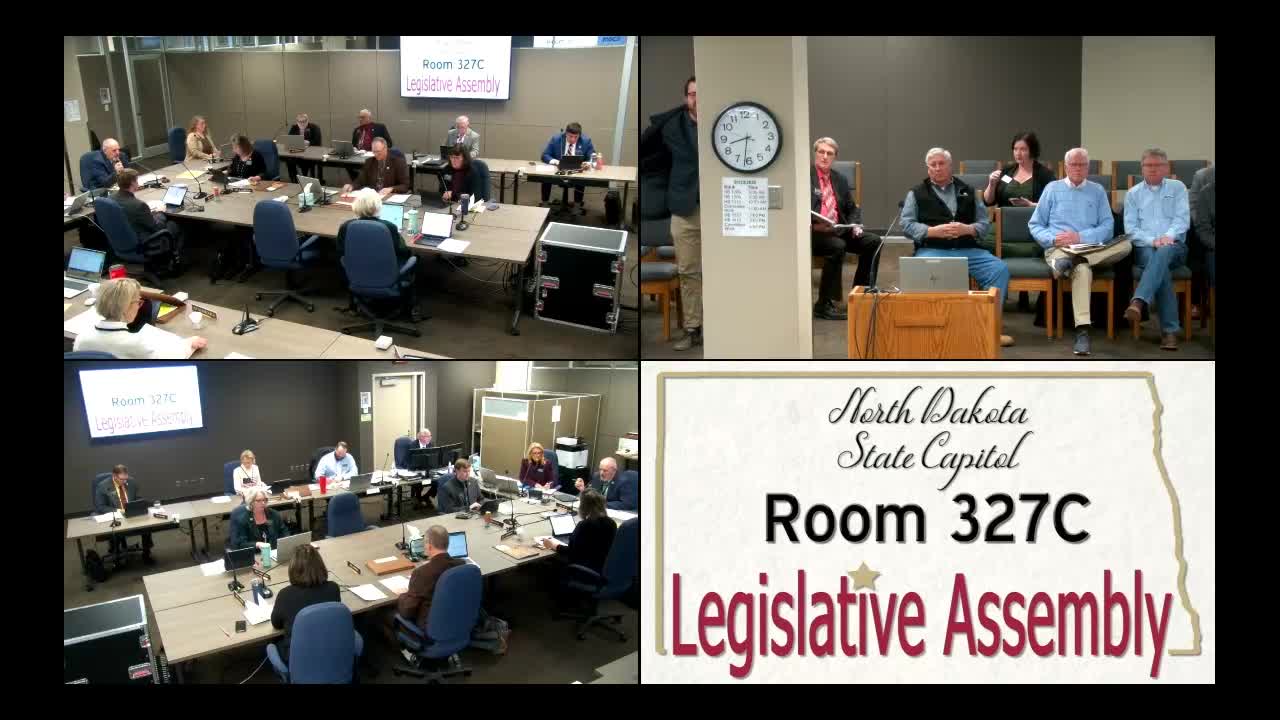
House Ag Committee hears Sargent County testimony on Legal Drain 11; bills would bar votes by landowners who don’t pay assessments
Summary
The House Agriculture Committee heard extended testimony on House Bills 1280 and 1396, both addressing maintenance of Legal Drain 11 after Sargent County officials said downstream flooding and crop losses followed larger culverts installed on Highway 13 in 2013.
The House Agriculture Committee took testimony on House Bill 1280 and House Bill 1396, both titled “relating to maintenance of drainage projects,” focusing on long‑running problems in Sargent County tied to Legal Drain 11 and disagreement with neighboring Ransom County over assessment and voting rights.
The bills would change how votes on maintenance projects affect landowners’ access to a legal drain: under the proposals, landowners who are assessed but fail to pay required maintenance fees could be barred from voting on measures obligating the district to finance work; a related provision in HB1396 would deny access to surface and subsurface drainage for five years to owners who vote against projects that proceed. Committee members heard detailed local testimony about how a 2013 upgrade of culverts at Highway 13 altered downstream flows and contributed to prolonged flooding and lost cropland in Sargent County.
Why it matters: Sargent County officials and landowners said Legal Drain 11 is a century‑old system that now faces maintenance and legal obstacles that have stopped long‑planned repair work. Witnesses warned the cost of litigation and stalled projects is already large and could grow: they cited $833,000 in legal fees and estimated full reconstruction at $30–35 million. Committee members repeatedly asked how voting and assessment rules applied across county lines and whether the bills would create forced obligations for landowners.
Representative Mike Brandenburg, who introduced the bills, described the local situation to the committee and urged action. He said county and water board efforts to persuade Ransom County to join the watershed or pay a share of the maintenance have repeatedly failed. "I support watershed districts," Brandenburg told the committee, noting that the problem was magnified after Highway 13 work in 2013 installed larger culverts that changed flows into Sargent County.
Sargent County water board members and farmers gave multiple on‑the‑record examples of the drain’s condition and the political dispute. Michael Wyom, a member of the Sargent County Water Board, told the committee that Ransom County was not assessed when the drain was originally built and refused the first reassessment bills after a more recent reassessment. Lucas Chimenowski and Todd Stein, both with the Sargent County water board, described tile drainage and surface drainage that now enter Legal Drain 11 even as some landowners oppose paying assessments.
Supporters said the bills are meant to protect local taxpayers and to move stalled maintenance projects forward. Opponents —including landowners who have voted against projects and some commenters online—argued the bills would effectively penalize voters for their ballot choices and create an unfair coercive link between voting and use of drainage infrastructure.
Committee members asked for clarifications on technical and legal points: how votes are apportioned by acreage and proximity; why some landowners in Ransom County are not being billed; the legal consequences of reassessments; and the ability of watershed districts and county commissioners to pursue joint powers agreements. Witnesses and lawmakers discussed practical fixes raised in testimony, including gated culverts and phased construction, but several said those approaches would face resistance from the Department of Transportation or would need significant state funding.
The committee did not take a final recorded vote on HB1280 or HB1396 during the hearing; both bills received extended testimony and were left in committee pending possible amendment or future action.
Ending: Committee members and witnesses agreed the underlying problem—cross‑county drainage that benefits landowners who do not share maintenance costs—raises questions about statutory authority, practical remedies, and the precedent set by the recent court ruling requiring a vote before work can begin. Several speakers urged local negotiation before more litigation, while others said legislative clarity was required to prevent similar disputes across other legal drains in the state.