Get Full Government Meeting Transcripts, Videos, & Alerts Forever!
Get email alerts on the Doj Settlement And Mfp topic
No spam. Unsubscribe anytime.
Department details DOJ settlement benchmarks, Money Follows a Person transitions and rental‑assistance request
Summary
Adult and Aging Services described obligations under a December 2020 settlement with the U.S. Department of Justice requiring outreach, diversion and transition work and set out benchmarks that drive requests for state rental assistance and transition funding to meet Olmstead‑related goals.
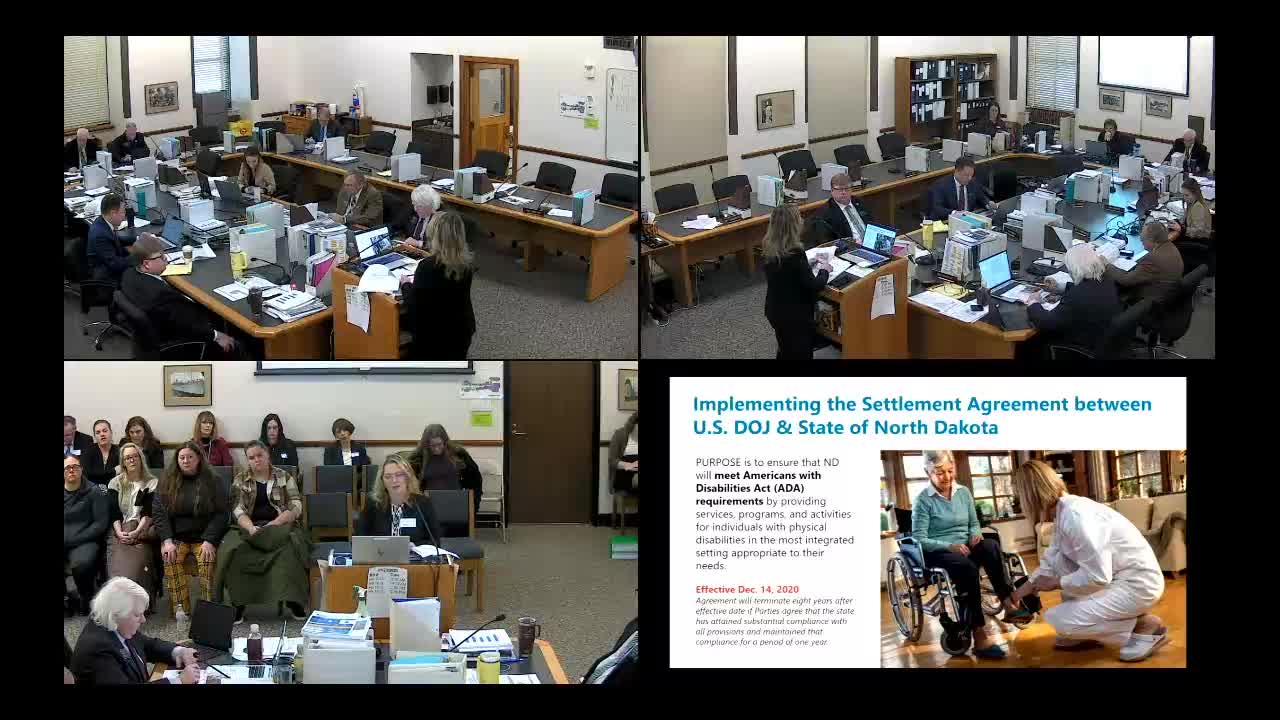
Nancy Nicholas Meyer, director of Adult and Aging Services, told the House Human Resources Appropriations panel that North Dakota entered a settlement agreement with the U.S. Department of Justice on Dec. 14, 2020, to address alleged over‑reliance on institutional long‑term care and to expand community alternatives.
Meyer said the settlement implements Olmstead principles under the Americans with Disabilities Act and requires the state to expand options and help people move to the most integrated setting consistent with their preferences. "On December 14, 2020, North Dakota entered into a settlement agreement with the US Department of Justice," Meyer told the committee.
Why it matters: The agreement sets multi‑year benchmarks for diversions and transitions that the department must meet or demonstrate substantial compliance with. The department told lawmakers it needs continued or new state funds for rental assistance and transition/diversion supports because federal COVID‑era relief that supported some activities is ending.
Program details and metrics Meyer gave to lawmakers: - Money Follows a Person (MFP): federal grant program used to assist people to move from institutional settings to community living; North Dakota reported supporting 1,040 transitions since 2007, with 38% of those in the past four years. - Diversions and transitions: In recent years the department reported increased diversions (people kept out of institutional placement) and transitions (people moved from institutions to the community). Meyer said in 2024 there were 261 diversions and 73 transitions using transition/diversion supports. - Benchmarks: Settlement benchmarks increase over time; later years require larger percentages (e.g., department materials cited targets that rise toward 70–85% of TPMs (target population members) who request transition). Meyer said the settlement sets an aggregate multi‑year target and that year‑by‑year benchmarks are part of the agreement.
Meyer described primary barriers to transitions as shortage of accessible, affordable housing and supports. She told the committee that a state rental‑assistance fund helped earlier cohorts and the department requests continuing state funds to fill gaps while clients await federal vouchers. "It is our number 1 issue," Meyer said of housing availability.
Budget requests tied to settlement work discussed in the hearing: - $300,000 general fund request for state rental assistance to support transitions and meet settlement benchmarks (the department said carryover funds from previous appropriations are now expended), - A $5.2 million package in total funds (roughly $2.7M general fund and $2.5M federal match) to continue transition/diversion supports learned during the MFP and settlement implementation, - The department said it is meeting earlier targets (reported meeting a 60% target and achieving 64% for a stated benchmark year) but future years’ targets are more aggressive.
Discussion and next steps: Committee members asked whether failure to meet benchmarks would trigger penalties; Meyer said the settlement calls for evaluation of substantial compliance and ongoing negotiation with the DOJ, and the department meets periodically with DOJ staff. Committee members pressed for clarity about timing, and the department said it will continue to report progress and stressed the dependency on affordable housing and rental assistance to achieve further transitions.
Ending: Meyer urged the committee to view the requested state rental assistance as a practical tool to help meet settlement obligations and to give consumers more community options rather than rely on institutional care.