Get Full Government Meeting Transcripts, Videos, & Alerts Forever!
Get email alerts on the Zoning Funeral Services topic
No spam. Unsubscribe anytime.
Papillion council narrows rules for crematoriums, approves amended funeral-services ordinance after contentious debate
Summary
The Papillion City Council voted 5-2 on Jan. 21, 2025, to amend proposed changes to local funeral-service zoning rules, including where funeral homes with crematoriums may locate and buffer requirements; the amendment loosens some restrictions that opponents said would have effectively blocked crematoriums from locating in the city.
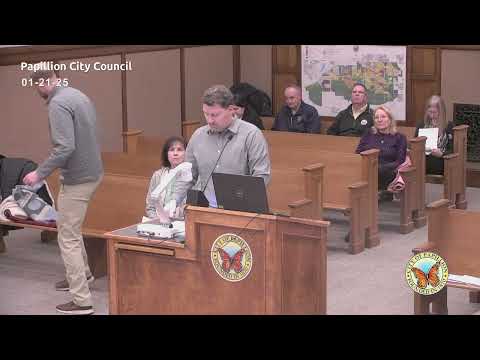
The Papillion City Council on Jan. 21, 2025, voted 5-2 to amend Ordinance No. 2036, a proposed change to the city's funeral-services zoning rules that had drawn public opposition and council debate over crematorium siting and potential health impacts.
The amendment, moved by Councilman Mungard and seconded by Councilman Stubbe, changes terminology in the code to distinguish a "funeral home without a crematorium" and a "funeral home with a crematorium," removes the historic use of the term "mortuary," modifies where funeral homes with crematoriums may be allowed by right versus by special use permit, and changes buffer-yard provisions that would have included parking lots in setback calculations.
Supporters of the amendment said the original proposal was excessively restrictive and risked preventing needed local services. "The original ordinance as introduced is far too severe and it's likely to make it too expensive and difficult for funeral homes with crematoriums to locate [in] Papillion in the future," Councilman Mungard said, arguing the stricter siting rules would effectively "shut down Papillion for any combination funeral home crematorium." He said the amendment preserves the city's ability to regulate locations while avoiding what he called unnecessary barriers to business.
Opponents and concerned council members cited public-health questions raised during prior hearings. Councilman Gaines highlighted concerns about mercury emissions and said limited studies have shown high mercury levels near some crematoriums, particularly noting risks to pregnant women. Councilman Gaines said he supported retaining stricter language to protect nearby residents.
Councilman Sunday urged the council to heed residents who had attended prior meetings to voice health and quality-of-life concerns. "I think we should pay more respect to a large citizen group that takes the time out of their busy schedules to come up here and voice their opinions on something that's going to affect their life and potentially their health," Sunday said, and questioned the rationale for allowing crematoriums near residential areas when industrial locations exist.
City staff and the ordinance drafters said the draft mirrored recommendations from planning and public-safety reviews; the amendment narrowed some requirements, such as excluding parking lots from the 1,000-foot buffer measurement and making certain locations subject to special-use review rather than an absolute prohibition.
On the motion to amend Ordinance 2036, the council voted 5 in favor and 2 opposed (Sunday and Gaines). After brief further discussion, the council approved the ordinance as amended by a 5-2 vote.
The ordinance text discussed at the meeting includes references to revisions to Article 3 use tables and specific code sections governing commercial and industrial zoning and funeral-service uses; the printed red-line amendment was available on the posted agenda.
The council record shows the vote tally on the amendment and the final passage but does not record any immediate implementation steps or an effective date beyond the ordinance numbering and posting; any future special-use applications under the amended rules would be subject to public hearings and conditional approval procedures.
Ending: The ordinance change resolves a months-long local debate over crematorium siting by loosening some restrictions while preserving council oversight for certain locations; opponents said they remain concerned about potential emissions and will likely monitor any future permit requests.