Get Full Government Meeting Transcripts, Videos, & Alerts Forever!
Get email alerts on the Impact Fees topic
No spam. Unsubscribe anytime.
San Luis council reviews draft impact fee increase for fire, parks, police, streets, water and wastewater
Summary
Consultant Benjamin Griffin presented a draft 10-year impact fee update that would raise per-unit fees across nonutility categories and utilities; council members and staff discussed comparisons with neighboring cities, revenue limits and the effect on housing costs.
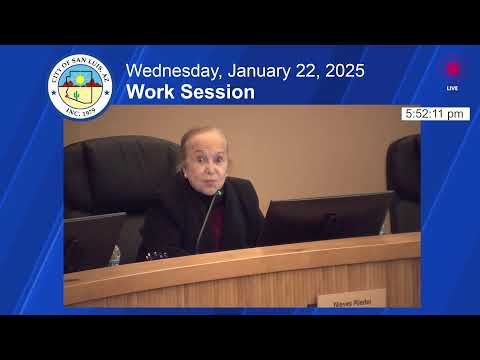
San Luis City Council members heard a presentation on a proposed update to the city’s impact fees at a March work session, with consultant Benjamin Griffin of Tischler Bice walking council through the land use assumptions, infrastructure improvements plan and draft fee schedules that cover fire, parks, police, streets, water and wastewater.
Griffin, identified himself as a senior fiscal economic analyst with Tischler Bice, and said the study uses a mix of incremental and plan-based methodologies to allocate costs tied to projected 10-year growth. He told the council the update would raise nonutility fees for a typical single-family home from about $38,100 under the current schedule to about $63,100 under the draft, and that the combined proposed fee (including water and sewer) for a single-family 3/4-inch meter would be roughly $91,000. Griffin said higher construction and equipment costs since the city’s 2019 study are the main drivers of the increases and noted timing requirements under Arizona law that constrain how and when fees can be adopted and spent.
The consultant said the study’s base year is 2024 and presented the draft land use assumptions and 10-year growth projections the team used to calculate demand. He described the fee components and key findings: fire fees reflect an increased level of service and much higher construction and apparatus costs since 2019, producing a proposed increase for the single-family fire component from about $562 to $1,470 per unit; parks proposed fees rise because of higher planned community-park acreage and amenity costs; police fees increase largely because of higher vehicle and facility costs; streets incorporate a new intersection component; and water and wastewater use a plan-based approach that builds excess capacity upfront, with anticipated credits from rate revenue and ARPA funds reducing net impacts on development.
Why it matters: the update would shift the cost of new capital infrastructure to new development — impact fees are one-time charges typically collected at building permit — and the draft schedule would noticeably raise the per-unit fee charged to future homeowners and developers. Griffin framed the increases as a response to higher construction and equipment prices and to the city’s increased level of service since the prior study; he also highlighted statutory constraints in Arizona, including a 10-year spending window for collected fees and limits on what kinds of facilities can be funded through impact fees.
Council members and staff asked questions about how San Luis’s proposed fees compare to neighboring jurisdictions, how credits and existing revenue (including planned ARPA funding and rate revenue) were applied, and how fee increases would affect housing costs. Jenny Torres, a city staff member, summarized the policy point raised several times in the discussion: “What the impact fees is doing is development is paying for the growth.” Vice Mayor Tadeo Saild de la Hoya said the increases are large but reflected a “need” for new infrastructure tied to growth. Mayor Nieves Bridal and other council members pressed staff and the consultant on comparative context (noting Yuma and Somerton are also updating or recently updated fees) and on how to explain the changes to residents.
Griffin walked through sector-level details included in the draft study and presentation slides: estimated additional square feet of fire and police facilities, number of additional apparatus and vehicles, acreage and amenity needs for parks, 10-year lane-mile and intersection projections for streets, and estimated max-day and average-day demands for water and wastewater tied to proposed treatment, storage and treatment-plant projects. He said some utility components use a plan-based method because it is more economical to build water and sewer capacity with excess capacity; those projects assume some cost-sharing through rate revenue and federal ARPA funds, which reduce the net fee burden on development compared with gross construction costs.
No formal action was taken on the draft impact fee schedules at the meeting. Griffin outlined the next steps and a tentative schedule: advertising the land use assumptions and infrastructure improvements plan (already advertised), a public hearing for those documents scheduled for March 19, an anticipated adoption window 30–60 days after the hearing (Griffin cited an April 23 possible adoption date for those documents), advertising development fees on April 28, a public hearing on May 28, anticipated adoption around July 9, and a statutory 75-day waiting period before fees could take effect (tentative effective date cited as September 22 if all deadlines are met).
The meeting included discussion of local revenue context. Several council members and staff noted San Luis’s revenue structure (reliance on sales tax and other nonproperty-tax revenues) and that the city lacks a property tax that larger neighbors use to spread capital costs, which influences how much development must contribute via impact fees. Council members asked staff to consider public messaging about the increases because the draft raises per-unit fees substantially in some categories.
The session closed with routine adjournment; council members did not vote on the impact fee update at the meeting and were expected to consider the advertised documents and hold public hearings before any formal adoption.
Ending: The consultant remained available for follow-up questions and council and staff signaled that the city will proceed through the advertised hearings and the adoption timeline Griffin outlined if council directs staff to move forward.