Get Full Government Meeting Transcripts, Videos, & Alerts Forever!
Get email alerts on the Winter Parking Ban topic
No spam. Unsubscribe anytime.
Watertown council hears hours of testimony on petition to limit winter overnight parking ban
Summary
A citizen petition to amend Watertown’s winter overnight parking ban—so it is enforced only during predicted significant snow or ice events—brought more than two hours of public testimony and a lengthy council discussion but no ordinance change. City officials urged a deliberate study and broader planning before any policy shift.
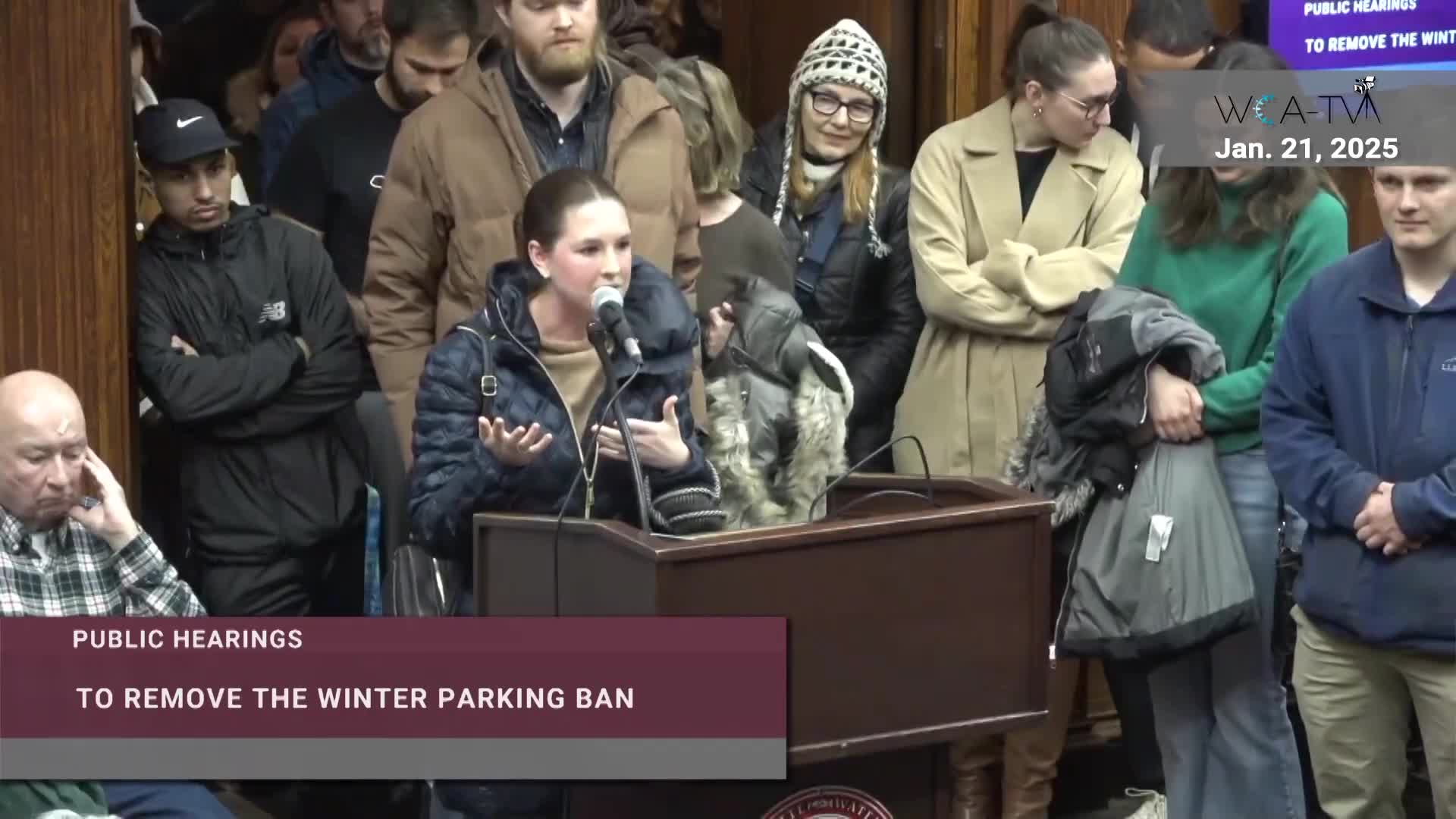
The Watertown City Council held a special public hearing on a citizen petition to amend the city’s winter overnight parking ban, drawing more than two hours of testimony from residents who described competing concerns about safety, equity and accessibility.
The petition, submitted to the council, asks the city to change Title 7, Chapter 73, Article 5 (sections 73‑505 and 73‑511) so the ban takes effect only when a significant snow or ice storm is forecast or when there is a significant accumulation of snow or ice. The council did not vote to change the ordinance at the meeting; instead members closed the hearing, heard remarks from city public‑safety and public‑works officials, and directed staff to study the issue further in the context of the city’s existing planning work.
Why it matters: Residents who lack off‑street parking said the year‑long enforcement imposes financial, safety and mobility burdens on renters, parents with young children, people with disabilities and overnight shift workers. Opponents of repeal warned that removing the ban would impede snow removal and emergency access, and could increase pavement and private driveway paving that harms stormwater and green space.
Residents’ testimony
Speakers who favor amending or repealing the ban described everyday hardships. Janice Provencher, who said she collected neighborhood signatures, told the council: “I support to maintain this existing winter parking ban,” and then explained she collected signatures because many neighbors want change so residents are not forced to park far from home. (See speaker list for full citation.)
Lori Gregorio, who identified herself as living with a neurological disability, asked councilors to “consider people with disabilities, the elderly, and families with young children who are disproportionately burdened by the winter parking ban,” saying the rule can force some residents to walk blocks on icy sidewalks at night. Other speakers described long walks to municipal lots, paying neighbors for driveway space, difficulty hosting guests and environmental effects when yards are paved for extra parking.
Opponents of changing the ban emphasized public‑safety and operational concerns. Russell Rigo and other speakers asked the council to maintain the ban to keep roadways clear for plows and emergency vehicles. Several residents urged improvements to enforcement and to notification systems rather than ending the ban entirely.
Administration and public‑safety response
City Manager George Proakis urged caution and recommended a deliberative process. “If we simply lift the ban, that would result in more more cars being in the city,” he told the council, noting interactions with housing affordability and parking requirements in city planning.
Sergeant David Sampson of the Watertown Police Department explained how the current rule is written and enforced: “It is on the books for 12 months per year,” and the ordinance sets a one‑hour limit between 1 a.m. and 6 a.m.; in practice the city enforces stricter restrictions during the winter months and by public notice during declared snow emergencies. He warned that notification systems do not reach every household and that towing and enforcement capacity is limited.
Fire Chief Ryan Nicholson said the department supports policies that ensure reliable emergency access and characterized the existing ban as “consistent and effective in what it accomplishes.” Ed Batista, highway supervisor for the Department of Public Works, said crews can clear streets curb‑to‑curb only when cars are removed and warned that large storms would overwhelm plowing if vehicles remain on narrow streets.
Council reaction and next steps
Councilors thanked residents for turnout and testimony and repeatedly described the issue as complex. Several members noted the petition raises questions the city’s adopted Comprehensive Plan already scheduled for study: the plan directs staff to evaluate on‑street winter parking in the midterm implementation window.
Councilor Anthony Piccherelli summarized a frequently heard tradeoff: “There’s no such thing as free parking. Parking costs and the question is, how much do we wanna pay to implement some of these things.” Multiple councilors said they would not support an immediate ordinance change without a formal study and broader public engagement that considers enforcement resources, parking permits, curb use and transit options.
No ordinance change was adopted. The council closed the public hearing, asked the administration and relevant departments to study the petition’s proposal in the larger context of the comprehensive and climate plans and the ongoing transit/parking work, and then adjourned the special meeting by voice vote.
What remained unresolved
Residents and officials proposed a range of interim and long‑term options that the council did not decide at the hearing, including: activating the ban only during declared snow emergencies; a pilot program of alternate‑side or one‑side overnight parking on narrow streets; expanded resident permit programs with limits on permits per address; improved Everbridge/notification use and enforcement; and negotiated shared use of large private parking facilities on defined schedules. Councilors and staff agreed these options require further analysis.
Ending note
Councilors said they will report back to the public with a timeline and recommended study scope; no changes to the winter overnight parking ordinance will take effect for the remainder of the current season based on this meeting.