Get Full Government Meeting Transcripts, Videos, & Alerts Forever!
Get email alerts on the Infrastructure Jail topic
No spam. Unsubscribe anytime.
Owen County narrows jail project financing options; municipal advisor to run numbers by Feb. 6
Summary
County leaders said a jail project would be sized to fit existing correctional-facility tax receipts, accumulated reserves and conservative financing assumptions; municipal advisor Jeff Peters will return with detailed financing scenarios by the Feb. 6 meeting.
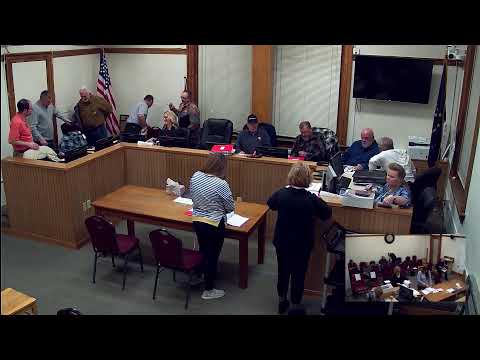
Owen County officials reviewed financing options for a proposed new jail during a joint meeting with the county council on Jan. 23, with municipal-advisory consultant Jeff Peters advising the county to size any project to the county’s existing revenue capacity.
County officials said the county’s correctional-facility local income tax — a long-term levy they described as a 22-year revenue stream — plus roughly $3.0 million in accumulated cash would form the principal repayment capacity for a bond or loan. County fiscal staff presented an illustrative annual budget capacity of about $1,315,567 for the first 17 years of debt service; officials emphasized the need to be cautious about assuming future income-tax growth and said any projections should be conservative.
Peters and county staff explained financing constraints that will affect the project size and structure: typical municipal market buyers expect 125% debt-service coverage when income tax is pledged as security, which reduces the effective amount the county can pledge. One option discussed would be to pledge property tax as a backup to permit the county to more fully use its income-tax receipts; Peters warned that publicly telling taxpayers property tax could be used in the worst case requires careful messaging. The group also discussed USDA-backed loans, the Indiana Bond Bank and lease/lease-rental structures using a building corporation for debt beyond statutory limits.
Officials also discussed capitalized interest during construction and the possibility of using proceeds and existing reserves as working capital; the county has about $3.3 million expected in the jail fund in the near term after a $300,000 earmark is added. The county and Peters noted the potential value of selling the current jail site after a property swap and earmarking proceeds for maintenance or debt retirement.
Peters agreed to run financing scenarios under the county’s stated constraint to avoid increasing tax rates, using a 17-year debt horizon and conservative static revenue assumptions. He said he could return with modeling by the commissioners’ Feb. 6 meeting; the county also asked Peters to serve as municipal advisor and to be paid from project funds if the project proceeds.
No binding financing decision was made at the meeting; commissioners and the council reiterated they do not seek a tax rate increase and want any project to fit the county’s current revenue capacity.