Get Full Government Meeting Transcripts, Videos, & Alerts Forever!
Get email alerts on the Building Emissions Ordinance topic
No spam. Unsubscribe anytime.
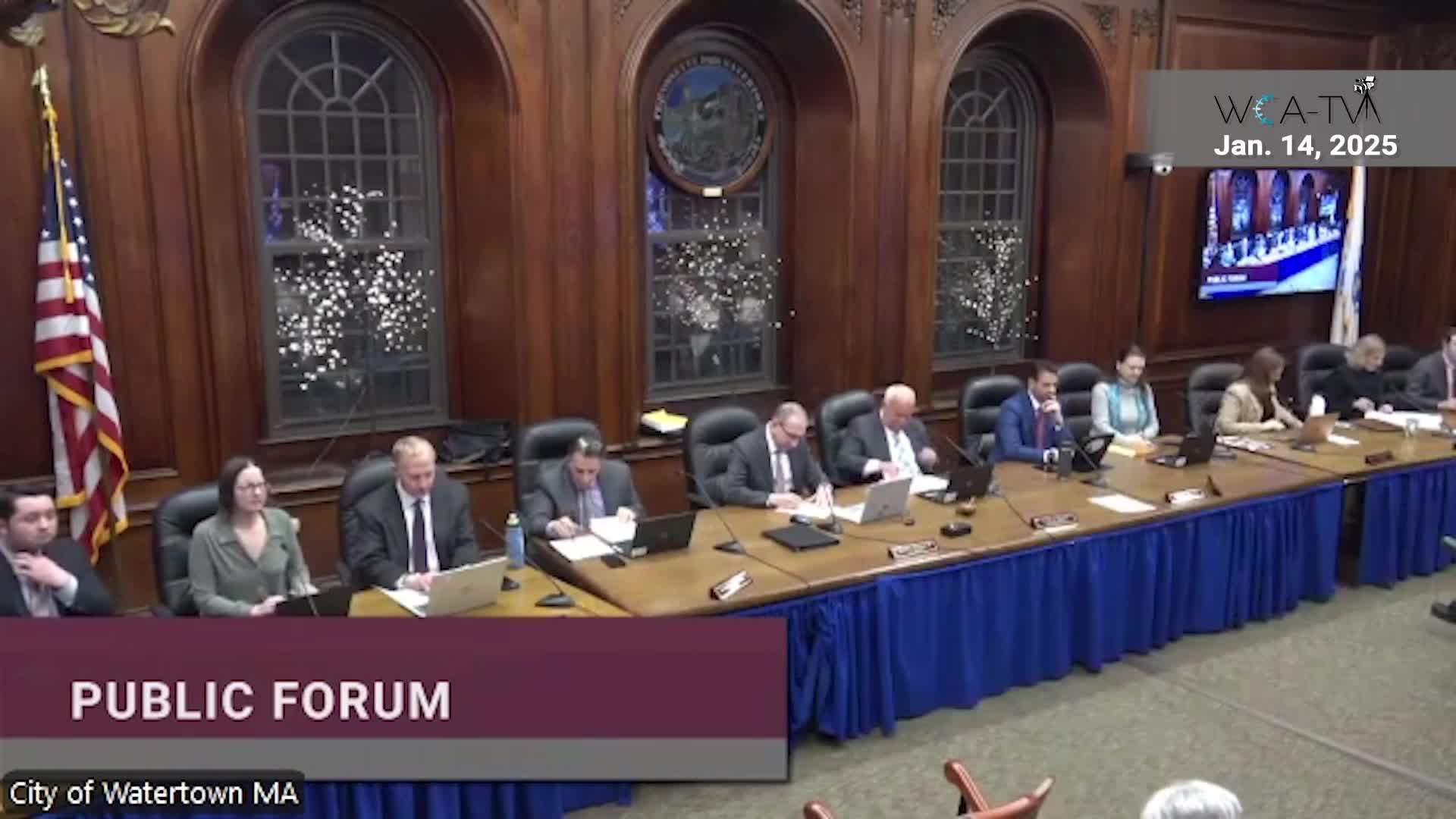
Watertown Council refers building emissions ordinance to committee after public support
Summary
Watertown City Council on Monday referred a proposed Building Emissions Reduction and Disclosure ordinance — commonly called the "Berto" — to the Rules & Ordinances Committee for further review.
Watertown City Council on Monday referred a proposed Building Emissions Reduction and Disclosure ordinance — commonly called the "Berto" in meeting materials — to the Rules & Ordinances Committee for discussion and drafting of implementing regulations.
The Berto would require a defined set of large buildings in Watertown to report and reduce greenhouse gas emissions over a timetable that includes baseline reporting in 2025–2026 and reduction targets for some buildings by 2035 and for all covered and municipal properties by 2050. City Manager George Proakis told the council the ordinance focuses on the relatively small number of large buildings that produce a disproportionate share of local emissions and that roughly 150 buildings would be affected; about 22 of those are city-owned.
Supporters who helped draft the ordinance urged the council to move quickly while the city manager cautioned that implementing the program will require dedicated staff time. "It's been a long time in process and I'm not gonna speak too long about it...I hope that we move expeditiously with it," said Brian Heyweissen, who identified himself as chair of the working group that assisted staff in drafting the ordinance. Resident Jocelyn Tager, who participated in the volunteer drafting process, described the working group's months of line-by-line review and technical consultation with city staff. Pat Rathbone, another volunteer, urged the council to carefully define the proposed Review Board so knowledgeable members interpret and apply the ordinance consistently.
Proakis said the ordinance and companion regulations are modeled on practices adopted by other Massachusetts communities and are intended to align with the city's 2022 Climate and Energy Plan. "The Berto essentially focuses on...about 150 or so buildings," Proakis said, adding the city owns about 22 of those properties. He said the city will seek to avoid duplicative regulatory language and that the companion regulation document provides operational detail for the Berto Review Board and other procedures.
Proakis asked the council to move the ordinance to committee promptly so the city can meet the reporting and reduction timelines. "There are time frame dates in here, in order to hit goals, to have certain buildings be net zero by 2035, and all covered properties and municipal properties by 2050," he said. He also told the council that administering the program at scale will require at least one dedicated staff position to manage reporting and compliance.
The council made a motion to refer the ordinance to the Rules & Ordinances Committee; the motion was seconded and the council then approved the referral. The manager said a final draft of the companion regulations would be provided to the committee ahead of its meetings.
The referral begins a multi-step review process that the ordinance's drafters and city staff say is necessary to meet the city's climate goals while providing waiver and review procedures for uniquely challenging buildings, such as ice rinks and other high-energy municipal facilities.