Get Full Government Meeting Transcripts, Videos, & Alerts Forever!
Get email alerts on the Energy Irp topic
No spam. Unsubscribe anytime.
Mesa presents integrated resource plan update, highlights solar-plus-battery projects and microgrid grant bid
Summary
City staff told the City Council the updated Integrated Resource Plan (IRP) emphasizes new renewable purchases, planned battery storage, potential local pilot sites and a pending state resiliency grant that could fund a microgrid to support critical facilities.
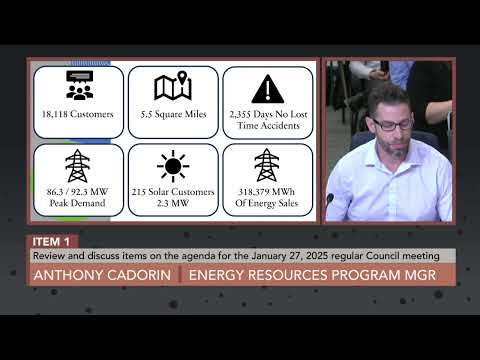
City of Mesa Energy & Sustainability Director Scott Boucher and Energy Resources Program Manager Tony Cadorn briefed the City Council on the city’s Integrated Resource Plan (IRP), outlining recent additions to the utility portfolio and options for local resilience projects.
The IRP is a recurring planning requirement tied to Mesa’s receipt of federal hydroelectric power and is used to set a framework — not a fixed procurement plan — for how the utility evaluates future resources, Scott Boucher said. “We do receive hydroelectric power, and as part of the requirement of receiving that power, we must complete an integrated resource plan,” Boucher said.
The update highlighted three near-term items: a firm renewable energy delivery agreement with Salt River Project (SRP) that will provide 16 megawatts of renewable energy; a previously approved EPCO solar project that pairs utility-scale solar with batteries; and the city’s pursuit of battery-storage pilots and a microgrid for resiliency. “We executed the SRP ... for 16 megawatts of renewable energy that SRP delivers to us on a firm basis,” Cadorn said. Cadorn described the broader shift in regional generation: “Prior to 2021, there was under a thousand megawatts of battery; now there’s over 14,000 megawatts,” underscoring why batteries figure prominently in planning.
Council members pressed staff on costs, local siting and resiliency. Cadorn said Mesa currently has no large, utility-scale batteries in service but that the EPCO project (previously approved) would add 20 megawatts of battery storage paired with 25 megawatts of solar. He also noted several vacant substation sites inside Mesa that could host local storage pilots. On microgrid options for critical facilities, staff said they have submitted an application to the Arizona Resiliency Office for federal funds passed through the state; if awarded, those funds would materially change the project economics and allow the city to move forward. “We submitted a grant application with the state of Arizona and the resiliency office specifically,” staff said; the application’s funds are federal dollars funneled through the state, the presentation noted.
Staff described relative cost positions across resources: hydropower currently appears least expensive on a per-megawatt-hour basis, followed by the EPCO solar with federal funding and the SRP purchase; market power contracts were described as more expensive in recent years. Cadorn added that solar paired with batteries is often competitive with other resources but that battery capacity carries reservation-style charges that differ from energy-only solar payments.
No formal council vote was recorded during the presentation. Staff said they will return with additional analyses and, if applicable, follow-up materials once grant decisions are known.
Why it matters: the IRP frames how Mesa will balance cost, reliability and sustainability in a region that has seen rapid retirements of large fossil generators, rising battery deployments and shifting market prices. Pending federal funding decisions could change the city’s near-term procurement pathway and the feasibility of local resiliency projects.
Staff said next steps include tracking the state resiliency-office grant decision, advancing the EPCO project work, continuing public outreach associated with the IRP and studying local pilot options for battery storage and microgrid installations.