Get Full Government Meeting Transcripts, Videos, & Alerts Forever!
Get email alerts on the Parks And Recreation topic
No spam. Unsubscribe anytime.
Rec and Parks outlines $15.2 million programmed for FY2026 and warns limited funds will slow playground and court renovations
Summary
The Department of Recreation and Parks presented its proposed FY2026 capital program, described revenue sources and project categories, and highlighted completed and underway projects including a skate park and Sparrows Point Park development.
The Department of Recreation and Parks presented its proposed FY2026 Capital Improvement Program to the Planning Board subcommittee, reporting $15,200,000 programmed for parks, preservation and greenways and describing how that total is sourced and allocated across project categories.
Bob Smith, director of the Department of Recreation and Parks, said the $15.2 million is allocated across seven capital project categories and five revenue sources: county bonds, Maryland Program Open Space (POS), local open space (LOS) waiver fee in‑lieu revenues, donations, and other. "It's important to note that the only revenue type whose amount is certain is the $8,000,000 in bonds having been approved by the voters during the 2025 general elections or 2024 general elections," Smith said.
Why it matters: limited POS and waiver fee receipts mean planned work will be constrained. Smith noted POS allocations have fluctuated; FY23 and FY24 allocations were substantially higher (about $11.1M and $12.2M), while FY25 dipped to about $4.4M. The department programmed $6,000,000 in POS for FY2026 but said final spending will be adjusted when the State of Maryland announces allocations.
Project highlights and figures: Program P301 (recreation facility renovations) is programmed at $3,300,000 for FY2026 and funds playground replacements, sports court renovations and similar work. Smith said "approximately 35 sites" had playgrounds replaced since the start of FY24 at a cost of about $6,700,000, with roughly 31 playground replacements underway and about 70 playgrounds remaining as of December 2024. Bonds of $600,000 programmed for playground replacements would likely fund only three to four playgrounds, he said.
P302 (athletic field construction/renovation) is programmed at $2,300,000 (including $1,800,000 in bonds). P307 (community and neighborhood park development) is programmed at $4,600,000. Other project allocations include P309 (greenways, streams, valleys and trails) at $1,200,000; P601 (park acquisition) at $3,200,000; and P755 (accessibility) at $500,000.
Smith reviewed recent and underway projects: Middle River Recreation Activity Center (opened Aug. 2024), the $4.3 million Hazelwood Skate Park (opened Oct. 2024), Meadow Creek Park ($1.9 million, opened Oct. 2024), Rosedale Recreation Activity Center (esports focus), Diamond Ridge Family Park renovations ($900,000 completed), and the large Sparrows Point Park development — a 22‑acre waterfront park donated by Tradepoint Atlantic that will include indoor and outdoor amenities such as a synthetic turf field and kayak launch. He also described a near‑$1.5 million lighting‑pole replacement at Eastern Regional Park that was funded from contingency after poles failed and inspection showed broader integrity issues; theft of wiring and other unexpected circumstances also drove contingency spending.
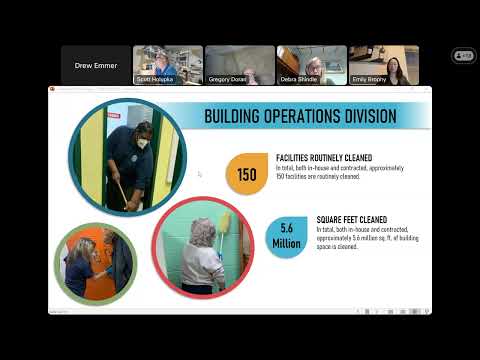
Board questions and operational notes: Members asked about POS and LOS revenue volatility; staff confirmed LOS waiver fee receipts depend on development pipelines and can vary widely. Smith and Deborah Shindle (Property Management) clarified that property maintenance is centralized under Property Management, which handles mowing, custodial and routine maintenance; Recreation and Parks coordinates design and program needs but does not perform day‑to‑day park maintenance.
Ending: Smith said equity and community input guide project priorities and highlighted the agency's CAPRA accreditation and recent projects as evidence of system improvements.