Get Full Government Meeting Transcripts, Videos, & Alerts Forever!
Get email alerts on the Government Transparency topic
No spam. Unsubscribe anytime.
Committee hears HF2 to require mandatory fraud reporting for state grants; bill laid over for fiscal note
Summary
The State Government Finance and Policy Committee received testimony and questions on House File 2, which would require state employees and agencies to report suspected fraud, mandate organizational transparency and allow suspension of grants when recipients are charged; the committee laid the bill over pending a fiscal note.
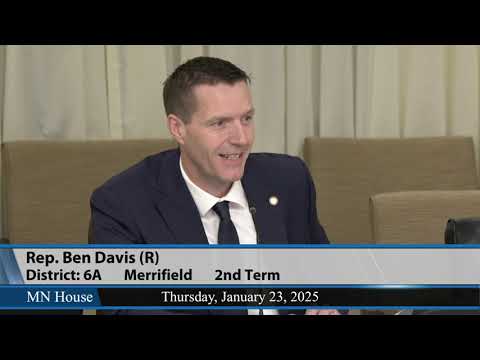
Representative Davis, Vice Chair, introduced House File 2 on Thursday, Jan. 23, 2025, proposing mandatory fraud-reporting requirements for state agencies, stronger transparency for grant recipients and provisions to suspend or terminate grant agreements when recipients are criminally charged or convicted.
The bill would require a state employee who suspects fraud in a program administered by an agency to immediately notify law enforcement and the chairs and ranking minority members of the House and Senate committees with jurisdiction over that agency’s operating budget, and would also require agencies to post full organizational charts and director/divisional staff contacts on their websites. Representative Davis told the committee the measure would also mandate unannounced in-person site visits of grant recipients to verify operations and financial stability and would require grant agreements to allow suspension if a recipient is charged with a criminal offense and termination if convicted.
Committee members asked for clarifications about overlapping reporting duties and protections for reporters. Representative Anderson pressed whether the bill requires reporting to law enforcement plus supervisors or instead permits reporting only to a supervisor; Representative Davis responded that the bill makes multiple reporting routes explicit and said employees “must report it to the supervisor, commissioner, or commissioner’s designee and the legislative auditor.”
Representative Joy urged that funding to a grantee should stop immediately when fraud is reported; Representative Davis pointed out that the bill already addresses suspension when a recipient is charged, saying section 10 provides that an agreement “will immediately be suspended if the recipient is charged with a criminal offense.” Mr. Sullivan, who identified himself as a staff member, said he believes existing state whistleblower protections would apply to employees who make such reports and offered to follow up with the committee if that interpretation changes.
Several members recommended edits. Representative Quam suggested the bill include language acknowledging existing inspector-general functions in some agencies and encouraged clearer direction about which law-enforcement contacts to notify. Representative Sexton asked whether contract employees would be included and Representative Davis said he was open to adding them. Representative Anderson noted the Minnesota Council of Nonprofits was listed as an opponent in research the committee had received and asked whether the author had been contacted; Representative Davis said he had not been contacted directly and said he was surprised by the listing.
Chair Nash said the committee would not move the bill without a fiscal note. The committee laid House File 2 over for a future date while the fiscal note is prepared and legislators consult further with stakeholders; the chair asked staff to encourage the Minnesota Council of Nonprofits to participate in future discussion.
Ending: The committee did not take a final vote on HF2; members said they expect additional drafting and coordination with other bills on oversight and whistleblower protections before the measure is brought back.