Get Full Government Meeting Transcripts, Videos, & Alerts Forever!
Get email alerts on the Budget Rules 2025 topic
No spam. Unsubscribe anytime.
Senate Finance Committee approves updated 2025 budget rules to standardize fiscal tracking
Summary
The Minnesota Senate Finance Committee voted to approve budget rules prepared by legislative fiscal staff and Minnesota Management and Budget; the rules clarify treatment of inflation, planning estimates, transfers, grant administrative set‑asides and cancellations for the coming biennium.
Saint Paul — The Minnesota Senate Finance Committee on the opening committee meeting of 2025 approved a set of updated budget rules that fiscal staff and Minnesota Management and Budget (MMB) say will standardize how proposed spending and revenue changes are tracked and presented to lawmakers.
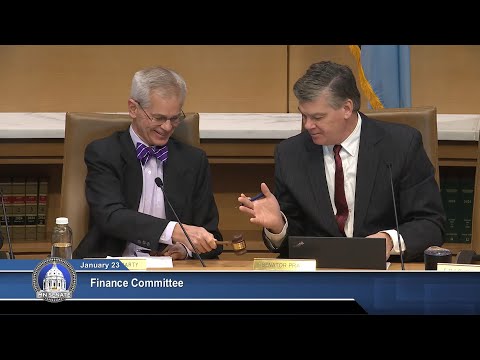
The committee, co-chaired by Sen. John Marty and Sen. Eric Pratt, voted to "approve the use of the budget rules by fiscal staff in creating budget documents," a motion moved by Sen. John Marty and carried by voice vote. No roll-call tally was recorded.
The rules are an interbranch agreement used by MMB and legislative fiscal staff to produce uniform tracking documents and budgetary fund statements. "Budget rules are an agreement between MMB and legislative fiscal staff in both the senate and house that govern how proposed fiscal policy items will be understood and tracked," Brian Dahl, financial planning director at Minnesota Management and Budget, told the committee. He emphasized that the rules "do not have the force of law and they are not binding," but are intended to align legislative and executive budget presentations.
Why it matters: The document provides consistent drafting and accounting guidance for appropriations, transfers, planning estimates and other fiscal conventions used when the Legislature and governor prepare and compare budgets. Committee members who questioned staff said the rules help prevent inconsistent or misleading budget presentations and give fiscal staff a shared baseline for dispute resolution.
Major points covered
- Organization and history: Staff described the rules as reorganized into eight sections and noted a substantial revision in 2024. The rules trace back to a 2002 legislative commission decision to formalize tracking conventions and have been updated periodically since. Dahl told members the document is intended as a transparent, written "rule book" for how the executive branch and legislative fiscal offices will display and reconcile fiscal impacts.
- Appropriations and transfers: Committee fiscal staff reminded members that, under the constitution, money can only leave the state treasury by appropriation. As Mr. Nauman, the Senate fiscal analyst for the committee, said, "For money to leave the state treasury we need an appropriation according to the constitution." The rules also restate that a legal transfer is not an appropriation and cannot, by itself, move dollars out of the treasury without appropriation language.
- Grant administration set-asides (16B.98, subd. 14): The rules call attention to a 2023 law that permits agencies to retain a percentage of newly enacted grant appropriations for administrative costs (statutory caps discussed by staff were up to 5% or up to 10%, depending on the grant language). Dahl said the rules advise specificity in statute if the Legislature intends a percentage other than the statute's default, to avoid uncertainty about how much agencies may retain.
- Inflation and forecasting: Staff explained that a recent change in law added an inflation component to the state forecast. The rules make clear that inflation in the forecast is a general estimate of economywide inflationary pressure and is not an appropriation. They also instruct that proposed change items must be tracked against the most recent forecast and cannot simply be offset against the forecast's inflation line; staff described this as closing an unintended incentive that would let a proposal appear budget-neutral by relying on the forecasted inflation number.
- Planning estimates and "tails": The rules repeat the practice of tracking budgets over a four‑year horizon (the biennium plus planning years) and explain that planning estimates for formulas are projected to fully fund those formulas rather than simply carrying forward a static second‑year dollar amount.
- Cancellation and "available until spent" language: Staff described a revised cancellation-estimate method used in the November forecast. Previously the forecast used a fixed cancellation assumption (for example, longstanding rounded figures staff described as $5 million and $15 million in first and second years). Staff said they now calculate cancellation estimates using a 10‑year historical average, excluding outliers, and report those averages in the forecast. The rules advise specifying expiration or cancellation dates in law rather than making appropriations available until spent; staff said that without a date some appropriations can remain legally un-cancelable and effectively lose the "light of day" for legislative review.
Committee concerns and clarifications
Several members asked staff to clarify how agencies use administrative set-asides and transfer authority in practice. Senator Sandy Pappas said oversight concerns justify some administrative holdbacks when grant programs require contract negotiation or heavy compliance work: "Sometimes they're large amounts ... small cities can struggle with that, as well as nonprofits." Several members, including Sen. Tori Westrom and Sen. John Jasinski, urged further review and discussion about whether a one-size-fits-all statutory percent is appropriate and asked staff to return with follow-ups.
On cancellations, Mr. Nauman said the new method aims to better reflect historical experience and be updated each November forecast. On transfers and some specific agency transactions (for example, questions were raised about whether an agency can sell or transfer state-owned buildings between departments), staff said they would research particular examples and report back.
Motion and immediate next steps
Sen. John Marty moved committee approval of the budget rules; Sen. Eric Pratt supported the motion. The committee approved the motion by voice vote (ayes were recorded; no roll-call was taken). Committee chairs and staff said they expect the rules to guide fiscal staff drafting and to be used as a reference point during omnibus bill drafting and second‑review work.
Ending note: Presenters from MMB and legislative fiscal offices told members the budget rules are meant to increase transparency and to make legislative and executive budget presentations reconcilable with the state's audited financial statements and generally accepted accounting principles (GAAP). Committee members requested follow-up briefings on several topics, including grant administrative percentages, agency transfer authority, capital investment guidance and a separate future discussion on fiscal notes and FTE cost components.