Get Full Government Meeting Transcripts, Videos, & Alerts Forever!
Get email alerts on the State Fraud Enforcement Reorg topic
No spam. Unsubscribe anytime.
Minnesota moves Commerce Fraud Bureau staff into BCA unit amid oversight, funding and data questions
Summary
Grace Arnold, commissioner of the Minnesota Department of Commerce, told the Senate Commerce and Consumer Protection Committee that Governor Walz's executive order moves the Commerce Fraud Bureau into the Bureau of Criminal Apprehension and that the bureau's work will continue under the BCA.
Grace Arnold, commissioner of the Minnesota Department of Commerce, told the Senate Commerce and Consumer Protection Committee on Jan. 23 that Governor Walz's executive order moves the Commerce Fraud Bureau into the Minnesota Bureau of Criminal Apprehension, part of the Department of Public Safety.
The transfer, which officials said is being carried out under an administrative reorganization order effective Feb. 7, 2025, will combine the CFB's sworn officers and civilian staff with agents and analysts already working on financial and white-collar crimes at the BCA to form a roughly 42 full-time equivalent unit focused on insurance fraud, program fraud and other financial crimes. "The work of the Commerce Fraud Bureau is not changing with the transition to the BCA," Arnold said, emphasizing that the unit will continue to handle insurance fraud and the auto-theft prevention program.
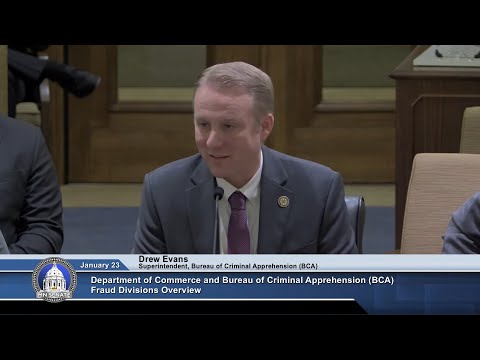
Bob Jacobson, commissioner of the Department of Public Safety, said the unit will be "the state's fraud experts" and that the personnel moved into the BCA will be asked to investigate fraud, not homicide or drug cases. Drew Evans, superintendent of the BCA, said the new section will be created inside the BCA investigations division and will pool expertise, investigative hours, forensic tools and federal task-force relationships.
Why this matters: Committee members questioned whether the move preserves existing funding streams and investigative authorities and whether combining units will create efficiencies or dilute important regulatory and industry relationships. Several senators pressed officials on (1) guarantees that industry-funded assessments will continue to fund the same work, (2) how subpoenas and other legal tools will be handled after the transfer, (3) the unit's reporting and transparency, and (4) whether the shift will improve detection of large-scale program frauds that have surfaced in recent years.
Funding and scope: Officials said the CFB is funded primarily by an insurance fraud assessment on insurers (passed through to policyholders), an appropriation from the Department of Labor and Industry for workerscompensation fraud work, administrative fees and a roughly $1.3 million auto-theft prevention grant appropriation. Superintendent Evans and Commissioner Arnold said those funding sources and program responsibilities will continue after the transfer; Evans told the committee the BCA will follow the current statutory framework and is open to additional statutory language or reporting requirements to reassure stakeholders.
Staffing and tools: Committee members heard differing staff counts during the presentation: Arnold said the Commerce Fraud Bureau has about 28 employees; Evans said the formation will contemplate the bureau and existing BCA financial-crimes staff to form a unit of approximately 42 FTEs. The governor's budget request accompanying the transfer would add one forensic accountant and two contracted assistant attorneys general to provide prosecutorial assistance and agency-focused feedback, officials said.
Legal and operational questions: Senators asked whether the broad subpoena authority used in insurance investigations will carry over. Evans said subpoena practice and issuance are being reviewed and that the BCA frequently works with prosecutors and the attorney general's office for criminal subpoenas; he said the transition team will ensure investigators have appropriate legal tools.
Reporting, data security and oversight: Committee members sought assurances that industry assessments and surcharge funds will continue to be dedicated to insurance-fraud and auto-theft work. Evans and Arnold said they will follow current statutory rules during the interim and will work with the committee and industry on reporting templates and cadence. Senators also raised privacy and data-security concerns given that the BCA houses large criminal-history and justice databases; Evans said the BCA maintains stringent security protections and that any data-sharing will adhere to legal requirements.
Detection of program fraud: Several senators cited high-profile cases and large-dollar fraud affecting pandemic-era and other programs, and asked whether this change would materially improve detection and enforcement. Evans said centralizing referrals and investigators "creates a one-stop shop for fraud in Minnesota" that may reduce redundancy and help identify repeat offenders across programs. Officials acknowledged that state agencies must still identify and refer suspected program fraud and said the new unit would provide a feedback loop and advisory support to agencies to tighten program controls.
Operational concerns and next steps: Committee members pressed whether co-location would disrupt informal, day-to-day information-sharing that some lawmakers said had been valuable when investigators and regulatory staff were based together. Officials said employees were generally "excited" about the opportunity but that they understood the change could cause anxiety; they said human-resources and wellness programs and coordination with Minnesota Management and Budget will guide the personnel transition. The administration said it will provide transparency through regular reporting and will accept legislative feedback on statutory protections or reporting requirements.
No formal action was taken at the hearing. Committee chairs said the transfer is proceeding under an administrative reorganization order and that the committee will continue oversight; the BCA and Commerce said they will return with reporting templates and consult with insurers and other stakeholders on statutory or reporting changes.