Get Full Government Meeting Transcripts, Videos, & Alerts Forever!
Get email alerts on the State Grant Funding topic
No spam. Unsubscribe anytime.
Office of Higher Education warns of state grant shortfall as FAFSA changes and enrollment spike strain North Star Promise funding
Summary
Minnesota Office of Higher Education officials told the Senate Higher Education Committee on Thursday that the state’s largest need‑based financial aid program faces a growing shortfall driven by higher enrollment and federal changes to the FAFSA that produced many more students with a zero or negative student aid index.
Minnesota Office of Higher Education officials told the Senate Higher Education Committee on Thursday that the state’s largest need‑based financial aid program faces a growing shortfall driven by higher enrollment and federal changes to the FAFSA that produced many more students with a zero or negative student aid index.
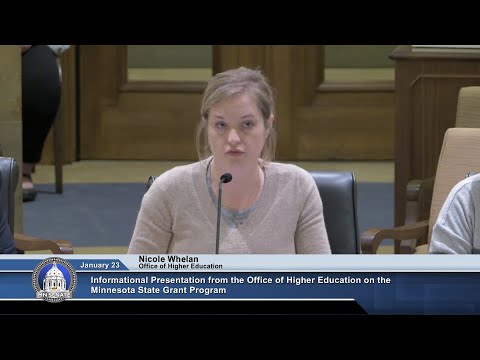
Nicole Whelan, Financial Aid Research Analyst for the Office of Higher Education, told the committee that the agency “is experiencing one [a deficit] this year” after projected enrollment and the FAFSA simplification increased the share of applicants with very high need. Whelan said the fall projections showed 43% of applicants with an SAI (the new term for EFC) of $0 or less, and “the vast majority of those students have an SAI of negative $1,500.”
Why it matters: the Minnesota State Grant is the largest state financial aid program by dollars and students served in Minnesota. The state grant is designed to “fill in” need after federal Pell awards; changes that increase the number of low‑or‑no‑contribution applicants raise state costs and can force the agency to ration awards or seek transfers from other appropriations.
OHE’s assessment and near‑term actions
Office staff told lawmakers the program ended fiscal 2024 with roughly 71,500 recipients (a 6% increase from FY2023) and that the combination of enrollment growth and FAFSA changes produced a projected deficit of about $5 million in fall projections — a number the agency expects to grow when February projections are published. The agency has already taken several steps: it rationed awards where permitted by law for the current year, set a December 1, 2024 FAFSA deadline for spring awards, and announced that summer 2025 state grant funding will not be available.
Whelan explained how the agency calculates awards and why the new FAFSA rollout complicated projections: the federal formula change lowered expected family contributions for many households below prior estimates, increasing the count of students with the highest need. “This change is putting a large strain on resources for fiscal year 25,” she said.
Governor’s proposal and parameter changes
Commissioner Dennis Olson previewed the governor’s budget proposal, which combines a funding increase and changes to state grant parameters. Olson said the administration proposed an additional $7.5 million a year ("$15,000,000 over the biennium") along with a larger proposed investment referenced in agency slides as $50 million over the biennium to stabilize the program. The agency’s legislative package would also:
- Clarify that the student or parental contribution cannot be negative — effectively setting a minimum contribution of $0 for SAI values that would otherwise go negative. - Reduce the living and miscellaneous expense (LME) allowance from 115% to 110% of the federal poverty guideline. - Increase the assigned student responsibility from 50% to 51% (phased in beginning in fiscal 2027). - Increase the assigned family responsibility (AFR) to 100% of the federal need analysis for all families (with the positive SAI floor above). - Change the deadline to receive a state grant from June 30 to the 30th day of the term in which the student applies. - Modify agency language that governs how rationing is implemented so the office can apply AFR/assigned student responsibility adjustments more flexibly when a deficit is projected.
Agency staff said the combination of parameter changes plus the appropriation is intended to reduce or eliminate the need to ration awards in the near term.
Interaction with North Star Promise and transfer authority
Agency testimony stressed that North Star Promise (a last‑dollar program with a separate special revenue account) and the state grant interact: reductions in state grant awards increase North Star base awards up to tuition and fees. Megan Flores, manager of state financial aid programs, said North Star Promise had disbursed roughly $44 million in the fall and the office estimates total FY25 spending for the combined North Star programs near their $112 million appropriation, leaving only about $1 million to carry forward in the special revenue account under current projections.
Nikki Oliver, Director of Government Relations and Community Engagement at OHE, clarified that the agency has statutory transfer authority to shift unencumbered funds from some appropriations (including, in practice, funds associated with North Star Promise) into the state grant when necessary. "The commissioner may transfer unencumbered funds from Northstar into state grant," she told the committee, while cautioning that the special revenue account for North Star Promise also has its own demand and programmatic needs.
Institutional and student testimony
Representatives from the University of Minnesota, Minnesota State Colleges and Universities, Augsburg University and the College of St. Scholastica described immediate effects on students and institutional planning. Nate Peterson, director of student finance for the University of Minnesota system, said systemwide spring dispersals were underway and warned that the office’s announcement to eliminate summer 2025 state grant awards will likely depress summer enrollments; historically the system averaged about 1,105 state grant recipients in summer terms.
College of St. Scholastica financial aid director Trish Johnson said the June rationing reduced awards by an average of about $1,200 per student; St. Scholastica used institutional funds to cover the difference for incoming freshmen but could not do so for the full returning population. Student witnesses described lost awards and added borrowing or work hours: Maddie Plouffe, a senior at St. Scholastica, said she received $800 this year but had expected roughly $2,000 and took a second job when the award shrank; another student, identified by the college as Derek, missed the agency’s December 1 deadline and lost roughly $7,000 a year in expected aid.
Augsburg’s director of financial aid, Amanda Burgess, told the committee the late timing of parameter changes leaves little time for students to respond and said Augsburg absorbed losses for a subset of its Promise students but cannot sustain covering gaps across the whole undergraduate population.
System Director Chris Holling (Minnesota State) implored lawmakers to remember that each affected recipient is an individual with a life and aspirations tied to the program’s stability.
Next steps
OHE said it will publish an updated projections report in February and work with the legislature on statutory changes necessary to implement the governor’s recommendations and any other legislative solutions. Committee members pressed the agency for additional detail on historical surpluses, transfer authority and whether tuition and fee caps should be part of any solution; agency staff offered to return with more data.
Officials emphasized limitations: the agency cannot change Pell Grant rules and does not set tuition and fees for public systems; many of the program levers available to OHE involve awards, assigned responsibilities and deadlines. Nikki Oliver told the committee the agency can pull limited forward funding with approval from MMB in exceptional circumstances but said doing so is “a difficult situation to be in.”
The hearing closed with committee members and witnesses agreeing the problem is complex: higher enrollments and federal aid formula changes have increased demand while program design and statutory deadlines constrain how the agency can respond without legislative action.