Get Full Government Meeting Transcripts, Videos, & Alerts Forever!
Get email alerts on the Whistleblower Protections topic
No spam. Unsubscribe anytime.
Committee advances bill to expand whistleblower protections for public employees
Summary
The Senate Labor and Industry Committee on Jan. 23 heard testimony and approved amendments to Senate File 475 to broaden who may report waste, fraud and abuse and to extend protections beyond classified state employees; committee recommended the bill be referred to the State and Local Government Committee.
Senate File 475, a bill to broaden who may receive protected reports of fraud, waste and abuse, was presented Jan. 23 to the Senate Labor and Industry Committee and advanced with amendments and a committee vote to refer the bill to the State and Local Government Committee.
The bill’s author, Senator Matthews, told the committee the measure is intended to “expand the protections granted to potential whistleblowers in the state of Minnesota,” citing recent high-profile fraud reporting that has drawn bipartisan attention. Matthews said the bill would expand the list of potential reportees and streamline language to match existing statutory definitions used elsewhere in state law.
The measure and its A-1 amendment change language that previously used the term “gross mismanagement” to instead protect employees who, in good faith, report “fraud, waste, or abuse in programs of a state agency or political subdivision.” The A-1 amendment adopts definitions already used in other statutes, Matthews said, and was adopted by the committee on a voice vote.
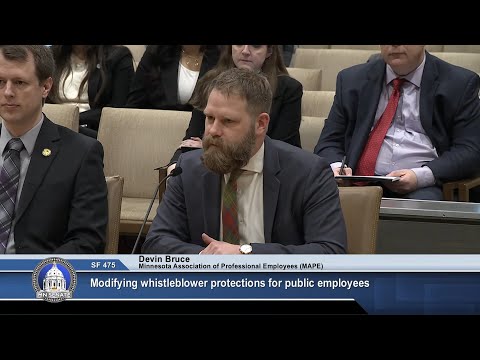
Testimony came from public employee representatives and unions. Devin Bruce, director of legislative and political affairs at the Minnesota Association of Professional Employees, said the bill “does expand some of the additional protections” but raised concerns that section 6 of the Whistleblower Protection Law currently applies only to classified state employees and could create a two-tier system. Bruce recommended that section 6 be amended to cover public employees at all levels of government.
Meg Luger Nicolai, an attorney for Education Minnesota, said the bill provides protections for conduct that might not fall squarely under other statutes. Nicolai gave examples from school districts—such as rejection of integration aid, withholding teacher training pay, and problematic special-education blanket policies—that she said could harm students but might not clearly trigger an existing remedy. She said the A-1 definition gives her confidence advising members they would have substantial protection if the bill passes, while noting concerns about data privacy rules under chapter 13 of the Minnesota Government Data Practices Act.
Committee discussion focused on who is covered and on statutory definitions. Several senators, including Senator Marty and Senator Pratt, pressed whether the bill should extend beyond classified state service to all public employees; Senator Marty proposed an oral amendment to replace “in the classified service of state government” with “public employee,” which the committee adopted. Members also discussed how statutory definitions interact with collective bargaining, supervisory actions, and what constitutes retaliation.
Senator Matthews accepted the oral amendment and invited ongoing work on definitions and implementation as the bill proceeds to the next committee. After debate the committee moved the bill as amended; members voted by voice to recommend passage and re‑refer Senate File 475 to the State and Local Government Committee.
The committee record shows education and employee-union groups supporting broader coverage and urging clarifications on how the bill would interact with data-classification rules and retaliation definitions; employee representatives asked for clearer guidance on what counts as retaliation and on how confidentiality would be handled in practice.
If the bill proceeds, sponsors and advocates said they plan to continue refining definitions and working with stakeholders on privacy and enforcement details.